

A cup of tea rarely feels like a complicated thing. Hot water, dried leaves, a few minutes of steeping, and a habit repeated in kitchens and offices all over the world. But one part of that routine has come under closer scrutiny: the bag itself.
A recent review in Food Chemistry pulled together research on microplastics and nanoplastics in tea-based drinks and found that these particles can enter tea from several routes, including production water, packaging, contaminated tea leaves, and teabags steeped in boiling water. Among those sources, the review says teabags are the most important contributor overall.
That does not mean every cup of tea carries the same contamination, or that the science has settled what this means for human health. But it does mean a common product that often looks paper-based can, in some cases, release large quantities of plastic particles during brewing.
Why the Teabag Became the Main Focus
The review, written by Neamatollah Jaafarzadeh Haghighi Fard, Faezeh Jahedi, and Andrew Turner, examined studies on tea drinks, tea packaging, and teabags themselves. Its main conclusion was direct: teabags steeped in boiling water are the leading source of microplastics and nanoplastics found in tea.
That finding runs against what many shoppers might assume. Some tea bags do use paper-like materials, but others rely on plastic mesh or mixed materials. Earth.com’s summary of the review notes that some pyramid-style sachets use plastic mesh, while other bags combine plant fibers with plastic. Even some cellulose bags can contain polypropylene as a heat-seal layer that keeps the seams closed in hot water.
The review also found that biodegradable and plastic-cellulosic composite bags are not exempt. Significant quantities of microplastics and nanoplastics were reported from those materials as well, even if the totals were sometimes lower than those measured from fully plastic teabags.
The Particle Counts Can Reach Into the Billions
The most attention-grabbing part of the research is the scale. According to the abstract, more than 10^9 plastic particles have been reported from a single plastic teabag when it is steeped in boiling water. That means more than one billion particles in some experiments.
Earth.com’s reporting adds detail from individual studies cited in the review. One experiment reported about 14.7 billion tiny particles released from a plastic teabag under the brewing and measurement conditions used in that study. Another reported about 1.3 billion particles per bag.
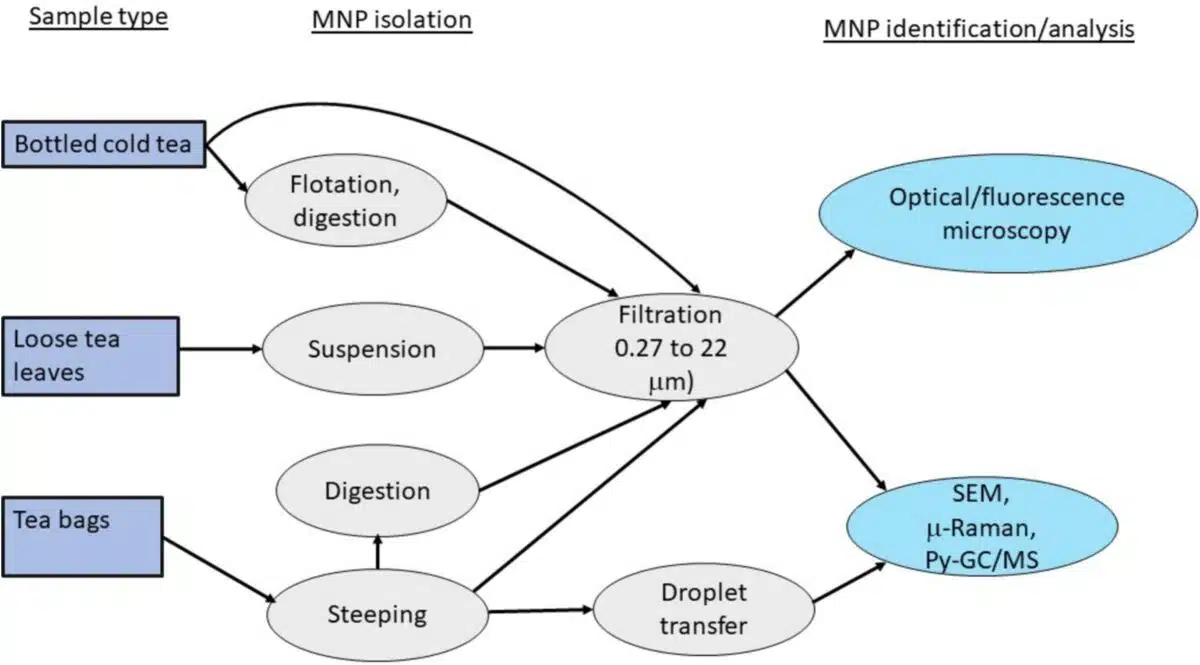
Those numbers are large, but the review also makes clear that they should not be read as a fixed number for every tea drinker. Different laboratories used different analytical methods, especially different size cutoffs for capturing and identifying particles. A filter that catches only larger fragments will miss much of what a finer method might detect. That is one reason concentrations vary so widely across studies.
Why measuring tea contamination is so difficult
Counting plastic particles in tea is not as simple as straining a brewed cup and tallying what is left behind. The particles can be extremely small, and researchers still need to confirm that what they detect is actually plastic and identify which polymer it is. The review points to differences in isolation and identification techniques as a major reason findings do not line up neatly across brands and studies.
There is also the constant problem of contamination. Earth.com notes that fibers from clothing, particles in laboratory water, plastic equipment, and dust in the air can all affect samples if the testing process is not tightly controlled. That makes method design a central part of the story, not a side issue.
The review therefore presents two ideas at once. First, plastic particles are showing up in tea-based drinks often enough to raise concern. Second, the exact quantities reported in headlines depend heavily on how researchers looked for them.
Plastic Particles Are Not the Only Issue in the Cup
The paper also points to another concern: additives and chemical residues associated with plastics. According to the abstract, some studies reported leaching of plastic additives and residues during steeping, though it remains unclear whether they came directly from intact teabags or from particles released into the tea.
Earth.com’s report says studies have identified compounds including some plasticizers, breakdown products, and bisphenol-type chemicals in tea infusions. The mechanism is still unsettled. Hot water may draw chemicals from the bag material itself, from particles that have broken away, or from contamination introduced during processing and preparation.
On health effects, the review stays cautious. It notes concern because teabags can generate higher concentrations of microplastics and nanoplastics than other beverages or foodstuffs, but it does not claim that harm in people has been established. Earth.com cites early lab work involving water fleas and human intestinal cell models, but those studies do not amount to clinical evidence in humans.
The clearest takeaway is not that tea itself is the problem. The issue is that a familiar packaging material can be a major source of plastic contamination when exposed to boiling water. The review found microplastics and nanoplastics across tea-based drinks from multiple sources, but it singled out the teabag as the most important contributor overall.
First Appeared on
Source link






Leave feedback about this