

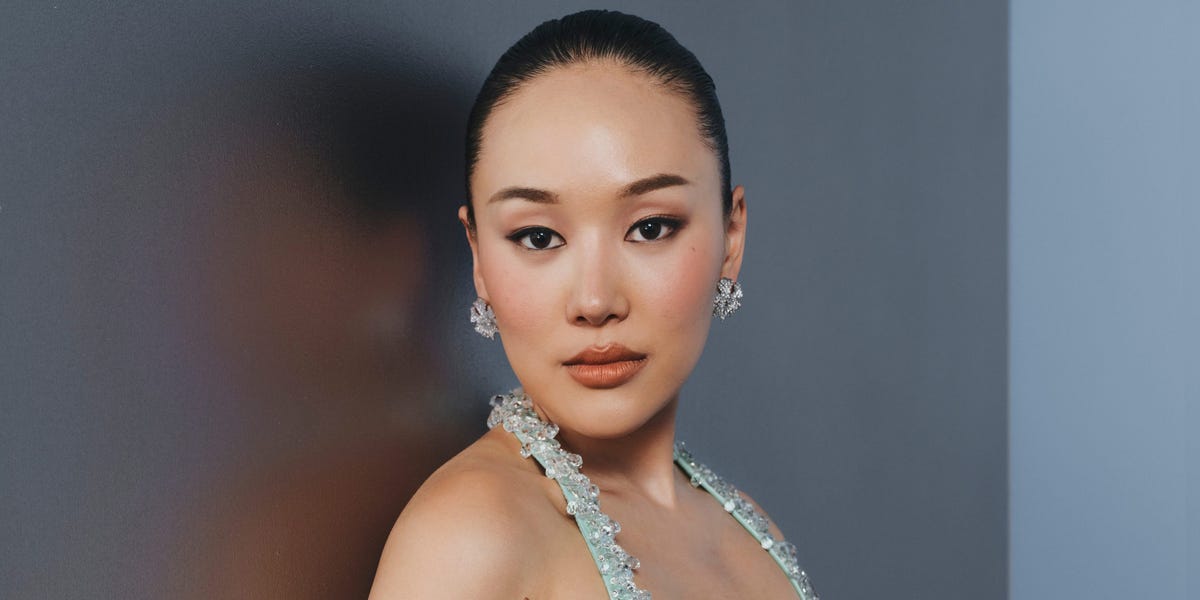
Yerin Ha has felt like the belle of her own ball for the last 15 months. From the moment she was cast as Sophie—the maid who falls for Luke Thompson’s free-spirited, aristocratic artist Benedict—in the latest season of Bridgerton, the Korean-Australian actress has openly embraced the pressure of leading one of the biggest TV franchises of the streaming age.
Offering a different take on the classic Cinderella story, the fourth installment of Netflix’s reimagined Regency romantic drama follows the winding path of Benedict and Sophie. After a chance encounter at his mother’s masquerade ball, the two weave in and out of each other’s lives until Benedict finally realizes that the “lady in silver” he’s been dreaming of is actually Sophie, an earl’s daughter reduced to a housemaid by her spiteful stepmother.
But in a dramatic departure from the second season, which explored Indian culture through the introduction of Simone Ashley’s Kate Sharma, Sophie’s heritage—reimagined with the surname Baek to match Ha’s own—is only mentioned in passing. It’s a welcome change of pace for Ha, who appreciates that her character’s identity exists as a natural backdrop rather than a primary plot point—a rarity for Asian roles in the Western world.
“The core of Benedict and Sophie’s story is the forbidden-ness of the class aspect. And if there was another aspect of him trying to find somebody because of their heritage, It might wish-wash that aspect, or just make it more complicated when we have so much to explore already,” Ha tells Harper’s Bazaar. “But it’s just refreshing to focus on two people falling in love with each other despite their race or class. I think that’s really special, because at the core of their love story is about who you are inside rather than the outside.”
Speaking on a recent Friday morning in New York City, Ha opens up about working intimately with Thompson to play out their characters’ fan-favorite love story, how she worked through her own body image issues to bare it all on camera—and why she is “immensely proud” to be part of the next generation of Asian actors looking to move the needle in Hollywood. (Dearest gentle reader, you have been forewarned. Spoilers ahead!)
Despite having the social status of a maid, Sophie clearly had an aristocratic upbringing; she is very well read and cultured. How did you think about playing the tension between her two conflicting identities, and what kind of impact do you think navigating that gap has had on Sophie emotionally?
For me, it just makes her feel like she’s neither here nor there—and I relate to it as well. When I was in Sydney growing up, I felt like I was with my Australian friends, but then also not. And when I was in Korea, I was like the foreigner, but not because I was still Korean. I think Sophie very much feels similar in that sense. She probably has a bit more of a proper accent [around nobility] than when she’s with her friends in the “downstairs” world. I think [her servant friends] can sense that there’s something a bit more educated about her than potentially the other people would. She’s constantly feeling like an outsider, and because of that, she’s just building this wall around her in every environment and situation—minus being around Alfie. I think he’s the only person that actually brings a bit more of Sophie’s personality out of her. So I was just more thinking about: Who do you become when you feel like you can’t be so accepted in one community or the other? How does that feel? How do you actually shut off from the world, and what would that look and feel like?
As a fan of Bridgerton yourself, you must have known what you were signing up for when you auditioned for the show. But once you landed the role, did you feel any kind of trepidation over what you would then have to bare on camera? Were you scared of the nudity? If so, how did you work through those fears?
Yeah, I was very scared of the nudity scenes. When I booked the role, I was so happy. And then very quickly, I was like, “Crap. I have to do intimacy scenes now.” That was my first thought. Especially growing up in an Asian household, I feel like body image is something that’s very talked about, like, “Oh wow, you gained a bit of weight.” That kind of commentary when you are so young really affects your confidence—I know it affects mine. I think there was a part of me that wanted to challenge myself.
[Being nude onscreen] was actually for me, and it was not about doing it for anybody else. I wanted to tell myself, “I can do it. I can step up into this. Fuck whatever anybody’s saying about me. Make yourself feel a little bit uncomfortable. On the other side of [this experience], it will probably be really freeing and make me feel okay within myself.” In terms of working through the fear, I was very vulnerable and honest about my feelings with Luke. Very early on in the process, I was telling him, “I feel really scared doing these things,” and he really helped me feel okay with feeling that, actually. When you’re vulnerable with someone and you trust someone as well, you gain a lot of respect for each other—and you’re able to navigate that day with a bit more tenderness and care than perhaps on other days.
The sexual tension between Benedict and Sophie comes to a head at the end of the episode 5, when the two finally have sex for the first time after declaring their love for each other. Can you give voice to Sophie’s internal dialogue as she hears Benedict repeatedly say “I love you” for the first time?
That day was actually a really emotional one because, as Yerin, I was so in awe of Luke’s acting, but also feeling like Sophie. Hearing Benedict truly declare his love, it felt like everything clicked at that moment. I remember in the book so vividly that when he says, “I love you,” she gets so overwhelmed that she cries. I remember feeling so heartbroken for Sophie, because she’s somebody who truly hasn’t heard that from anyone for who knows how long. I don’t even know if her [Asian] father would’ve said, “I love you.” To actually hear those three words come from somebody that deep down inside makes her feel like, “This is what love is,” is so impactful because words have so much weight and a lot of power. And when he says that to her, at that moment, I think she’s on cloud nine. Everything that she craves and desires is love from someone. So it was a really bittersweet moment, and I really tried to make that clear when she hears it for the first time from him. It was very easy because Luke was just so present and so honest, so it wasn’t really hard to react off of him.
Bridgerton has always been renowned for centering the female gaze in intimate scenes. Benedict already had a lot of sexual experience, but Sophie is really experiencing her sexual awakening with him. Were there any particular moments that you really wanted to play in that climactic scene?
It’s the first time you actually see the undressing [between them], and a bit more of the mess of what intimacy can look like. I think we were trying to lean into that a little bit more. But there’s that moment where she stops him before they actually start to have a very intimate moment physically. I wanted to play that beat of wanting it, but also not knowing what it is, like she was toeing the line—because maids are people who have so much information. They actually know so much and hear all the gossip about what intimacy could look or feel like, which is probably why Sophie knows what self-pleasure is. She’s not completely in the unknown, and she had a logical understanding of what it could be, but in terms of actually feeling it, that was different. So I wanted to play that line with Benedict before they actually start to have sex a little bit potentially differently [than other Bridgerton female leads], or just a bit more less like she has no idea what she’s doing.
I would argue that Benedict and Sophie’s bathtub scene in the finale is even more intimate than the first time they consummate their relationship. There are so many striking details: Sophie pushes Benedict against the bath tub, causing water to splash out; Benedict then tells Sophie to turn around, she turns her back to him, and she reaches back and pleasures him. Were all of these moments scripted, or did you workshop any on the day with your intimacy coordinator Lizzy Talbot?
I think pushing him to the back of the bathtub was choreographed with Lizzy, but reaching to the back, I’m pretty sure, was scripted. And if I’m not [mistaken], I think that’s actually the first time we see a female pleasure a male in the Bridgerton intimacy world, which is quite interesting—because I think pleasure goes both ways. I think there’s a weird idea that receiving is the only way [to feel] pleasure. Just because you are pleasing somebody else doesn’t mean that that’s not pleasurable for you.
It was interesting because you have to understand the confinements of what that bathtub space actually looks like. The bathtub was really long, so I was like, “How are my legs going to turn around and push him? Because I have nothing to anchor myself onto!” [Laughs.] It’s a lot of problem-solving and piecing together and seeing what’s achievable in the confinement of the space [in rehearsals]. So, obviously, we’ve got the script, and the intimacy scenes are written quite thoroughly. There were certain beats that we wanted to hit and make sure that we brought to life, and then there were certain other things that Lizzy would come up with and be like, “Oh, I think this would be really steamy”—everything Lizzy does always has intention or motivation. So the pushing back into the bathtub is very much Sophie coming into her power and into her sexuality as well, and steering the ship. I think that’s really powerful as well for her, for someone who’s never done that.
Sophie and Benedict’s love story starts and ends the same way, with the two dancing the night away on the gazebo. How did you and Luke want to juxtapose those dancing scenes at two very different points in the story?
And also two very different stages of production! It truly felt like a full-circle moment. It was so effortless because we at the same time were feeling a little bit like a certain chapter was ending—or if you look at it another way, a certain chapter was starting. But I think the difference, at least in Sophie’s emotional journey, is that she, for some reason, by the Queen’s ball, knows how to dance. I have a few theories as to why that could be. [Laughs.]
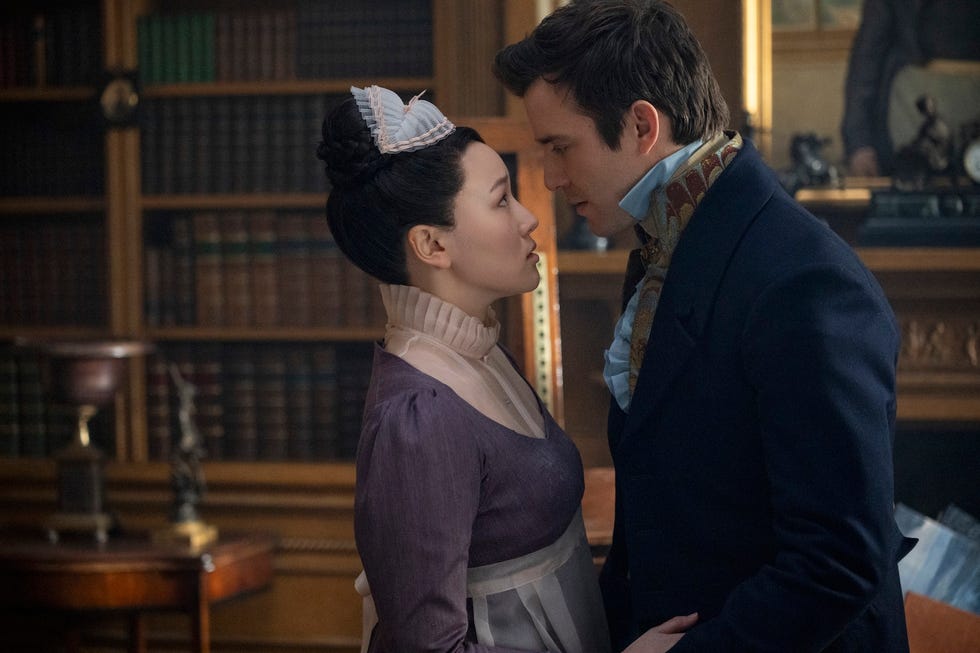
Give me your best theories!
I feel like, in her spare time, the maids get down—and maybe she got some lessons from a fellow footman friend or Alfie post-masquerade, and she was feeling a little bit embarrassed. Or maybe she did know how to dance all along, which I don’t think is the case.
But I think dance is so intimate. Being able to move with someone in a space at the same time does create a lot of connection and intimacy in a different way. And for her to be able to do that with her true lover without the masks, and feeling like they can truly just enjoy the present moment—it was so easy to do, because all Luke and I had to do was be present with each other. It’s hard when you don’t have any music, and you have to do steps in silence. It’s funny, but because we had such a sentimental attachment to that gazebo from the first scene, it was very easy to feel a sense of sentimentality.
Some viewers may actually miss the beautiful post-credits scene in the finale when Benedict and Sophie get married.
Yeah. Watch the post-credits scene, everyone, please!
Nicola Coughlan told me last season that the weddings on Bridgerton feel so real, presumably because the sets are so lavish and there is so much love coming from your co-stars. What was it like for you to walk down the aisle at what Benedict and Sophie call “Our Cottage”? Did you have any input into Sophie’s wedding dress?
No, I didn’t, but I remember seeing the sketches and feeling like… It felt like so Sophie. Also, we were so deep into shooting that we were all like, “Let’s just get there,” and I was like, “I trust you guys!” It’s funny that Nicola said that because I was like, “Why am I coming down the aisle? I feel like I should just be doing this the only one time in my life, which is when I actually get married.” [Laughs.] So it really feels true and genuine, although I will say walking down that aisle at a very slow pace is extremely exposing as someone who actually does not like attention and eyes on them. But it was really, really sweet.
Sophie’s Korean heritage is not a focal point of her characterization, but there were a lot of people who were very excited—myself included—to learn that the female lead of this season was going to be East Asian. What has bringing that kind of representation to a global audience meant to you, and what is the feedback you have been receiving from East Asian fans in particular?
I feel so immensely proud that I get to make people feel seen. That’s the dream. Yes, acting can feel very individual in terms of the process, but I’ve always believed that acting is bigger than that and that it is a bit of a responsibility. I went to a Gold House event in New York, and [I was struck by] the amount of women that were saying, “It’s so nice to feel like a character that is desired—and to be seeing you onscreen—when we’re not represented in a way that’s often depicted like that [without being fetishized].” Hearing those comments from people throughout the evening was so special because it proves how important it is to keep advocating for [representation], and that we should be pushing this narrative continuously. It’s 2026, and the fact that I’m still hearing that makes me feel like we still have a long way to go, but to feel like I’m one of the people that are helping that narrative change makes me so proud. I have a duty to my community in a way, which I’m happy to take on.
This interview has been edited and condensed for length and clarity.
All four seasons of Bridgerton are now streaming on Netflix.
First Appeared on
Source link


Leave feedback about this