

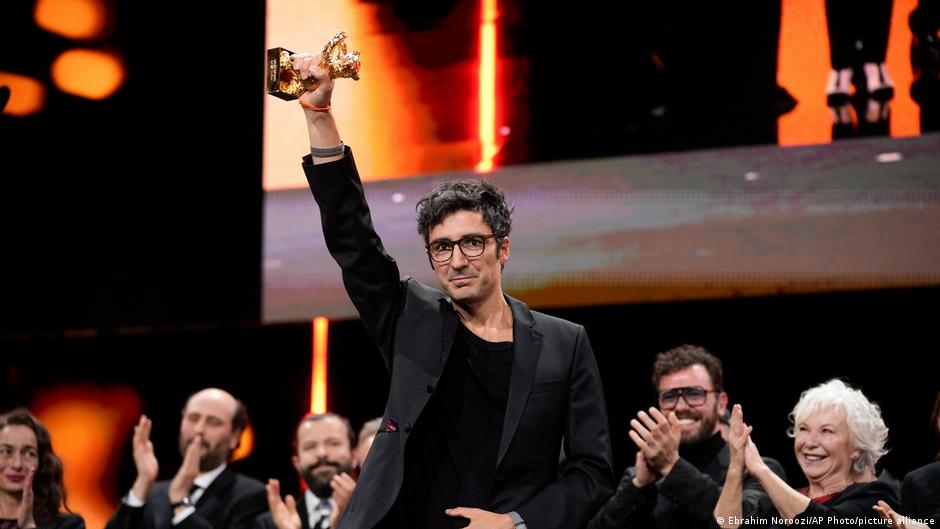
The Golden Bear, the Berlin International Film Festival‘s top prize, was awarded on Saturday to the political drama “Yellow Letters,” by German director Ilker Catak. His previous film, “The Teachers’ Lounge” (2023) was nominated for an Oscar.
Starring Tansu Bicer in the role of a playwright and Ozgu Namal as a famous actress, “Yellow Letters” follows the married artists whose relationship is tested as they get caught in the state’s crosshairs.
The allegory on authoritarian oppression is set in contemporary Turkey, but was shot in Germany, with Berlin and Hamburg taking on the roles of Ankara and Istanbul.
“Yellow Letters” was decidedly the most political of all 22 works in the main competition, an apt conclusion to an event overshadowed by political debates — starting with the festival’s opening press conference, when jury president Wim Wenders said that filmmakers “have to stay out of politics.”
But presenting the award, Wenders also commended the way the film spoke up “very clearly about the political language of totalitarianism as opposed to the empathetic language cinema.”
In his acceptance speech, Catak noted that the autocrats of this world are the ones we should be opposing, not the artists with diverse political opinions: “Let’s not fight each other, let’s fight them,” he said.
A festival reflecting ‘a polarized world’
“This Berlinale took place in a world that feels raw and fractured,” said festival director Tricia Tuttle at the opening of the gala on Saturday, immediately referring to the polarized political debates that went viral during the event, including an open letter that criticized the festival’s “silence” on Gaza.
Tuttle acknowledged that criticism plays an important role in a democracy, and recognized the courage of those who voice their opinions publicly. Criticism is “good for us — even if it didn’t always feel good,” she added.
Before announcing the winners of the Golden and Silver Bears, jury president Wim Wenders also reacted to the controversy in a speech that noted the contrasting roles of social media, which has an “affective language,” and cinema’s long-form storytelling, which has the enduring power to transmit empathy.
The winners of the Silver Bears
The festival’s second top award, the Silver Bear Grand Jury Prize, went to Emin Alper’s “Salvation,” another timely exploration of the mechanisms behind politically-driven mass murders and massacres.
In his acceptance speech, Alper shared words of solidarity with the people suffering in Gaza, the protesters in Iran, the Kurdish people fighting for their rights, and his fellow Turks imprisoned for their political beliefs: “You are not alone,” he said to all of them.
The Silver Bear Jury Prize recognized Lance Hammer’s “Queen at Sea,” a drama on dementia starring Juliette Binoche, as well as Tom Courtenay and Anna Calder-Marshall, whose heart-breaking performances as a husband and wife were also recognized with the Silver Bear for Best Supporting Performance.
Grant Gee took the Silver Bear for Best Director for “Everybody Digs Bill Evans,” a stylish biopic on the iconic jazz pianist.
Sandra Hüller’s stunning performance in “Rose,” as a woman passing as a man in the 17th century earned her the Silver Bear for Best Leading Performance.
Canadian director Genevieve Dulude-De Celles took the Silver Bear for Best Screenplay for “Nina Roza.”
“Yo (Love is a Rebellious Bird),” a playful documentary on a special friendship between two creative women, won the Silver Bear for Outstanding Artistic Contribution.
Palestinian director wins debut film award
The Perspectives section, introduced last year by Tricia Tuttle as she became the new director of the festival, focuses on debut features.
The GWFF Best First Feature Award went to Palestinian director Abdallah Alkhatib for “Chronicles From a Siege.”
A refugee in Germany, Alkhatib said in his acceptance speech that even though some people warned him against criticizing the German government, he nevertheless asked why the country accepted to be “partners of the genocide in Gaza by Israel. I believe you are intelligent enough to recognize this, but you choose not to care,” he said.
Lebanese filmmaker Marie-Rose Osta, who won the Golden Bear for best short film for “Someday a Child,” also referred to the suffering of Palestinians in her home country and in Gaza in her acceptance speech.
“We defend everyone’s right to speak,” said Tricia Tuttle at the end of the gala, closing the politically-charged film festival with a plea for acceptance and tolerance.
Edited by: Andreas Illmer
First Appeared on
Source link





Leave feedback about this