

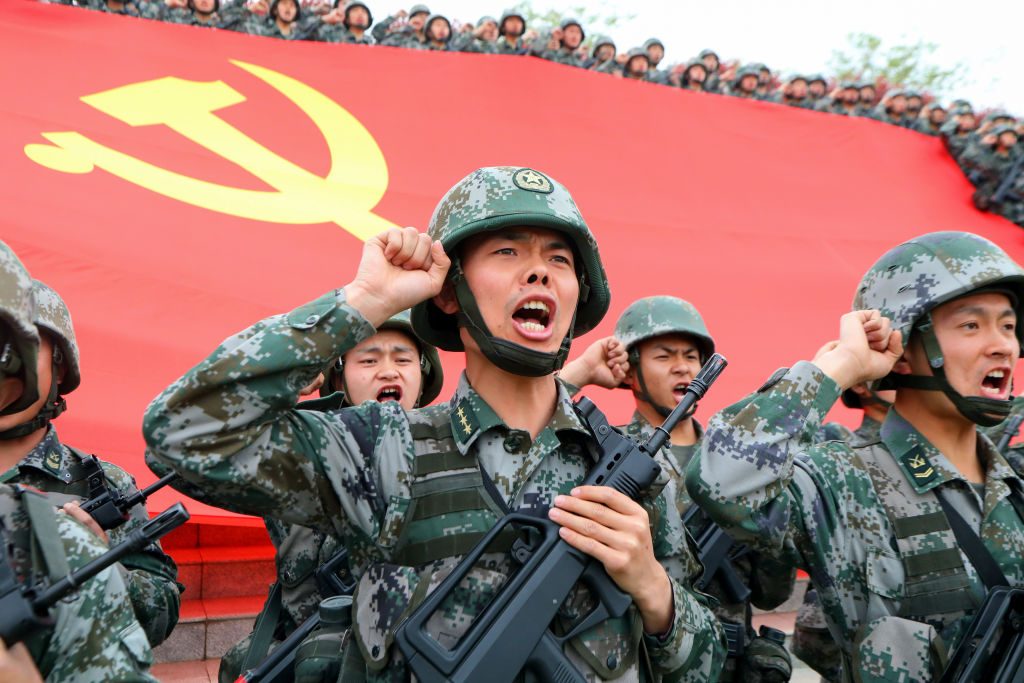
Foreign analysts tend to watch China’s military reshuffles through a narrow lens. Every promotion or purge is scrutinised for signals about Taiwan or clues as to how China is modernising its army. When senior generals fall, the instinctive conclusion is often that turmoil at the top must weaken China’s capacity for war, at least for a while.
President Xi Jinping’s removal last month of General Zhang Youxia, until recently the most senior uniformed officer in the People’s Liberation Army (PLA), has been interpreted in precisely this way. Western commentators have described the move as destabilising, even self-defeating — and in the short term, that judgement may be valid. Yet by focusing only on the immediate disruption, they risk missing the bigger story: Zhang’s fall marks not the unravelling of Xi’s control over the military, but his success in remaking it in his image.
The PLA has never been an apolitical military. From its foundation as the Red Army, it has always combined military tactics with extensive political indoctrination, deepened during formative events such as the Long March (1934-5). It remains, at its core, a Party army, embedded in the institutional structures, political norms, and — perhaps most importantly — ideological doctrine of the Chinese Communist Party (CCP). Power runs formally through Party mechanisms.
Yet the PLA has always had its own mythology. And for decades senior officers have enjoyed a level of discretion. During the Cultural Revolution (1966-76), generals, like other elites, had little room for manoeuvre, but that all changed when Deng Xiaoping set about modernising the military in the Seventies. Military leaders were given more space to make their own choices about tactics and spending (which in turn led to increased corruption). Careers and promotions came to follow relatively conventional and foreseeable routes. Patronage mattered, but so did experience.
The new system left senior officers with a degree of institutional confidence and professional standing, which allowed them to inform and advise decisions made by the Party. The PLA’s leaders have as a result played a crucial role in developing China’s military strategy since the Nineties, a period that has seen its focus shift from land warfare to naval and air power.
After his rise to power in 2012, Xi Jinping moved fast to rein in military autonomy, becoming both the general secretary of the Party and the chairman of the Central Military Commission (CMC). (The two roles are often but not always held together: a reminder that the CMC is a separate power base.) One of his first targets was General Xu Caihou, the former vice chairman of the CMC, who was arrested in 2014 on charges of massive corruption. Only his death from cancer in 2015 prevented him from being court-martialled. In the years since, Xi has sought to tighten his control over the armed forces. But, until now, there still seemed to be some officers who were untouchable.
Zhang was one of them. As first vice chairman of the CMC, he sat at the apex of China’s armed forces, second only to Xi himself. He had been unscathed by earlier purges that toppled officers of similar rank, protected by longstanding family and personal ties; Zhang’s father served with Xi’s during the Chinese Civil War of the Forties, making both men “red aristocrats”. His reputation for competence and rare combat experience — he fought in China’s 1979 war with Vietnam — gave him unique authority. He was too big a figure to be felled in the name of party discipline, anti-corruption, or factional housekeeping.
Zhang stood strong while Xi’s anti-corruption campaigns uprooted the military system, demolishing entrenched networks and hollowing out senior ranks. Commanders have been investigated, removed or disappeared since 2012 at a rate unseen since the Cultural Revolution. Yet Zhang appeared to sit slightly outside this logic. Foreign observers often described him as one of the few officers who could speak frankly about readiness, logistics and the real costs of conflict. Former Pentagon official Drew Thompson, who met Zhang, remarked on his seriousness, his detailed questioning, and his respect for professional expertise. “I assessed that Zhang Youxia’s combat experience, his self-confidence, intellect and lifelong commitment to the defense of China and the Communist Party would protect him,” he wrote on his Substack after the arrest. In an increasingly disciplined system, that combination of wartime credibility and personal influence gave Zhang the rare ability to say “no” — or at least “not yet”.
In another world, that arrangement might have faded away gently. Zhang might have retired quietly at the next Party Congress, or else seen his influence diluted as other figures around him were promoted. Instead, Xi ordered his public downfall. His message was unmistakable: no rank, relationship, or history protects an officer from scrutiny. Corruption, disloyalty and failure to uphold the Party’s authority over the military are existential threats — even if, in Zhang’s case, the basis for those charges is murky at best.
Chinese state media has framed the purge in unusually vitriolic moral and political terms, accusing General Zhang — as well as Chief of the Joint Staff General Liu Zhenli, who worked closely with him — of “undermining the Chairman’s authority”, “endangering the Party’s ruling foundation”, and “exerting vile influence on the Party”. Meanwhile it has exhorted the Party to “cleanse the institution of rot”, “eliminate ideological toxins”, and “promote organisational healing”. Translation: Zhang was not only corrupt but threatened the Party’s, and Xi’s, rule. As such, the Party needed to restore ideological discipline and reassert firm control over the armed forces. The implication is that Xi saw a generational reset of the military as unavoidable.
In the short term, this could all prove highly disruptive. A military leadership unsettled by investigations is unlikely to launch the most complex military operation in its history, which an assault on Taiwan would certainly be. Major campaigns require trust up and down the chain of command, confidence in delegation, and officers willing to exercise rapid judgements under pressure and amid uncertainty. These conditions are difficult to sustain when senior officers are acutely aware that missteps — especially political ones — carry heavy consequences.
But if Zhang’s downfall is the coup de grâce to the old order in the PLA, then the question is: what replaces it? It won’t be a vacuum. A new generation of generals is already rising. They have come up through an era of reform and modernisation, with joint theatre commands, new war‑fighting doctrines and a far more capable arsenal than their predecessors ever had. They have also spent their careers under Xi’s political campaign of “self‑rectification”, in which internal discipline is constant and the safest way to get promoted is to avoid standing out. For them, the lesson of Zhang’s downfall will be clear: personal advancement depends not just on competence, but on never looking like an independent pole of authority.
“A new generation of generals is already rising.”
This is less about ideology than incentives. Officers who are conditioned in this environment are likely to be intensely attentive to the preferences of the Party centre and acutely aware of the personal risks of deviation. So when the Party’s small civilian circle reaches a decision, there will be fewer internal brakes, a smaller chorus of voices with the confidence or legitimacy to push back. A system that constantly tests loyalty tends, over time, to narrow the range of views that ever reach the top.
Systems built around discipline often hesitate in ambiguous situations, which can itself be dangerous when ships and aircraft are operating at close quarters. Yet once a clear order is given, those same systems can move with disturbing speed, because dissent has been driven out in advance. The danger, in other words, may lie less in deliberate aggression tomorrow than in miscalculation later, when decisions are made by a tighter circle who succumb to groupthink.
Seen in that light, Taiwan is part of the story but not its whole. Many Western military analysts have posited that China wants to be ready for a military capture of Taiwan by 2027, although that doesn’t mean this will happen. Over the next year or two, turmoil at the top of the PLA will probably lower the appetite for a high‑risk assault across the Strait. By the early 2030s, however, a reconstituted high command — greener in combat experience but fully socialised into Xi’s remade system — could make the region more volatile. A leadership that believes it finally has “its own” military, and faces fewer internal doubts, may calculate risk differently.
Meanwhile, the global zeitgeist is changing. Gone is the old language of the “rules‑based order”; today, large powers talk more about spheres of influence and less about restraint. In Washington, President Donald Trump has embraced a more transactional view of raw power, codified in a National Security Strategy that treats dominance by the “larger, richer, stronger” as a “timeless truth” of geopolitics, and as a simple fact of life. The United States should not be surprised, then, if China comes to a similar conclusion. Social Darwinism was central to the thinking of China’s 20th-century elites, and their successors have not forgotten it.
A fully Xi‑controlled PLA, operating in this cutthroat new world, may reduce the risk of an overeager wayward general — perhaps raised in the spirit of the Wolf Warrior diplomats — dragging China into a conflict Xi doesn’t want. But it also increases the risk that, in the event that the civilian leadership is inching toward using force — over Taiwan, in the South China Sea, or in a crisis we have not yet foreseen — there will be fewer people in the room with the standing to say that the costs are too high.
Mao Zedong said that the Party must always control the gun. For over a decade, President Xi has sought to do just that. He may finally have succeeded.
First Appeared on
Source link




Leave feedback about this