A new digital reconstruction of Little Foot’ face, one of our oldest human ancestors, is giving scientists a fresh look at what this ancient hominin might have actually looked like.
Little Foot’s discovery in the 1990s sparked major interest among scientists. The nearly complete skeleton was found in South Africa’s Sterkfontein Caves, though the skull and some other parts were crushed by rock over time. Thanks to some cutting-edge technology, researchers have now been able to digitally reconstruct Little Foot’s face, revealing details that were impossible to make out before.
Digital Technology Brings Little Foot to Life
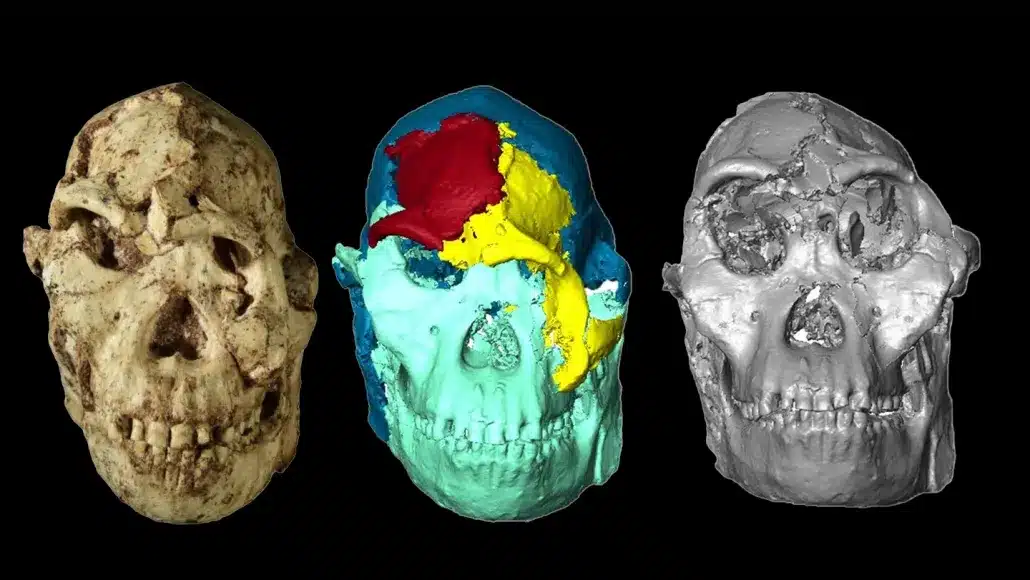
Published on March 2 in Comptes Rendus Palevol, the study explained that to recreate Little Foot’s face, scientists turned to high-resolution scans of the skull, captured in 2019 using synchrotron X-ray imaging. These scans produced incredibly detailed 3D models of the bones, which were then digitally reconstructed.
“Now we have a very good reconstruction, something we could not do with the physical specimen,” said Amélie Beaudet, a researcher involved in the study.
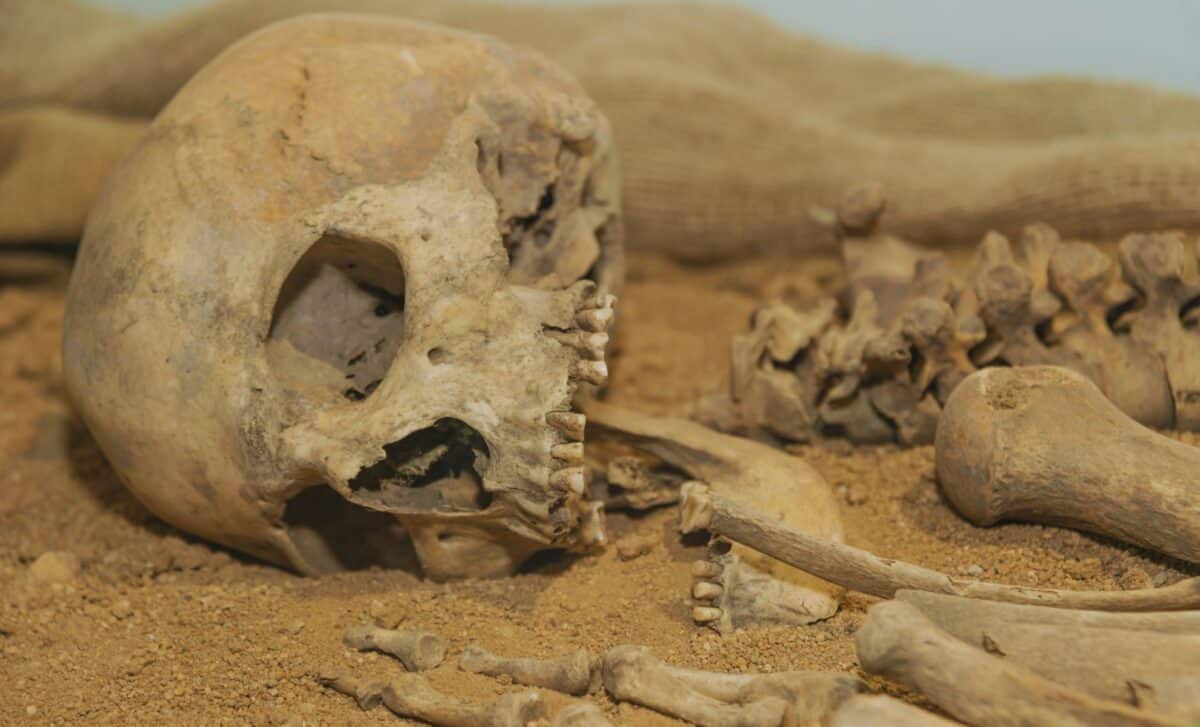
Little Foot remained entombed in cave sediment for millions of years before being discovered. Credit: Paul Myburgh
The result is a clearer and more accurate depiction of Little Foot’s features. What stands out in the new face is the wide eye sockets and smaller jaw, which are typical of Australopithecus. This reconstruction iS a valuable tool for scientists who are studying how early human ancestors might have looked and lived.
East African Influences?
One of the most surprising findings from Little Foot’s reconstruction is that some of its features seem to resemble those of fossils from East Africa, rather than the South African region where the skeleton was found.
According to Beaudet and her team, the wide eye sockets and other facial traits of Little Foot appear more similar to East African fossils than those found in the same area. This has led some scientists to think that Little Foot could be part of a group of ancestors that migrated from East Africa to South Africa more than 3.5 million years ago.
A closer look at Little Foot is offered through its original skull, digital scan, and reconstructed face. Credit: Amélie Beaudet
This theory would mean that early humans weren’t as isolated in different parts of Africa as previously thought. While researchers are cautious about jumping to conclusions, the similarities between Little Foot’s face and East African fossils are intriguing. It suggests that migration could have played a bigger role in shaping early hominin populations than we realized.
What’s in Store for Little Foot’s Evolutionary Secrets?
While the new face reconstruction is a huge step forward, there’s still more to learn from Little Foot. The next phase of research will focus on modeling the teeth and braincase, which will give scientists a deeper understanding of the species’ diet and brain development.
These features could explain how Australopithecus contributed to the development of Homo, the genus that eventually led to modern humans.
“We have only a few specimens, so we need to be really careful.” She explained, “That’s the only way, I think, for us to understand … why we evolved the way we did.”
As Beaudet noted, studying Little Foot’s teeth and braincase will help explain how early hominins adapted to their environments and how these adaptations might have set the stage for human evolution.





Leave feedback about this