

Researchers have uncovered intriguing insights into the Earth’s interior through the study of a subtle, continent-scale dip in the planet’s gravity field, known as the geoid. This anomaly, often referred to as a “gravity hole,” has a negligible effect on a person’s weight, someone weighing 198 pounds (90 kilograms) would be only about 5 to 6 grams lighter in this region. However, its true significance lies in what it reveals about Earth’s dynamic past. In a study published in Scientific Reports, scientists reconstructed the evolution of the Antarctic geoid low over millions of years.
A Measurable Valley in the Geoid, Not a Literal Hole
The Antarctic geoid low is a “valley” in the geoid, a surface defined by gravity, rather than an opening in the ground. In words used by study co-author Alessandro M. Forte, “What people call a ‘gravity hole’ is not a literal hole in the ground, and it’s not a place where gravity disappears,” adding that “It’s a very broad, gentle low in Earth’s gravity field.”
In today’s field, the gravity-defined sea surface in the region sits far below the global average. According to Space.com, the sea surface in the Antarctic geoid low is about 394 feet (120 meters) below the global average, which is a striking swing in geophysical terms even if it does not feel like anything on the surface.
Scientific Reports also emphasizes a definitional issue that has caused confusion: geodetic reference frames often place the deepest geoid low in the Indian Ocean, while a geodynamic definition relative to a hydrostatic ellipsoid puts the strongest nonhydrostatic geoid depression over Antarctica. In that framing, the strongest low sits over the Ross Sea, in the Ross Embayment, between Victoria Land and Marie Byrd Land.
A 70-Million-Year Reconstruction Tied to Deep Mantle Buoyancy and Slabs
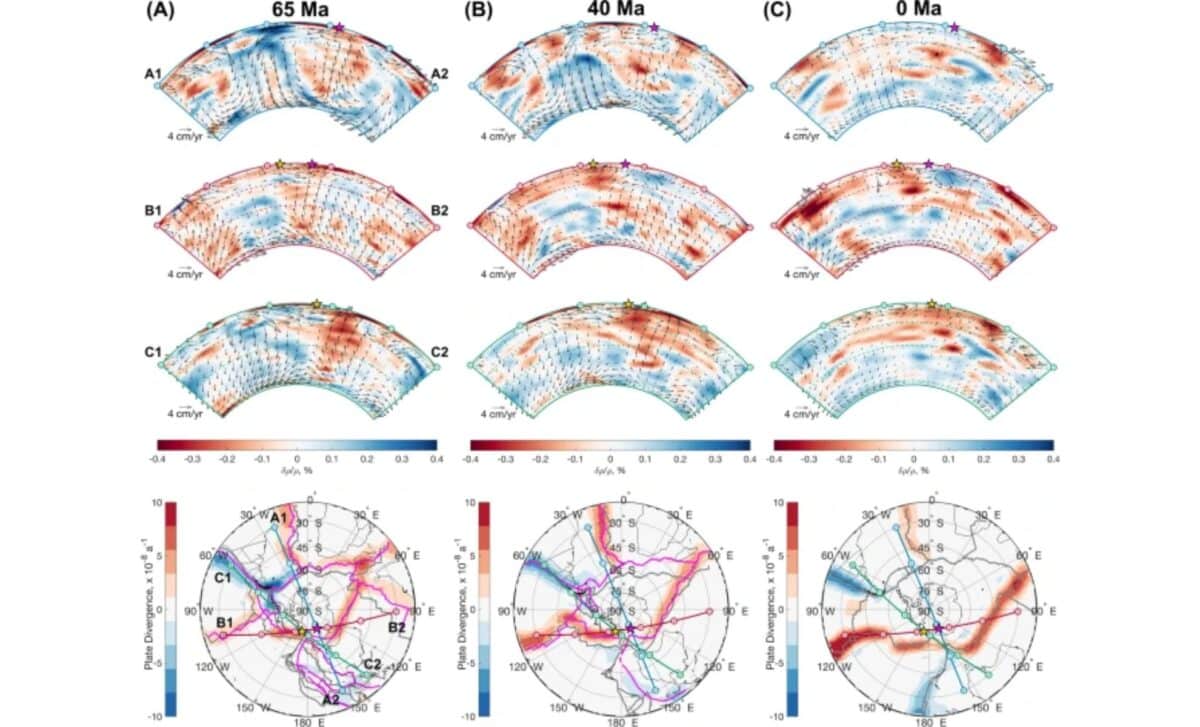
The new work does not treat the geoid as a static snapshot. According to the paper, Petar Glišović and Alessandro M. Forte reconstructed the time-dependent evolution of the Antarctic geoid low over roughly 70 million years using a back-and-forth nudging approach for time-reversed mantle convection modeling, starting from 3-D mantle density structures derived from seismic tomography.
The broad result is persistence with change. Scientific Reports states that the Antarctic geoid low has persisted for at least ~70 Myr, with a major transition in amplitude and position between 50 and 30 Ma. Space.com reports Forte’s reaction to that long continuity: “What surprised me most is how coherent the long-term story appears to be. The gravity low is not a random, short-lived feature.”
As for what’s driving it, the reconstruction points to time-dependent coupling between negative and positive buoyancy at different depths. According to the study, the feature was initially supported by stable lower-mantle density anomalies, while over the past ~40 Myr an increasing contribution from upper-mantle buoyancy, particularly above ~1300 km depth, amplified the magnitude. The paper links this shift to long-term deep subduction beneath the Northwest Antarctic margin and a broad, thermally driven upwelling of buoyant material sourced from the lowermost mantle.
Cross-Checking the Model with True Polar Wander and a Cautious Ice-Sheet Link
The study, published in Scientific Reports, did more than generate an interior-flow story; it also tried to test whether the time-evolving gravity field it predicts lines up with Earth’s rotational behavior. The key transition between 50 and 30 Ma coincides with an abrupt lateral shift in Earth’s rotation axis at ~50 Ma, independently validated through paleomagnetic constraints on true polar wander. Space.com describes this as a potentially testable way to connect deep-Earth evolution to surface observables.
There’s also a carefully framed hypothesis touching Antarctica’s glaciation timeline. Space.com notes that the Antarctic geoid low appears to have intensified around the time Antarctica transitioned into a permanently ice-covered continent about 34 million years ago, raising a question about whether long-wavelength gravity-field changes could alter the baseline of regional sea level and influence ice-sheet boundary conditions.
Forte also draws a firm line between what the study shows and what it does not claim: “Our study shows how deep Earth dynamics can reshape the gravity field over geological time,” while adding, “Whether that translated into a measurable influence on climate/ice is a separate question that requires additional coupled modeling and evidence.”
First Appeared on
Source link






Leave feedback about this