

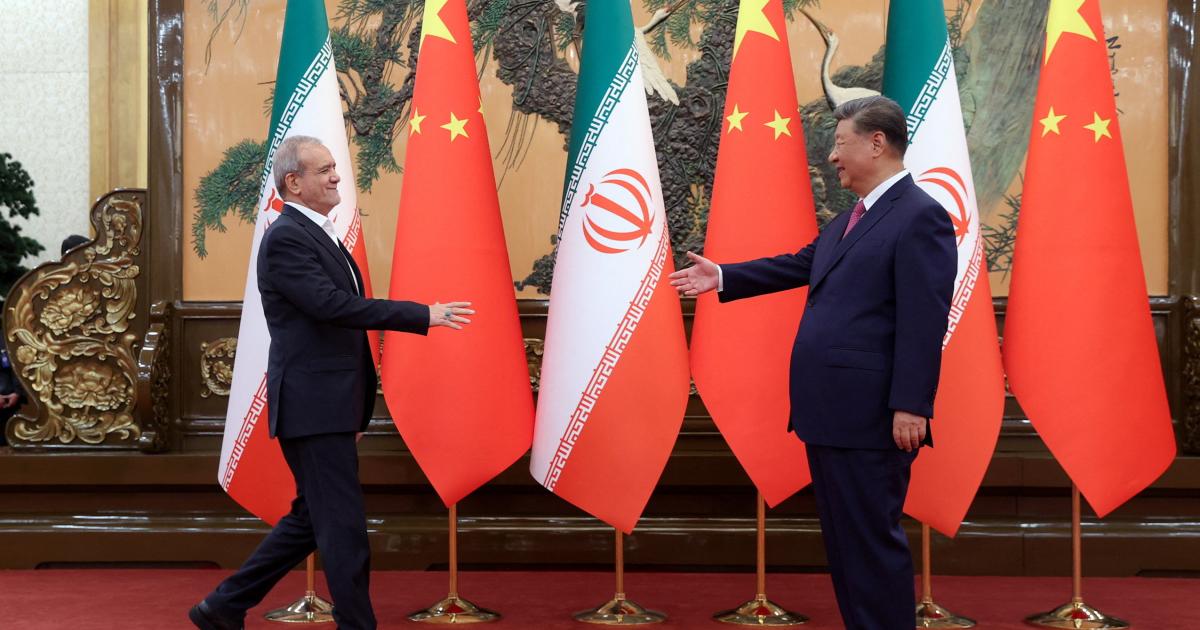
China is watching carefully as the United States and Israel bombard Iran. Beijing is, after all, Tehran’s most important partner. The two countries grew close over shared history and goals: both trace their roots to leading ancient non-Western civilizations, and both oppose a Western-dominated global order today. China’s energy security is also connected to its relationship with Iran. More than 55 percent of China’s total oil imports in 2025 came from the Middle East (approximately 13 percent from Iran itself), most of which must pass through the Strait of Hormuz, the narrow waterway bordered by Iran. Because the recent bombing campaign will disrupt Iran’s oil supply and could undermine production across the Gulf states, and because it potentially jeopardizes Beijing’s ability to ship oil from the region, some analysts have speculated that Beijing will come to Tehran’s aid—either with direct military intervention or at least material support such as dual-use equipment and parts, similar to what China has provided to Russia in the Ukraine war.
But although China is concerned, it is not likely to get involved. After Israel’s 12-day war against Iran in June 2025, China offered only boilerplate diplomatic rhetoric in support of the Islamic Republic. Similarly, in the Chinese Ministry of Foreign Affairs’ official press conference remarks this week, the harshest language that the ministry was willing to use was in its condemnation of the assassination of Iran’s supreme leader, Ayatollah Ali Khamenei, rather than of the overall campaign against Iran. The ministry’s call for “relevant parties to stop military operations”—a request that includes Iran as well as the United States and Israel—and its vocal support for respecting the “sovereignty, security, and territorial integrity” of Gulf states suggests that China is trying to stay on good terms with countries in the Gulf as much as with Iran.
This hands-off approach to Iran has been a long time coming. Since October 7, 2023, when Hamas attacked Israel, Beijing has grown increasingly disillusioned with Tehran’s capability and credibility as a regional power. Chinese strategists have also lost confidence because of what they see as Iran’s tendency to capitulate to Western demands, rather than fight back, as manifested in its persistent desire to negotiate with Washington. Ultimately, Beijing doesn’t see regime change in Iran as a worst-case scenario. China is willing to work with whatever leadership emerges after the strikes as long as it protects oil flows and prioritizes shared economic interests. Only if these interests are threatened, or if a protracted war of attrition disrupts oil shipments through the Strait of Hormuz, will Beijing have to reconsider its place on the sidelines and respond more forcefully.
FALLING OUT OF FAVOR
China’s Iran strategy has long been predicated on the assumption that the country could be a foothold for Beijing’s interests in the Middle East. In 2021, to underscore their growing cooperation, the two countries signed a 25-year, $400 billion strategic cooperation pact that aimed to bolster their economic and security ties. But few of the projects envisioned in the pact have materialized because of Tehran’s concern that China’s influence would compromise Iranian sovereignty and independence, and Beijing has become frustrated by Tehran’s inconsistency and unreliability. Most important, China has determined that Iran’s power and revolutionary credentials are both overstated. Iran has a population ten times that of Israel and three times that of Saudi Arabia, but its GDP is less than 90 percent of Israel’s and only 25 percent that of Saudi Arabia. In Beijing’s estimation, Iran has used proxy wars and asymmetric warfare to deter its adversaries, which has inflated its capacity and disguised its internal weaknesses.
China also sees a mismatch between Iran’s strategic goal of leading an Islamic revolution and the conditions needed to achieve it. According to public commentary and analysis by Niu Xinchun, the executive director of the China-Arab Research Institute at Ningxia University, the Iranian regime’s Islamic ideology precludes compromises with and concessions to the United States on political and nuclear issues. But because of crippling sanctions, a better relationship with the United States is the fundamental precondition for Iran to improve its economy, develop its strength, and ease the external pressure hindering domestic reform. Iran is thus stuck between its opposition to the United States and its need to reach a deal with Washington, and between its theological conservative roots and the need for reforms.
Moreover, in the view of many Chinese analysts, Iran has failed to demonstrate enough resolve to directly confront its adversaries. When the United States assassinated Qasem Soleimani, Iran’s top military general, in 2020, for instance, and when Israel struck the Iranian embassy in Syria in 2024, Tehran’s retaliation against U.S. bases in Iraq and Israel was seen as underwhelming. Many Chinese observers also found the Iranian response to the 12-day war, which included offering advanced warning to Qatar and the United States before launching missiles, disproportionately weak and ineffective. Chinese netizens derided Iran’s responses as “performative retaliation.” Pessimism about Iran’s fate is now baked into Chinese assessments of the Middle East: in the current crisis, Chinese opinion leaders such as the prominent pundit Hu Xijin lament the quagmire Iran and its people now face and blame Tehran for leading the country into it.
Iran’s treatment of its proxies has further weakened Chinese confidence. Since 2023, these groups have been targeted and wiped out one after another. Israeli forces have decimated Hamas and Hezbollah, for instance, yet Iran has failed to lend meaningful support or retaliate effectively. Beijing watched, dumbfounded, in December 2024, when Iranian Vice President Mohammad Zarif denied the country’s relationships with proxy groups in the region—the so-called axis of resistance—and declared that Iran had no control over their actions. Then, in April 2025, Iran evacuated its military personnel from Yemen in the midst of a U.S. bombing campaign, which meant abandoning its Houthi allies to avoid increasing tension with Washington and keep alive the hope of resuming negotiations with the United States.
Pessimism about Iran’s fate is now baked into Chinese assessments of the Middle East.
Beijing is also disappointed in the Iranian regime’s domestic failures. Although Chinese state media have refrained from openly criticizing the regime, the Chinese policy community focused on the Middle East is clear-eyed about the bad decision-making, rampant corruption and poor governance in Tehran. Israel’s ability to infiltrate the Iranian security apparatus, which is what allowed it to effectively target Iranian military leaders and nuclear scientists during the 12-day war, suggests that many Iranian officials don’t trust their system and are willing to sell out their country. Chinese leaders are skeptical of the viability of an Iranian state that its own officials don’t have faith in.
China’s disillusionment with Iran’s leaders means that Beijing is not inherently opposed to regime change. Because its priority is to ensure that Iran remains a viable economic partner, it is regime agnostic. In fact, if the U.S. and Israeli attacks curtail Iran’s rogue military ambitions and the country repositions itself as an economic power in the Middle East, it could represent a future that China embraces.
Beijing is also unlikely to try to backstop the Iranian regime because of China’s relationship with the United States. U.S. President Donald Trump and Chinese leader Xi Jinping are scheduled to meet at the end of March—a meeting that carries the prospect of a potential grand bargain between the United States and China that could lead to a real détente after eight traumatizing years of great-power competition. Beijing does not want a war in the Middle East to derail its effort to work with Trump.
CHANGING THE CALCULUS
China’s interest in Iran is first and foremost about energy security. Although China has diversified its energy supply and invested heavily in coal, solar, wind, and nuclear—renewables surpassed oil to become China’s second-largest source of energy consumption, after coal, in 2025—oil plays an irreplaceable role in its economy. China still relies on imported oil for fueling its jets, powering its ships, and producing petrochemicals. China’s is estimated to have between 1.3 and 1.4 billion barrels of oil in reserve, or around 30 percent of its imports in 2025, which is enough to withstand a short-term disruption of shipments from the Middle East but not a long one.
One thing China worries about—and what could sway Beijing’s calculus and force it off the sidelines—is the closure of the Strait of Hormuz, which would cut off more than half of China’s oil imports. Chinese oil executives and Middle East experts have long dismissed the possibility of regional conflict leading to a long-term shutdown of shipping lanes. If war in the Middle East disrupted oil shipments through the strait, they argue, it would trigger a global energy crisis and a collective solution would quickly emerge. During the 12-day war, for instance, Chinese experts dismissed Iran’s willingness to close the Strait of Hormuz because they believed it would antagonize the whole Gulf and undercut Iran’s own revenue. Beijing has used this argument to refute domestic calls for—and Western speculation about—potentially building a Chinese military presence in the region.
The assumption that global energy producers and consumers will not allow the region to fall apart is now being put to the test. Beijing is pressuring Tehran to keep the Strait of Hormuz open and avoid taking any measures that could disrupt energy shipments. If China’s oil supplies from the region are threatened, it could turn to alternate suppliers, especially Russia, which is currently the source of more than 17 percent of China’s oil imports. But Beijing is uncomfortable with overreliance on any single supplier because it fears another major disruption of its supply.
An even bigger test for China would be a protracted war. If the Iranian regime withstands U.S. and Israeli bombardment and inflicts real damage in its counterstrikes, it would create a dilemma for Beijing. If Tehran abandons its capitulation tendency, fights back, and survives, it would be difficult for China to stand aside and withhold assistance for the regime. Iran is still China’s key regional partner. Refusing to provide support even if Iran demonstrates its resolve and capability of withstanding attacks would reveal China’s lack of commitment. If China were to get involved, its support for Tehran could reflect what it has done to help Russia in the Ukraine war: providing supplies of dual-use technologies and parts, such as drones; purchasing Iranian oil; and offering technological support for building up Iran’s local defense industry.
The longer the regime holds out, the more China will have to step in and support it, which could prolong the war even further. But if the regime collapses quickly like that of Bashar al-Assad in Syria, or the situation quickly stabilizes like what transpired after the removal of Venezuela’s Nicolás Maduro, Beijing is unlikely to dwell on such an outcome. China has already lost faith in the leadership of the Islamic Republic. What matters now is figuring out how to work with the next power holders to keep oil flowing from the Middle East.
Loading…
First Appeared on
Source link

Leave feedback about this