

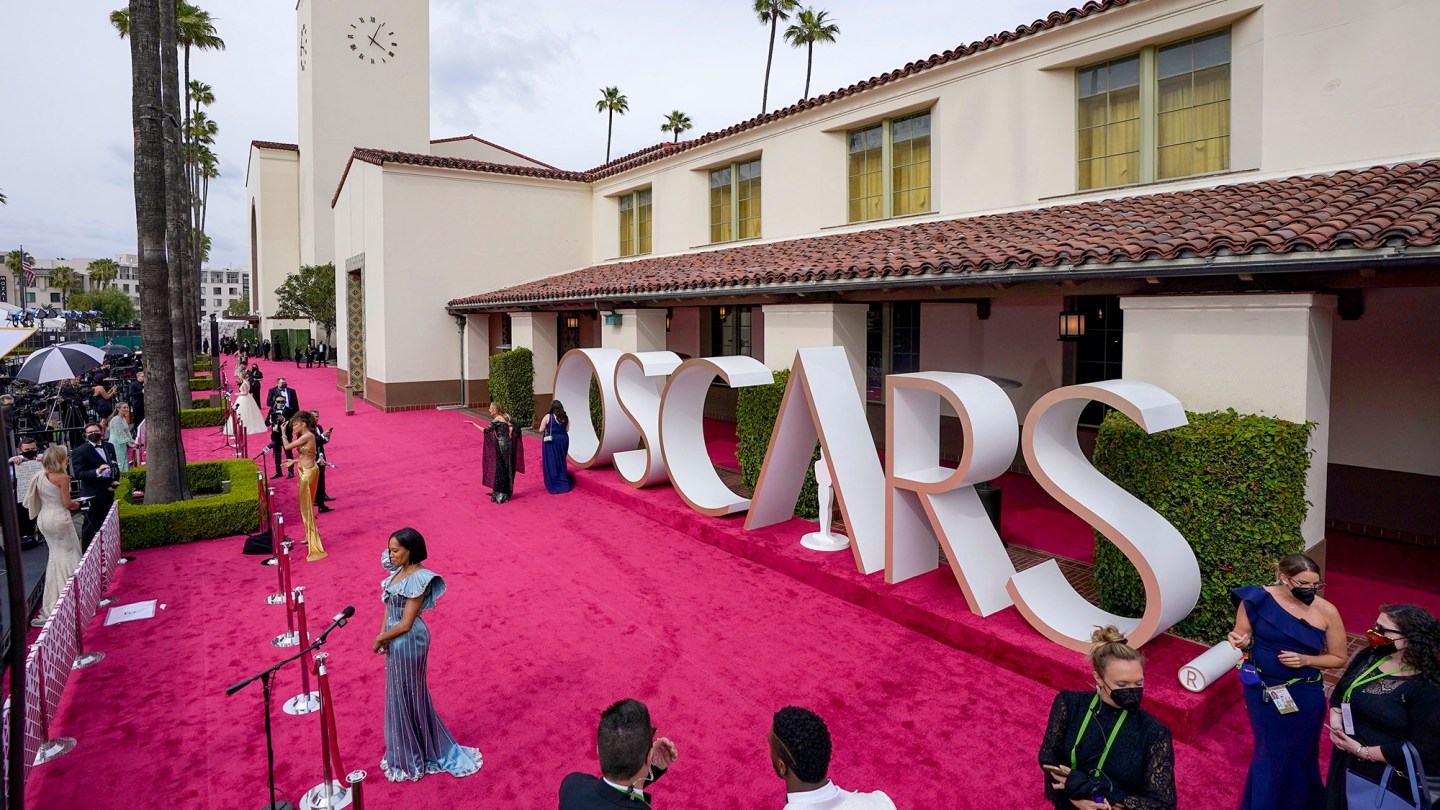
The world was a very different place five years ago. The pandemic was killing thousands daily and, with vaccines only just beginning to roll out, normal life and work had largely ceased. Hollywood, meanwhile, was rocked by mandatory production shutdowns, theater closures and postponements of high-profile titles, from No Time to Die to West Side Story, while streamers — Netflix, Prime Video and Hulu, as well as newcomers Disney+ (November 2019), HBO Max (May 2020) and Peacock (July 2020) — became America’s go-to for distraction and comfort, accelerating an existential threat to the established order.
For nearly a century, the Oscars had been a constant, postponed three times — after the L.A. floods in 1938, the assassination of Dr. Martin Luther King Jr. in 1968 and the attempted assassination of President Reagan in 1981 — but never canceled. The ceremony went forward after Pearl Harbor, throughout World War II and in the wake of 9/11. But how could the 93rd Oscars, originally scheduled for Feb. 28, 2021, proceed when people couldn’t leave their homes without risking their lives? That was the question.
What follows is the answer, from interviews with more than 40 people, including Dr. Anthony Fauci; Simone Ledward Boseman, the widow of Chadwick Boseman; the producers of the telecast, including Steven Soderbergh, and its director; the Academy’s president and CEO at the time; and dozens of that year’s Oscar nominees and winners. It’s the story of an awards season unlike any other — one that stretched over 14 months and came to an end in, of all places, a train station in downtown L.A., with a ceremony that many felt went off the rails, even as its very occurrence was something of a miracle.
COVID COMETH
DR. ANTHONY FAUCI In the very early days, the information that was coming from China was not particularly transparent. They first said that the virus didn’t transmit very efficiently and was well controlled by classical public health methods. As weeks went by, it became clear [that it was worse], not from the Chinese authorities, but from the Chinese scientists saying, “Wait a minute, it really is spreading a bit more easily and efficiently than the original SARS, and people are getting really sick. Some of them are dying.” There was a satellite photo of the Chinese building thousand-bed hospitals at the same time they were saying, “No, it’s not so bad.” I started to get concerned. When Chinese people from Wuhan were visiting northern Italy for business, I was getting contacted by the Italians — whom I knew because many of them trained in my laboratory — and they told me, “Tony, no kidding, this is really, really bad.” When I got the real scoop from my Italian friends, I said, “We are in real trouble here.”
That was in February 2020. The 92nd Oscars, for unrelated reasons, had been moved up from March to Feb. 9, 2020. If it had not been, it would have been impacted by COVID too.
FAUCI COVID probably was much more prevalent under the radar screen than we thought.
On March 11, 2020, the World Health Organization declared COVID a global pandemic; Tom Hanks and Rita Wilson tested positive; and President Trump announced a ban on travel from Europe. Days later, the Dow fell nearly 3,000 points, its biggest single-day drop. That same day, following the lowest-grossing weekend at the North American box office since 1998, Universal canceled the theatrical release of its film Trolls World Tour and sent it straight to PVOD. The following day, the nation’s three largest cinema chains — AMC, Cinemark and Regal — shut down all locations. And March 19, California issued a mandatory stay-at-home order. Plans for films with Oscar potential began to fall apart.
NICOLE NEWNHAM (CO-DIRECTOR OF THE DOCUMENTARY CRIP CAMP) We’d had our Sundance premiere at the Eccles [in January 2020] — we were the opening night film — and got this epic standing ovation. Then we went to the True/False Film Fest [March 5-8, 2020]. I remember we had our last screening there, and it was a packed house. Jim [Lebrecht, her co-director] and others wanted to go have lunch, and I was like, “I think I just want to sit here and experience this one more time.” Sure enough, that was the last time I saw it with an audience.
MAITE ALBERDI (DIRECTOR OF THE DOCUMENTARY THE MOLE AGENT) I was lucky in the sense that at least I had the chance to make the premiere at Sundance. It was my only experience of the film with an audience.
FLORIAN ZELLER (CO-WRITER/DIRECTOR, THE FATHER) The first screening was at Sundance, and there was a very enthusiastic reception. I was sitting next to Michael Barker from Sony Classics, and he said, “You should get used to this!” But that’s the only time I attended a screening of my film.
LEE ISAAC CHUNG (WRITER-DIRECTOR, MINARI) At Sundance, we had started hearing reports of it. We were talking to Youn Yuh-jung [one of the film’s stars] about the need for her to be careful as she was flying back to Korea. We knew there were cases in Asia, but we didn’t know what was coming.
RAMIN BAHRANI (WRITER-DIRECTOR, THE WHITE TIGER) Netflix’s policy was, “We’re not going to any festivals during COVID.” We had an online premiere, and people were “invited.” They got a link and — Netflix was so generous — a beautiful package in the mail with food, and DoorDash was delivered to their house.
PETE DOCTER (HEAD OF PIXAR AND CO-WRITER/DIRECTOR, SOUL) We had spent four-plus years on the movie. We were approaching the end, and then, bam! Within days, though, we were back up — we’re lucky because in animation you can do it somewhat remotely — so I was sitting in my bedroom watching dailies and finalizing shots. As the film approached release, it got delayed and delayed again. Finally Bob Iger and Alan Bergman called: “We are going to put it on Disney+.” At first, I thought that was something to be discussed, and then I quickly realized, “Oh no, they’re just telling me.” I’ll be honest, it was pretty heartbreaking.
MADELINE SHARAFIAN (DIRECTOR OF THE ANIMATED SHORT BURROW) Pete Docter is my hero, and he had asked me, “Hey, would it be cool if I put Burrow in front of Soul?” I was like, “Would it be cool? This is the best day of my life!” But unfortunately Soul ended up being released on Disney+.
DARIUS MARDER (CO-WRITER/DIRECTOR, SOUND OF METAL) Sound of Metal took me 12 years to make. I worked extremely hard, and I managed to set up a theatrical release for it with a three-month window, which was pretty hard to accomplish with Amazon. Then COVID happened, so there was no theatrical.
KEMP POWERS (WRITER, ONE NIGHT IN MIAMI, AND CO-WRITER, SOUL) Both films got into a bunch of film festivals, all of which were either canceled or we couldn’t attend. Soul was selected for Cannes, which got canceled. One Night in Miami debuted in Venice, but we couldn’t go. For One Night in Miami, we did a drive-in premiere in Malibu. They actually did a red carpet where people drove their cars through a red carpet.
One film that was already in the can, having shot in 2019, was Ma Rainey’s Black Bottom, which starred Chadwick Boseman, best known for Black Panther. Unbeknownst to any of his collaborators, Boseman made the movie while battling colorectal cancer.
SIMONE LEDWARD BOSEMAN (WIDOW OF CHADWICK BOSEMAN) It’s so strange to talk about it in these words because obviously with COVID so many people lost loved ones. But the timing of lockdown for what we were going through was honestly ideal. I am really grateful for that time.
THE ACADEMY ACTS
Academy officials were desperately trying to figure out how to move forward, all while working remotely.
DAWN HUDSON (ACADEMY CEO) Every day was hell, to be honest. We were operating 12 hours a day. We did that for a whole year.
To be eligible in most Oscars categories, a film had to screen for one week in a commercial theater in Los Angeles County. Before theaters shut down, though, only a handful of films had qualified. The Academy decided it had to act. On April 28, its board of governors met via Zoom and determined that films that had been intended for a theatrical release prior to COVID would be allowed to qualify that year via the Academy’s members-only streaming service — which, fortuitously, had been opened to all films only months before.
SHAWN FINNIE (ACADEMY OFFICIAL) Thank God, because I don’t know what eligibility would’ve possibly looked like without it.
Academy president David Rubin and CEO Dawn Hudson said in a statement: “The Academy firmly believes there is no greater way to experience the magic of movies than to see them in a theater. Our commitment to that is unchanged and unwavering. Nonetheless, COVID-19 pandemic necessitates this temporary exception to our awards eligibility rules.”
Several weeks later, on June 15, the Academy announced that it was extending the close of that cycle’s Oscars eligibility window from Dec. 31, 2020, to Feb. 28, 2021, and was pushing back the 93rd Oscars from Feb. 28, 2021 to April 25, 2021. Not long after, in a sign of the times, the Academy announced that it would also allow films to qualify via drive-in screenings.
Meanwhile, America was on fire. On May 25, George Floyd, an unarmed Black man, was killed by Minneapolis police officer Derek Chauvin while being arrested.
TRAVON FREE (WRITER/CO-DIRECTOR OF THE SHORT TWO DISTANT STRANGERS) I started seeing the video online before it made its way onto the news. It was so heinous; you couldn’t believe what you were seeing. I think that’s why it culminated in the largest global protest ever. We came back from a protest in downtown L.A., and I said, “This is the worst version of Groundhog Day ever,” and that was the seed of the idea for the film. I wrote it at the end of June in five days, and we shot it in September in five days, during the only window that L.A. allowed anyone to film in L.A. They opened everything up for one week, and we happened to have our permits for that one week.
Speaking of production opening back up, several people who would later play key roles in the 93rd Oscars were instrumental in making that possible. Filmmaker Steven Soderbergh, who had learned about pandemics and befriended experts while making his 2011 film Contagion, headed the Directors Guild’s COVID-19 Safety Committee and helped write the report “The Safe Way Forward,” published June 12. And from Aug. 17-20, live TV maven Glenn Weiss produced the virtual Democratic National Convention, at which Joe Biden was nominated, from a temporary studio in his home.
Meanwhile, Boseman’s health was rapidly declining, and to the shock of the world, he died on Aug. 28. He did get to see the film for which he would posthumously receive widespread recognition, even though it would not drop on Netflix until Nov. 25.
LEDWARD BOSEMAN We did get a chance to see it because he was going to have to do press. What I remember most, more than the watching of the film, were the conversations around knowing that they were going to be pushing toward award season and reconciling with what he was going to be able to participate in and what he wasn’t going to be able to do because of where he was. Those were hard conversations to have. I think that’s when members of his team started to recognize, “OK, something’s wrong.”
A JOLT TO THE OSCARS INDUSTRIAL COMPLEX
Given that the Oscars remained on the calendar and people had little else to do, campaigning continued. FYC billboards went up around L.A., though few were leaving their homes. Interviews, Q&As and panels moved online. With everyone at their wit’s end, these sometimes took strange turns. During a Zoom Q&A for Mank, filmmaker Paul Schrader was called on and asked Amanda Seyfried if she thought that Marion Davies, whom she played in the film, was — randomly quoting Nicolas Winding Refn’s film Only God Forgives — William Randolph Hearst’s “cum dumpster,” leaving Seyfried and dozens of Academy members shocked.
RIZ AHMED (ACTOR, SOUND OF METAL) The Zoom meeting is now familiar to everyone, but it was the start of that. I remember Hollywood Reporter roundtables, Actors on Actors, all of it — we were little boxes on screens. That became the new normal.
POWERS I’d be lying if I didn’t say that many times I was wearing sweatpants — or no pants.
GLENN CLOSE (ACTRESS, HILLBILLY ELEGY) If you were lucky, you had good lighting at home.
ZELLER I was in France, so I would wake up in the middle of the night and do a Zoom.
PAUL RACI (ACTOR, SOUND OF METAL) Zoom after Zoom, saying the same things. It was depressing, although at the same time I had to stay excited putting on my minstrel show, “Hey, everybody, look at me!”
CHUNG There was no excuse for not being able to make a meeting.
MARDER There was no talking to people afterward. There were no meals. There was no travel. There was no joy. It was just being in front of your screen, having hundreds and hundreds of interviews.
JON BATISTE (COMPOSER, SOUL] During awards season, I was also taping The Late Show with my friend Stephen Colbert, also on Zoom. So for five shows a week I would be on Zooms, and simultaneously I was also doing the campaign around our film on Zoom.
LAKEITH STANFIELD (ACTOR, JUDAS AND THE BLACK MESSIAH) Doing everything remotely felt convenient at first, but it quickly started to feel dystopian.
The Cannes Film Festival had been postponed and then canceled; the Palais was now housing homeless people. But the fall film fests limped along: Venice took place in person, though few attended from abroad. Toronto was on an online streaming platform. And Telluride held a one-film-only drive-in screening — the world premiere of Nomadland — at the Rose Bowl in Pasadena, with attendees honking and flashing headlights in approval.
CHLOÉ ZHAO (WRITER-DIRECTOR, NOMADLAND) There was a fire over the mountains, and you could see the ashes falling — so apocalyptic.
Every day brought something unusual — a half-in-person/half-virtual Emmys telecast on Sept. 20, a mostly vote-by-mail presidential election Nov. 3 and a press release Dec. 3 announcing that Warner Bros. would release its entire slate simultaneously in theaters and on HBO Max, marking the beginning of the end of its relationship with Christopher Nolan.
The Academy, meanwhile, tried to forge ahead with planning for the Oscars, announcing Dec. 8 that it had hired live TV specialist Jesse Collins, Oscar-winning director Soderbergh and Oscar-nominated producer Stacey Sher to produce the show. The trio said in a statement, “We’re thrilled and terrified in equal measure.”
JESSE COLLINS (OSCARS PRODUCER) They’d called Oprah and asked her to produce the show, and she said, “It’s not for me, but you should call Jesse.”
HUDSON Howard Rodman [the screenwriter and Soderbergh friend] told me Steven had a vision for the Oscars, that it was very specific, and that it probably could never be done.
STEVEN SODERBERGH (OSCARS PRODUCER) I wrote a manifesto outlining, “Here’s what my approach would be if I were to be involved with this.”
HUDSON He wanted an intimate Oscars, very much like old Hollywood, sitting around with your friends.
SODERBERGH And she said, “That all sounds good to me.”
STACEY SHER (OSCARS PRODUCER) Soderbergh called me and asked if I would do it with him. I never say no to anything he asks me to do. [The two had collaborated on Out of Sight, Erin Brockovich and Contagion.]
SODERBERGH There’s no upside to doing that job. You’re going to get trashed no matter what. There’s a certain freedom in that because you go in with the attitude of, “I’m just going to make something that I would enjoy if I saw it,” and let the rest of it go. The asterisk of it being a COVID year was, to me, a huge opportunity. So the first thing we hit them with was, “We want to move it somewhere else” [other than the Dolby Theatre in Hollywood, where it is usually held], something I have always wanted to do. What I was pitching, and what the COVID situation provided for, was something where we could control the number of people in the room, make it really personal and focus more than is typical on the nominees and their stories.
GARRETT BRADLEY (DIRECTOR OF THE DOCUMENTARY TIME) I remember thinking how genius it was that the Academy had brought Soderbergh on to produce the show. The unknown can be a threat to filmmakers, but if there’s anybody who thrives off of it or goes after it, it’s Soderbergh.
Oscars producers Stacey Sher and Steven Soderbergh.
Matt Sayles/A.M.P.A.S./Getty Images
Campaigning continued into 2021 amid the backdrop of not only a raging pandemic — L.A. County hospitals were so full that on Jan. 4 ambulances were advised to stop bringing in patients who had little chance of survival — but also rioters storming the U.S. Capitol on Jan. 6 (THR was remote-recording its Writers Roundtable when the news broke), Biden being sworn in as president on Jan. 20 and Super Bowl LV taking place in Tampa in front of a capped-crowd of just 25,000 real people interspersed with cardboard cutouts of fake people (Collins, one of the three newly-hired Oscars producers, produced the halftime show and would also produce the Grammys on March 14).
The Oscar precursor awards took place in one form or another over the ensuing months — among them, the Golden Globes on Feb. 28 (bicoastally so New York-based nominees wouldn’t have to travel), the Critics Choice Awards on March 7 (a hybrid of in-person/virtual), the SAG Awards on April 4 (held virtually, winners were notified days before and pre-taped acceptance speeches) and the BAFTA Awards April 10-11 (presenters were at Royal Albert Hall, but winners accepted remotely). Viewership plummeted across the board.
POWERS With the ones that were remote, a lot of times they would let the winners know in advance so you could pre-record a speech. There were also a few where they had all the nominees record speeches, and then they just pressed play on the winners. I’m sure I have videos on an old computer somewhere of me accepting awards I didn’t win.
MARDER I was going through a major personal tragedy at the time [a family member was ill], so I accepted a DGA Award and a Spirit Award from a hospital.
DANIEL KALUUYA (ACTOR, JUDAS AND THE BLACK MESSIAH) I was winning awards, but I wasn’t having the “experience.” You start realizing that the award isn’t the award, it’s the experience of being close to people that you are inspired by.
The most emotional moment of many ceremonies was when Chadwick Boseman was posthumously recognized. His widow delivered powerful acceptance speeches on his behalf at the Golden Globe, Critics Choice and SAG awards.
LEDWARD BOSEMAN It was very cathartic to be able to talk about him, but it was challenging to figure out what I was going to say because I couldn’t say what he was going to say. I wanted people to be able to hear from him in whatever way they could, so I started leafing through his notebooks to find: “What could I give that still felt it held his spirit?” It was an honor to be able to do that for him.
THINGS GET REAL
On March 15, Priyanka Chopra and Nick Jonas announced the Oscar nominations from London. Streamers, indies and diverse filmmakers were represented among the nominees in unprecedented numbers. Boseman, meanwhile, became just the fifth person to posthumously receive a best actor Oscar nom, following James Dean, Spencer Tracy, Peter Finch and Massimo Troisi.
NEWNHAM People were dropping off flowers at the door because they couldn’t come inside. Flowers were piling up.
STANFIELD I was very shocked that I received a nomination because throughout award season, there wasn’t any buildup to it, where typically you would see a bunch of nominations leading to an Oscar nomination. I got a call at 5 a.m. from my friend. He was like, “Congratulations!” I was like, “For what?” He’s like, “Google your name.” It said I’d been nominated, and I was instantly overwhelmed. I hung up the phone and immediately started crying. I don’t know where those emotions came from.
During the nominations announcement, it was also decreed that all events usually associated with the Oscars — from the Nominees Luncheon that precedes it to the Governors Ball that follows it — were canceled. Plus, the Oscars would be held in-person at Union Station, a train station in downtown L.A. built in 1939 in a blend of Art Deco, Mission Revival and Spanish Colonial styles. It had been featured in many movies and had recently undergone an eight-year, $4.1 million restoration.
SODERBERGH I wanted the show to be visually beautiful, and that meant finding a location that could support interesting shots.
SHER We scouted where the original Oscars was held [the Hollywood Roosevelt hotel], but it wasn’t big enough or ventilated enough.
POWERS Honestly, the Oscars could have been in someone’s fucking garage and I would’ve been like, “This is nice.”
On March 18, nominees received an email from the Oscars producers detailing their vision for “a safe, carefree evening” at “an intimate, in-person event.” They directly addressed the obvious question: “Of course, your first thought is CAN THAT BE DONE SAFELY? The answer is YES, IT CAN. We are treating the event as an active movie set, with specially designed testing cadences to ensure up-to-the-minute results, including an on-site COVID safety team with PCR testing capability. … For those of you unable to attend because of scheduling or continued uneasiness about traveling, we want you to know there will not be an option to Zoom in for the show.” The New York Times reported that Soderbergh had insisted on having a no-Zoom clause in his contract.
SODERBERGH I never saw or signed a contract and was never paid. And I didn’t follow up. Frankly, I was like, I want to do it. And I also felt that not signing a contract gave me a sort of license to do whatever I wanted.
Many nominees — particularly those of a certain age and/or based outside L.A. — expressed bewilderment that they would be forced to attend in-person and/or travel to L.A. if they wanted to be part of the ceremony. COVID vaccinations had not yet become universally available in America (people under 65 only became eligible for them on April 1, 2021), and COVID was surging in Europe.
SHARAFIAN I’m a very cautious person, and COVID really scared me. I felt if I wasn’t able to get a double vaccination by the time the show happened, I would not go. It was down to the wire. It’s not worth dying for.
Numerous nominees and distributors expressed concerns about the quarantine requirements. Many countries were only issuing visas for “business essential” travel, and some countries’ visa offices were shuttered. During a March 30 Zoom, the producers, accompanied by COVID consultant Dr. Erin Bromage of UMass Dartmouth, announced a softening of their position: They would set up “hubs” — mini-Oscars ceremonies — in major cities around the world, which would be included on the telecast.
SODERBERGH When it became apparent that we couldn’t get everybody on a plane, we wanted to have a proper setup as a remote that was not a laptop, so we sent real cameras out so that the image would look identical to all the other imagery in the show. And there was a cost involved in that, but we felt it was worth it.
Soderbergh later told the L.A. Times, “It’s the fucking Oscars. It’s not a webinar. So we’re just trying to get people somewhere where we can really make it look great. We want everybody to participate. It is our desire to hook up the people who can’t come to Los Angeles through satellites and not through Zoom.”
The producers still encouraged anyone who could safely and legally travel to the L.A. ceremony to do so. This would require, according to Dr. Bromage, quarantining in compliance with L.A. County policies, for a period that could be shortened if guests (a) traveled via business or first class, (b) were vaccinated, or (c) were already operating in a production bubble. The costs of quarantining in L.A. would be covered by “partners to the show that we have relationships with — airlines and hotels,” Soderbergh announced. All attendees would have to undergo rigorous COVID testing. “We have built a state-of-the-art testing facility just for the Academy Awards,” Dr. Bromage revealed. Attendees had to have at least two PCR tests performed by the Academy’s vendor and three tests in the week before the telecast.

Pixar chief and Soul co-director Pete Docter and his wife, Amanda, showed off their Oscar-branded masks.
Courtesy of Subject
FREE When they finally figured out the process of how we would test, how we would quarantine, how limited people could come, it was super exciting.
DOCTER When the Oscars finally said, “We’re going to do it in person,” it was like this breath of fresh air, this shining light of, “You mean we’re going to get to leave our bedrooms? This is amazing!”
CLOSE You had to test right up to the moment you walked into the venue. They were very careful and assiduous about that.
FAUCI I was looking at them saying, “Here’s an industry that’s trying to make the best of a difficult situation.”
Even with the “hubs,” many nominees based abroad went to great efforts — often with the help of the Academy — to attend the L.A. ceremony.
THOMAS VINTERBERG (CO-WRITER/DIRECTOR, ANOTHER ROUND) We had to call ambassadors and pull a lot of strings to get out of Denmark.
ALBERDI Our problem was that you could not travel internationally from Chile. “How can we go out of the country when there are not many planes and we have to get special presidential permission?” Until two weeks before the show, we didn’t know if we were going to be there.
DANIEL PEMBERTON (SONGWRITER, THE TRIAL OF THE CHICAGO 7) If I didn’t leave [the U.K.] on that Friday, I legally couldn’t come to America because of the amount of time you had to be quarantined once you got to America. I finally got a meeting at the American embassy and was like, “This will be done by Thursday, right?” And the guy was like, “No, it normally takes a month.” I’m like, “If I don’t leave by Friday, I can’t go on the Oscars.” And he’s like, “Well, yeah, it’s probably not going to happen.” So I had a really weird night where I got depressed and was like, “I guess it’s not happening,” and had a few drinks. Then, in the morning, my phone went off. I answered and it was someone saying, “Hi, I’m your lawyer.” I’m like, “I’ve got a lawyer?” And he’s like, “Just to let you know, the paperwork’s come through.”
ZELLER [France] changed the rules at the last minute, and I was not allowed to travel.
The Oscars producers also teamed with the Academy to interview on camera all of the nominees ahead of the telecast, hoping to center their personal backstories during the show to enhance audience investment.
FINNIE The producers had specific questions for the nominees. I was the person speaking with each.
SODERBERGH The nominees and the stories of the nominees were at the foreground of every decision we made. I felt like it was important to show to people, “Most of the nominees here tonight did not grow up in Beverly Hills as the offspring of people in show business. They’re from all over the world.”
Soderbergh was extra busy ahead of the show.
SODERBERGH I was shooting Kimi while we were doing this, so it was essentially a full day of work and then another full day of work. But it was fun.
Soderbergh vowed repeatedly that the Oscars telecast would “feel like a movie.” Despite speculation that promoting the show as a film was a ploy for cooperation from L.A. County health officials (film sets had different rules), Soderbergh did end up shooting the show like a film, 24 frames per second, with cinematic angles and shots.
Less than a week before the Oscars, it was announced that a verdict had been reached in the case against Chauvin, the cop who killed Floyd.
FINNIE We had a meeting, and I remember them saying that if he was found not guilty, we’d have to cancel the show because there would be riots, there wasn’t enough police, and they wouldn’t prioritize the Oscars over a riot. I just remember, as a Black man, hoping for justice but also, as an exhausted employee, being like, “Please don’t tell me I had so-and-so quarantined for two weeks in Mexico from London, after sending countless emails to the embassy because there was a federal travel ban,” for this not to happen.
SHER We were told that the entire security detail for the event would be pulled and we would have no security in the event of civil unrest. While we were on that call, the verdict came in.
On April 20, Chauvin was found guilty on all counts. But COVID never stopped threatening the Oscars.
COLLINS As we were building the show, we were still getting approvals. It was just willing it through.
SHER Because of the rules from the Department of Health, even up until two days before, there was a chance that we were not going to be able to go forward.
COLLINS I remember Brad Pitt came in for rehearsal. He said, “So what’s the concept for the show?” And I was like, “People.” He was like, “Really?” I was like, “Yeah. We’re going to have people in these seats.” And he was like, “Good idea.”
THE BIG DAY ARRIVES
On April 25, 2021, a few hundred people gathered at Union Station — nominees and presenters, a handful of Academy and ABC employees, and the telecast producers, director and crew. No members of the press were inside. It was the smallest Oscars since the first.
BAHRANI I saw so many homeless people in tents and empty streets. That’s my memory of the drive going there.
RACI As a boy, I dreamed of someday being at the Oscars. And here I am. At the train station.
ZHAO We all showed up feeling like, “Are we going to contaminate the world by gathering?”
A small red carpet consisted of a step-and-repeat and socially distanced spots marked off for photographers from the Academy, ABC and the Associated Press, with one video camera pooling footage for various media.
Andra Day had ample space to vamp, as, recalls presenter Marlee Matlin, “There was so much room on the red carpet, you could do cartwheels.”
Matt Sayles/A.M.P.A.S./Getty Images
DIANE WARREN (SONGWRITER, THE LIFE AHEAD) It was very subdued.
MARLEE MATLIN (PRESENTER) There was so much room on the red carpet, you could do cartwheels.
BEN PROUDFOOT (CO-DIRECTOR OF THE SHORT A CONCERTO IS A CONVERSATION) Having gone to the Oscars a number of times now, I know that there’s usually all kinds of things happening, with publicists and makeup artists checking people. All there was was a mirror.
AHMED It was so low-key that I didn’t fully realize we were being filmed. I found out that we were because a big viral moment happened by mistake. A stylist kept telling me, “Make sure you help Fatima” — my wife — “with her hair. Just make sure it’s straight.” We step out onto the carpet, and there’s two guys there taking pictures. I said, “Guys, just one minute.” And following my instructions as ordered, I helped straighten out Fatima’s hair. Unbeknownst to me, there were cameras filming. It started this online conversation. People were like, “I think it’s controlling behavior!” Other people were like, “I think it’s No. 1 husband behavior!” And other people were like, “This was totally staged; they knew the cameras were there!”
MARDER When you have a red carpet with no people, is it a red carpet?
Zendaya, below, arrived to present best original score and song.
Mark Terrill-Pool/Getty Images
The most memorable outfits that year were the custom Dolce & Gabbana tuxes worn by Free and his Two Distant Strangers co-director Martin Desmond Roe, which were embroidered inside with the names of Black people who had been killed by police.
After the carpet, guests entered one of two open-air courtyards for a preshow reception catered by Wolfgang Puck and from which a preshow telecast was being hosted by Ariana DeBose and Lil Rel Howery.
NEWNHAM It was a Mediterranean fantasy garden with tons of hanging flowers, hanging lanterns and low banquettes to sit on. And they waited on you. It was quite glamorous. It was like being at a garden party.
KAOUTHER BEN HANIA (DIRECTOR, THE MAN WHO SOLD HIS SKIN) The food was very good. And they gave us blankets to not feel cold.
VINTERBERG It was really nice, actually. Cozy, luxurious, very nice atmosphere.
DOCTER You know how during COVID some people would wear a mask that looked like a welding mask, like a shield? The people working there who were serving food had ones that went up. That made so much more sense to me.
Wolfgang Puck cuisine was served in the courtyards.
Courtesy
MARDER I do remember getting one of those Oscar-shaped salmon-on-bread things.
SHARAFIAN I remember seeing the little boy from Minari [Alan Kim] and Daniel Kaluuya talking to each other, and just thinking how cute that was.
PROUDFOOT The bathrooms were kind of like Porta Potties built along the side of the courtyard.
BAHRANI I’d always heard stories about the Oscars, like, “You’re going to go to the bathroom and suddenly Al Pacino’s going to be next to you and you’re going to have a conversation.” That, of course, didn’t happen. But something else happened. It was very intimate because there were so few people there. Within a few minutes, I found myself in a conversation with a different hero, Joel Coen, and Frances McDormand.
Because of concerns that singing indoors could spread COVID, performances of the best original song nominees were prerecorded in open-air settings (four from the roof of the not-yet-opened Academy Museum, “Husavik” from its namesake city in Iceland) and broadcast before the show.
WARREN The good old days when all the songs were at least done on the preshow!
PEMBERTON I remember thinking, “There’s my song being performed on the Oscars. Every single person here is ignoring it, kind of including me.”
H.E.R. pretaped a performance of her Oscar-nominated song, “Fight for You,” from the roof of the Academy Museum.
Richard Harbaugh/A.M.P.A.S./Getty Images
The ceremony itself took place inside Union Station on a set that was built by celebrated architect and designer David Rockwell. Per L.A. County health officials, no more than 170 people could be inside at any given time. (The usual venue, the Dolby, holds 3,300.)
PROUDFOOT You know that sort of preserved terminal in there where they shot that bank scene in Catch Me If You Can? It’s usually empty, out-of-use and coned off. They had built a whole set in there.
DAVID RUBIN (ACADEMY PRESIDENT) We had a whole system built, piping in air — we had to purify the air that was pumped into the room — which was a cost, a serious cost, but we had to do it.
CLOSE It was like walking into a nightclub. It was fantastic. You sat at a banquette and there was a little stage, like a cabaret stage.
ERIC ROTH (PRODUCER, MANK) You almost expected a comedian to come up and do stand-up, or a singer.
MATLIN It was like being in Dan Tana’s.
AHMED It was beautifully lit. It felt like an old 1920s jazz club or something.
FREE Each table had a little monitor on it where you could watch the actual show.
A view of the set at Union Station, inside of which no more than 170 people could congregate at the same time
Richard Harbaugh/A.M.P.A.S./Getty Images
The last time that Oscars attendees sat at tables rather than in rows of seats? 1943, when the ceremony was held at the Cocoanut Grove nightclub.
Nominees were notified that they would be brought into the ceremony only for the segment(s) of the show involving the award(s) for which they were nominated, then escorted back out to the courtyards. Cleaning crews sanitized the space between rotations.
BAHRANI They came and found you.
ROTH You had to stand in a line to go in. One group was going to come out, and you waited in a line inside a corridor to go in.
MATLIN It was like playing musical chairs. You waved and sent air kisses to everybody. One minute later, you looked at them again and there was somebody else sitting in their seat because they switched them out.
AARON SORKIN (WRITER-DIRECTOR, THE TRIAL OF THE CHICAGO 7) I was there the whole time.
CLOSE I was in there the whole time. I was one of the lucky ones.
MARDER I kind of didn’t leave. I just didn’t play by those rules. I was very affronted by that idea. For instance, the editing Oscar. I obviously edited my film, but they literally had scheduled me to not be in the room for that award because I was not nominated for it. Someone came to usher me out and said, “Sir, you don’t have a seat for this.” I said, “Yes, I do.” I waved to some stranger across the room, that stranger waved back, and I said, “That’s my seat,” and I just went over.
Attendees were given specific instructions for when they were inside the ceremony.
MARDER You didn’t have to have a mask on if you were sitting in a seat, but once you stood up …
VINTERBERG COVID rules were absurd at times.
FAUCI People were criticized, “If you really want to be protected, you have to wear a mask literally every minute.” And that is true. But wearing a mask 85 percent of the time and taking it off 15 percent of the time when you get your award is better than not having a mask at all.
Presenters were instructed not to hand an Oscar statuette to a winner, but to leave it on a pedestal for the winner to pick up. Many nominees and presenters joined the show via satellite feeds from hubs in London (Stanfield, Olivia Colman and Christopher Hampton), Paris (Zeller), Seoul (Bong Joon Ho), Sydney (Sacha Baron Cohen) and elsewhere.
Oscar statuettes backstage during the 93rd Annual Academy Awards
Richard Harbaugh/A.M.P.A.S./Getty Images
COLLINS That was one of the most technologically challenging shows because we were determined to not have any winners in their living room.
SODERBERGH We were in a venue that isn’t designed to house a live television event, we had COVID protocols, and we had 13 live feeds from all over the world. It was a real Gordian knot of variables.
ZELLER I was with a few nominees in Paris at Canal Plus, which has a small theater. The funny thing is that there was a real Oscar statue for everybody who might win one, just to have an object to hold, but it was not yours.
FINALLY, SHOWTIME
Soderbergh had a vision for how he wanted the telecast to begin.
REGINA KING (PRESENTER) I knew that I was going to be presenting, but I didn’t know what category. I kept asking my publicist to find out. He was like, “They said that Soderbergh wants to talk to you directly.” I was like, “Oh, OK. That’s strange.” He’s someone I would love to work with someday, so there was a part of me that felt like, “OK, this is kind of like an interview.” But that’s not the energy that he gave at all. He talked about everything that was going on in the country at the time and that Hollywood is always looked at as we aren’t being responsible with things that are happening in the world. He said it would be irresponsible for us not to say something about what’s going on in the country right now. I was like, “Yo, yeah, I get that.” He said, “And I think it should be you.” I was like, “Whoa! Way to bury the lede.” And he was like, “No, because everyone trusts you and your voice.” And I was like, “Oh, wow, that’s a huge compliment.” But now the nerves were starting. All of a sudden, I, the person that usually knows what I want to say, was like, “I don’t know what to say. What do you want me to say?” And he was like, “Well, we’ll work on that together.” This was three or four days before the Oscars. Then we started going back and forth with the writers. It was three or four rounds of getting together those opening words. It was four women writing these things together.
SODERBERGH To not acknowledge what was happening in the country was not an option. The question becomes, “How do you do it?” What we really tried to do was, again, make it personal. Regina turned out to be a really good person to articulate a feeling that a lot of people in the creative community felt, that we can’t pretend that things aren’t going on. Again, you’re going to get your head handed to you either way, so you’ve just got to make a choice that five years later, you feel good about. And I can tell you, if we’d said nothing, I would not have felt good about that.
KING He asked me, “Are your shoes comfortable?” And I was like, “Oh, that’s an interesting ask.” I was like, “I don’t know that heels are ever really comfortable, but why are you asking?” And he said, “Well, it’s going to be a little bit of a walk. You’ll see in rehearsal.” Luckily, Louis Vuitton had already been making my dress, so we already knew what heels I was going to wear, and I brought those to rehearsal. When I got there and saw how long the walk was, I was like, “Oh my God, you lied to me! This is half a mile, Steven!” And he told me how the camera was going to be moving with me, so I did the walk during rehearsal. I talked about how scared I was about that walk for the next 24 hours. On the day? Usually, I like to drink some champagne or tequila before an award show, just to kind of loosen up, but I was like, “I’m not drinking shit. This has got to off without a hitch.” Colman Domingo was the last person I saw right before the show started. He was like, “What’s going on, sis?” Because I guess my eyes looked terrified. I was like, “I have to walk all the way to the stage from right here!” And he just held me and looked in my face and said, “You are going to be amazing.” Then he gave me a big squeeze, and the show started.
Filmed in an Ocean’s Eleven-like tracking shot, King started in one of the courtyards, picked up an Oscar from a pedestal and walked through Union Station to the set while jazzy music played over movie-style credits: “The Academy of Motion Picture Arts & Sciences presents … The 93rd Oscars … Starring …” and listed the presenters, producers, writers and director.
PROUDFOOT I remember seeing the Oscar and saying to myself, “Oh, there’s an Oscar.” And then somebody came by and picked it up, and it was Regina King, and there was a Steadicam following her. I said, “Oh my God, that’s the show!”
King stumbled just once, at the end.
KING It was that moment of, “Damn, I almost made it!”
GLENN WEISS (OSCARS DIRECTOR) I have to give props to Tore Livia, our Steadicam operator who did that shot.
King said from the podium, “It has been quite a year. We are mourning the loss of so many, and I have to be honest, if things had gone differently this past week in Minneapolis, I may have traded in my heels for marching boots. Now, I know that a lot of you people at home want to reach for your remote when you feel like Hollywood is preaching to you. But as a mother of a Black son, I know the fear that so many live with, and no amount of fame or fortune changes that. OK. But tonight, we are here to celebrate.”
KALUUYA It was a kind of reminder of what a surreal time we were currently in — a surreal time, and a real time.
LESLIE ODOM JR. (ACTOR/SONGWRITER, ONE NIGHT IN MIAMI) She was a beacon for so many in that time. It was fitting to have her open the show. It was the right choice.
FREE I was glad that they acknowledged it. I can’t imagine how bad it would look in retrospect — or in that particular moment while you’re still going through all of that as a country — to have a Black woman open the show and then not mention all the stuff going on in the world.
CLOSE Boy, we’d been through a lot in our poor country. And the fact that it was reflected at the Oscars? That’s the way it should have been.
SODERBERGH What she did in the opening of that telecast was absolutely extraordinary. When we first went to commercial, I ran out of the control tent and thanked her. She’s like, “I stumbled over my foot right at the last minute.” And I go, “That was perfect. You were spectacular.” She had to do a lot and she really crushed it.
CHUNG I remember seeing Steven Soderbergh going around and checking in with everybody behind the scenes and feeling like, first of all, “This is my hero,” but secondly, a level of appreciation for him as a fellow director who was just trying to put on a show and doing the best he could. That was an interesting meta moment, to not just be part of the wedding but to really be sympathizing with the wedding planner.
MARIA BAKALOVA (ACTRESS, BORAT SUBSEQUENT MOVIEFILM) I was seated at a table with the filmmaker that made me fall in love with cinema in the first place, Thomas Vinterberg, who was nominated for Another Round. So I mostly remember the time that I got to spend with him.
Laura Dern presented best international feature to Another Round. Vinterberg, in a lengthy speech, closed by acknowledging his daughter, Ida, who had been killed in a car accident four days into the production.
Laura Dern arrived to present best international feature and supporting actor.
Matt Petit/A.M.P.A.S./Getty Images
VINTERBERG I’d received this email saying, “You can do one minute and you can’t say any second names because we’ll be bored by that, and you can’t hold a piece of paper.” It was kind of a tough email, and I was like, “Fuck them, I’m going to do seven minutes.” Because I wanted to dedicate this to my daughter. It was not about getting screen time. It was because there was stuff that I could not leave out.
For better or worse, the producers didn’t play off any winners mid-speech that night.
SODERBERGH I was really proud of the fact that we never played anybody off. I told everyone, “That’s why I watch the show. I want to see what people say.”
SHER Unfortunately, some people really took advantage of that. But when someone’s telling you a passionate story about losing their child, there was no way we were going to start playing him off.
CHUNG I remember Alan Kim was just behind me playing on his Nintendo Switch the whole time.
RITA MORENO (PRESENTER) I was with my daughter, who is always my date. I said at one point, “Let’s take a break. This [all of the long speeches] is so boring.” We went back into the train station, and there were about six women talking at the top of their lungs. I finally said to them, “Can you please keep your voices down? I would love to know who won.” They told me in no uncertain terms to “fuck off.”
RACI I look over at the table across from me, and Rita Moreno is sitting right there — Rita Moreno! I remember when I was a kid in high school watching her in West Side Story — she was like my masturbatory dream! Just a really nice lady.
ODOM Nicolette [Robinson, Odom’s wife] had just had our son — I think she was four weeks post-partum. We brought our son with us to the ceremony. He couldn’t come inside, so we took a big Sprinter van and Nicolette’s mom was in the car with our son, and she went and fed our son two or three times during the ceremony.
ZHAO I went to the bathroom and then I couldn’t get back in for one of our categories. Thank God we didn’t win it!
Dern then presented best supporting actor to Kaluuya, who was in L.A. about to film Nope but whose mother and sister were watching from the London hub. When he won, he declared, “We got to celebrate life, man. It’s incredible! Like it’s incredible my mum, my dad, they had sex. Like, do you understand? I’m here!”
KALUUYA It was like, “Oh my God, it’s happening now! I love Laura, she’s cool! Oh my God, she called my name! Have I just won an Oscar? Let me go up onstage. Oh my God, no one’s giving it to me, I have to pick it up on this stool. Wow, it’s fucking heavy. OK, let me speak. OK, I said everything, mentioned everyone [although he was later “heartbroken” when he realized he forgot to thank his director, Shaka King], let me have fun.” I just said my truth.
POWERS I remember laughing at Daniel’s speech. I believe he thanked his parents for doing “it” and making him.
KALUUYA My mom, she still sometimes says little digs from time to time.
From the Dolby, Bryan Cranston presented a Jean Hersholt Humanitarian Award to the MPTF in front of 70 health care workers. From the Seoul hub, Bong Joon Ho presented best director to Zhao for Nomadland, making her the second woman and first woman of color to win that prize.
Nomadland’s Chloé Zhao won best picture and best director. She was only the second woman and first woman of color to win the latter.
Matt Petit/A.M.P.A.S./Getty Images
ZHAO I had a lot to deal with at that time. Life stuff. I probably should have enjoyed it more and told myself, “You did a good job.” Instead, I was a little too focused on the things that didn’t quite work out.
Riz Ahmed presented best sound to his own film, Sound of Metal, and best live action short to Two Distant Strangers. Free noted in his acceptance speech, “James Baldwin once said the most despicable thing a person can be is indifferent to other people’s pain. So I just ask that you please not be indifferent. Please don’t be indifferent to our pain.”
FREE He said our name. It’s genuinely indescribable. There’s a massive “I can’t believe my life just changed” feeling.
Around this time, in Spain, future Emilia Pérez star Karla Sofía Gascón tweeted, “More and more the #Oscars are looking like a ceremony for independent and protest films, I didn’t know if I was watching an Afro-Korean festival, a Black Lives Matter demonstration or the 8M. Apart from that, an ugly, ugly gala.” This tweet was one of many unearthed during her Oscar campaign.
Pitt presented best supporting actress to Yuh-Jung Youn for Minari, which he produced. Youn said from the podium, “How can I win over Glenn Close?” In a sign of just how much can change in five years, Close had been nominated for a Hollywood film celebrating J.D. Vance.
CLOSE I mean, that was when he [Hillbilly Elegy author and now Vice President J.D. Vance] was saying that the great yellow man [Trump] was Hitler!
Viola Davis presented a second Jean Hersholt Humanitarian Award to Tyler Perry. Then, during a comedic segment called “Questlove’s Oscar Trivia,” Howery asked attendees questions about songs. Close brought down the house by performing the dance to “Da Butt,” a song featured in Spike Lee’s 1988 film School Daze.
Tonight Show musical director Questlove spun tunes during the show. Fellow late night bandleader Jon Batiste, who won best score for Soul, said of the pandemic Oscars, “It stands out as one of my favorites.”
Richard Harbaugh/A.M.P.A.S./Getty Images
CLOSE They had set up something for me to answer — it seemed like a really random, out-of-the-ballpark thing for me to know. But I had watched the movie, and I actually knew what “Da Butt” was, so in a moment of craziness, I got up and did “Da Butt.” That was not written. That was totally spontaneous.
Angela Bassett introduced the “In Memoriam” segment (“As of April 25, 2021, there were recorded over 3 million souls lost around the world to COVID”). And then, in a move that shocked many, Moreno came out to present … best picture. It was the first time since 1972 that best picture wasn’t the last award of the night.
ROTH I remember my wife and I saying, “That’s strange.”
Angela Bassett and Daniel Kaluuya. Says Glenn Close: “It was like walking into a nightclub. It was fantastic. You sat at a banquette and there was a little stage, like a cabaret stage.” Added presenter Marlee Matlin: “It was almost like being in Dan Tana’s.”
Richard Harbaugh/A.M.P.A.S./Getty Images
The winner was Nomadland, producers of which included Zhao and McDormand.
BAHRANI It’s a beautiful film, and the reception of it would have always been extremely positive. But I think part of why it overwhelmed that season was we all felt what Frances’ journey in that movie was in our own lives.
Moments later, Renée Zellweger presented McDormand with best actress, making her the first woman to win for producing and acting in the same night. McDormand proclaimed, “One day, very, very soon, please take everybody you know into a theater, shoulder to shoulder, in that dark space, and watch every film that’s represented here tonight.” There was only one award remaining.
ZELLER When I realized that best actor was last, I was like, “OK, I know what this means.”
SORKIN It became clear what they were going for. I just thought, “What are you doing? We can do a nice, appropriate tribute to Chadwick Boseman without turning this into a memorial service.” They were hoping to end the evening with pathos, for some reason.
SODERBERGH The thinking was that if Chadwick won and his widow came up onstage and spoke, there was nowhere to go after that. Our feeling was, “If there’s a chance of that happening, then we should change the order of the show.”
SHER I’m going to just spill all secrets. Everything we did was about kindness. Chadwick Boseman’s widow was coming in. She didn’t go to any other shows. We had a special camper for her that she could be in so that she didn’t have to sit in the room. The idea was that if it was before best picture, and Chadwick lost, she’d have to sit through to the end, and we didn’t want to put her in that position. It was actually done to be as kind to her as possible and keep her in the room for the least amount of time that she had to be because it was a brave and intense thing for her to be dealing with her grief publicly.
FINNIE I worked with Chadwick’s team, who was walking with his widow through this transition, especially with him being nominated, and coordinated for her to come and made sure that she was taken care of. She didn’t come for the whole thing, she came towards the end, maybe the category before, just to be settled.
LEDWARD BOSEMAN I felt a lot of pressure to get it right in that moment, if he were to have won. I went with his best friend, Logan Coles, and his publicist, Nicki Fioravante, and so it’s not like I was alone, but just to not have him there? I wish I had the words to say how alone it really did feel.
Joaquin Phoenix came out to present best actor. Phoenix opened the envelope and read that the winner was … Anthony Hopkins for The Father.
CLOSE There was this audible gasp in the room.
NEWNHAM I did hear gasps.
ROTH There was a gasp, no question about it.
DOCTER Where I was [in the courtyard], there was stunned silence.
BRADLEY It was a shock, and unfortunate.
FREE To have someone like Chadwick, who did such a great job in his final role, not get the Heath Ledger treatment was just strange.
CLOSE I think everybody had been looking forward to being able to pay tribute to this wonderful actor that we’d just lost.
KING I’m not going to lie, I was disappointed. I voted for Chadwick. As an actor, to think that this man gave that performance while knowing he was dying was mind-blowing to me. It was just impossible that he was not going to win.
KALUUYA The body spoke. I wanted Chad to be celebrated because of how much he gave to us and this art form. But that’s not the only way we can celebrate him.
AHMED Anthony Hopkins’ performance was transcendent, stunning, gorgeous and inspiring in a totally different way than Chadwick’s was. Which is why there’s something slightly ridiculous about the whole idea of comparing performances or art.
LEDWARD BOSEMAN Denzel [Washington, who produced Ma Rainey] gave as his cast gift a dog tag with a cross on it that’s engraved and says, “Man gives the award, God gives the reward.” And I think that that summed it up really perfectly.
Hopkins, at 83, became the oldest winner of an acting Oscar. He was asleep at his home in Wales, having decided not to risk his health by traveling to one of the hubs in Europe and having been notified that he could not pre-tape an acceptance speech or join the telecast via Zoom. The last time a living person had been absent when he or she won an acting Oscar: 1987.
ZELLER He was really cautious about COVID. That’s the reason he didn’t go to a hub.
COLLINS They may have offered a pre-tape, but I’m sure we politely declined, as there were no pre-tapes.
SHER If we had let him Zoom, then all the people [not at the L.A. ceremony would have wanted to Zoom], and all of a sudden it was going to look like a bunch of Zoom boxes.
Phoenix awkwardly ended the show by saying, “The Academy congratulates Anthony Hopkins and accepts the Oscar on his behalf. Thank you.”
MARDER It was this collective, “What?!” It was literally the worst ending ever.
CLOSE I remember very much the kind of suspended moment of, “What?!”
DOCTER It didn’t really work out the way they planned.
RACI I remember it being like a fizzled-out balloon.
BAHRANI There was something haunting about the whole ceremony.
SORKIN It ended up being an anticlimax, which might have even been preferable to what it could have been.
LEDWARD BOSEMAN And then it was over. It was awkward. It was maybe more than a little bit uncomfortable. But to be nominated for best actor is still an incredible accomplishment and is still recognition of his work. I don’t think that it was the intention of the producers for it to be uncomfortable … Looking back, it would have been better if best picture was last. It would’ve been a nice reset before the end of the night to have another celebratory moment, for someone that was hopefully able to walk up onstage and accept the award and give a speech and all of that.
Asked if there was anything in particular that she would have wanted to say that night …
LEDWARD BOSEMAN I had written a whole speech. I wonder if I have it in my Notes. (Searches computer and finds it.) Oh! It says:
“I will never stop thanking God for you. Thank you to the most high God. Thank you, Carolyn and Leroy Boseman [Chadwick’s parents], and your mothers, and your mothers’ mothers. What purity. What honesty. What pain. What a role. What work. What beautiful, intricate humanity. What courage, bravery, fearlessness, honesty, commitment, humanity, strength. A spirit that refused to surrender to despair. What an actor. What an artist. What a cast. What a team. What a vision. Glory be to the most high God. Long live the King.”
AFTER THE SHOW
SORKIN I think most people, when the show ended, turned to their plus-one and apologized.
RACI The character I played in Sound of Metal, Joe, ran a safe house for people who were addicts and were deaf. Many people contacted me and wanted to know, “How many years are you sober?” I’m not sober. I drink. I love expensive tequila. I sip it. When the whole thing was over, the hoopla was done, I thought, “I’d like to have a shot of some tequila. I wonder what they got. But I can’t.” My wife goes, “What’s the matter?” I go, “I don’t want anybody to see me drinking.” She goes, “What are you talking about?” I said, “I’ve been getting these emails from people, and they admire me for my fortitude and strength, so I don’t think I’m going to order a shot.” And my wife goes, “Paul! There’s nobody here!” And she goes to the bartender, “Can we have two shots of Don Julio over here, right now?”
KRIS BOWERS (CO-DIRECTOR OF THE SHORT A CONCERTO IS A CONVERSATION) I remember leaving at the end and being like, “Surely there’s some sort of afterparty thing” but being reminded of the COVID situation. There was nothing to do afterward, so we just went back to the hotel and ate pizza in our room.
POWERS We had a little dinner at the Four Seasons afterward, but there was no after-thing. It was just like, “It’s done. Back to your cave.”
ZELLER At 6 a.m., I was alone in the streets, very happy, but still, by myself.
Zeller called Hopkins.
ZELLER He was convinced he would not win. I called him on the phone to say, “Anthony, you did it!” He said he was sleeping. I don’t know if it’s true. But it was such a joyful moment.
In the morning, Hopkins posted a video to Instagram: “Good morning. Here I am in my homeland in Wales, and at 83 years of age, I did not expect to get this award. I really didn’t. And I’m very grateful to the Academy, and thank you. And I want to pay tribute to Chadwick Boseman, who was taken from us far too early. And again, thank you all very much. I really did not expect this, so I feel very privileged and honored. Thank you.”
LEDWARD BOSEMAN It was very beautiful and very wonderful and very kind and thoughtful of him to include Chad in his acceptance speech. It’s not something that he had to do.
Not unexpectedly, the telecast drew record low viewership: Just 10.4 million people tuned in, making it the least watched Oscars since tracking began in 1974. It also took a critical beating. The New York Times wrote, “When the people in the room aren’t excited, it’s hard to get excited at home.” THR’s reviewer lamented the overload of talking and absence of film clips: “Every creative person in that room has heard the cliché ‘Show me, don’t tell me.’” Meanwhile, on late night, Jimmy Fallon joked, “Most people thought the show was a little sluggish and a bit uncomfortable. It was as if the whole ceremony had just gotten its second Pfizer shot.” And Jimmy Kimmel cracked, “How can something so woke put so many people to sleep?”
SHER Of course your feelings get hurt. Nobody thinks about what we went through. Everybody loves to play Monday morning quarterback. Nobody knows what the show that we set out to make would’ve looked like. And it didn’t make sense for us to whine, “The Board of Health was going to shut us down two days ago.” The protocols were rock solid, so no one got sick. That was the thing that we were really concerned about.
SODERBERGH In the postmortem Zoom with the Academy the week after, somebody asked me, “Would you do anything differently?” And I said, “No.” There was dead silence for 30 seconds.
THE LAST FIVE YEARS
A year later, the Oscars ceremony was somehow even weirder than the 93rd — thanks, Will Smith. Meanwhile, several people nominated at the pandemic Oscars have been recognized again, including this year, Zhao, Warren, Sharafian, Hania and Ryan Coogler.
Diane Warren in a mask that said, “You Are Seen,” a reference to the song for which she was nominated, “Io Sì (Seen).”
Chris Pizzello-Pool/Getty Images
POWERS I was so excited a few years later to get nominated again. The thing I said was, “This means I get to take my class picture!”
Others are still working on getting back to the show.
RACI Every year when we watch it on TV I go, “Oh my God, that’s what I want. I want to be in the auditorium.”
One thing is certain: the people who were at the 93rd Oscars will never forget it.
BOWERS I always think about how challenging that must have been for the people who produced it. I feel like they did an incredible job, given what they were tasked with. I just feel thankful that they figured out a way to do it to the best of their abilities.
SORKIN They had an extremely difficult job, and they took a big swing, and it didn’t work, and that’s the way it goes sometimes.
CLOSE That was kind of a cool Oscars, I have to say, because you got to see everybody.
WARREN That was definitely not the most fun Oscars. But look, on the bright side, you got nominated for an Academy Award.
BATISTE Having gone through other ceremonies, it really stands out in my memory as one of my favorites, just because of how we all felt like we were making it through together.
AHMED Honestly, I wouldn’t mind doing it like that again at some point.
POWERS That was one weird fucking year, man.
A version of this story appeared in the March 11 issue of The Hollywood Reporter magazine. Click here to subscribe.
First Appeared on
Source link




Leave feedback about this