

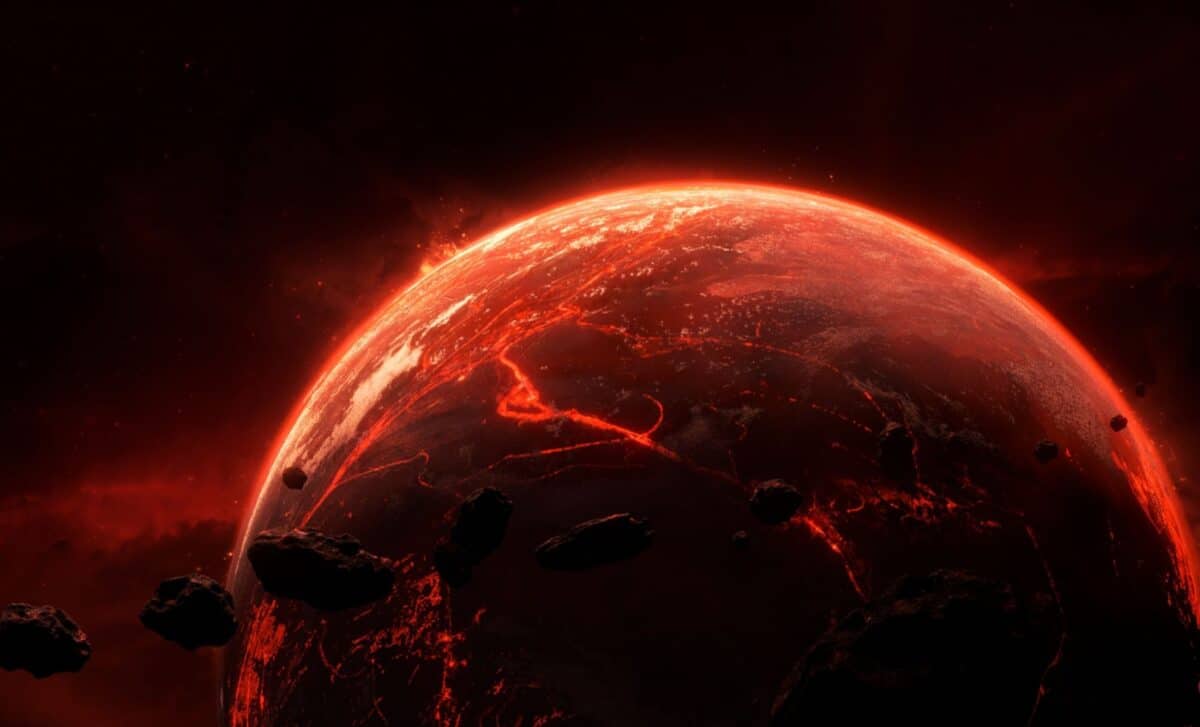
A rocky planet orbiting its star in just over 10 hours, a world so extreme it was assumed to be a barren, atmosphere-stripped rock, turns out to be wrapped in a thick, volatile-rich gas envelope. NASA’s James Webb Space Telescope has delivered what researchers are calling the clearest evidence yet that a rocky planet beyond our solar system can hold onto an atmosphere under conditions that should make that impossible.
The findings, published in The Astrophysical Journal Letters, center on TOI-561 b, an ancient super-Earth roughly twice the mass of our planet. The discovery doesn’t just rewrite what we know about this one world, it challenges a foundational assumption about how planetary atmospheres survive in the universe’s harshest environments.
For decades, the working assumption among planetary scientists was straightforward: small, intensely irradiated planets lose their gas envelopes early in their lives. TOI-561 b, orbiting a star more than twice the age of the Sun, appeared to be exactly the kind of world that confirmed that rule. Now, it’s the exception that may break it.
A Planet That Shouldn’t Have an Atmosphere, But Does
TOI-561 b sits at a staggering proximity to its host star, just one-fortieth the distance Mercury maintains from our Sun. One hemisphere is locked in permanent daylight, and the planet’s surface temperatures exceed the melting point of most rock-forming minerals. According to Carnegie Science Postdoctoral Fellow Nicole Wallack, the second author on the study, “astronomers would have predicted that a planet like this is too small and hot to retain its own atmosphere for long after formation.”
Yet JWST’s Near-Infrared Spectrograph measured the planet’s dayside temperature at roughly 3,200 degrees Fahrenheit, around 1,800 degrees Celsius, far below the nearly 4,900 degrees Fahrenheit expected for a bare rock with no atmosphere. That temperature gap of well over 1,000 degrees points strongly to heat redistribution, which requires a substantial atmospheric layer to pull it off.
The research team, led by Carnegie Science astronomer Johanna Teske, also noted that the planet’s density, at 4.3 grams per cubic centimeter, is lower than expected for an Earth-like composition, hinting at a volatile envelope inflating the planet’s apparent size. As Teske put it, “it is less dense than you would expect if it had an Earth-like composition.”
A “Wet Lava Ball” With a Self-Sustaining Atmosphere
The most compelling explanation the research team arrived at involves a dynamic equilibrium between the planet’s magma ocean interior and its atmospheric gases. According to co-author Tim Lichtenberg from the University of Groningen, “there is an equilibrium between the magma ocean and the atmosphere“, gases escape from the molten interior to feed the atmosphere, while the magma simultaneously reabsorbs them, creating a continuous recycling loop. “This planet must be much, much more volatile-rich than Earth to explain the observations,” Lichtenberg added. “It’s really like a wet lava ball.“
Co-author Anjali Piette of the University of Birmingham explained the cooling mechanics in detail: strong winds could transport dayside heat to the planet’s nightside, while gases like water vapor would absorb near-infrared light before it escapes into space. Bright silicate clouds may also play a role, reflecting starlight and cooling the atmosphere from above. According to Piette, “we really need a thick volatile-rich atmosphere to explain all the observations.”
The team’s modeling tested several atmospheric compositions, including pure water vapor, oxygen-dominated mixtures, and water-carbon dioxide blends, and found that volatile-rich compositions could reproduce the observed brightness temperatures. A bare-rock or thin rock-vapor surface was ruled out at high statistical significance across multiple independent data reductions.
Rewriting the “Cosmic Shoreline”
Perhaps the most far-reaching implication of the discovery is what it means for the so-called “cosmic shoreline”, the empirical boundary used to divide planets with atmospheres from those without. That boundary, derived largely from solar system observations, predicts that a planet with TOI-561 b’s high radiation exposure and low escape velocity should be thoroughly stripped of any gas. According to the study‘s authors, this JWST evidence places TOI-561 b in direct conflict with that prediction.
The planet orbits a thick-disk star, old, iron-poor, and chemically distinct from most stellar hosts studied so far making its formation environment unlike anything in our solar system. As Teske noted, “TOI-561 b is distinct among ultra-short period planets in that it orbits a very old — twice as old as the Sun — iron-poor star.” That unusual chemistry may hold clues about how volatile elements become locked into a planet’s interior rather than escaping to space.
The observations were drawn from more than 37 hours of JWST monitoring across nearly four complete orbits of the planet, and researchers are continuing to analyze the full dataset. According to Earth and Planets Laboratory Director Michael Walter, “there are more exciting results on the horizon.” For now, TOI-561 b stands as evidence that the universe’s most extreme rocky worlds are stranger, and more alive, than science had given them credit for.
First Appeared on
Source link




Leave feedback about this