

Wall Street staged a dramatic comeback Monday after oil prices plunged from earlier highs when President Donald Trump suggested the war with Iran could be nearing its end.
The Dow Jones Industrial Average, which had been down nearly 900 points earlier in the day, finished up 239 points after markets rallied in the afternoon.
The Nasdaq led the rebound, jumping 1.4 percent, while the S&P 500 rose about 0.8 percent.
Oil also swung sharply lower after Trump told CBS News the conflict was already ‘very far ahead of schedule’ and ‘very complete, pretty much.’
US crude had surged overnight above $119 a barrel – its highest level since the global energy shock triggered by Russia’s invasion of Ukraine in 2022.
But prices tumbled later in the day.
The US benchmark crude fell roughly 9 percent to around $81 a barrel, while global benchmark Brent crude dropped below $90 after the president’s remarks.
Markets were also helped by signs governments may step in to calm energy prices.
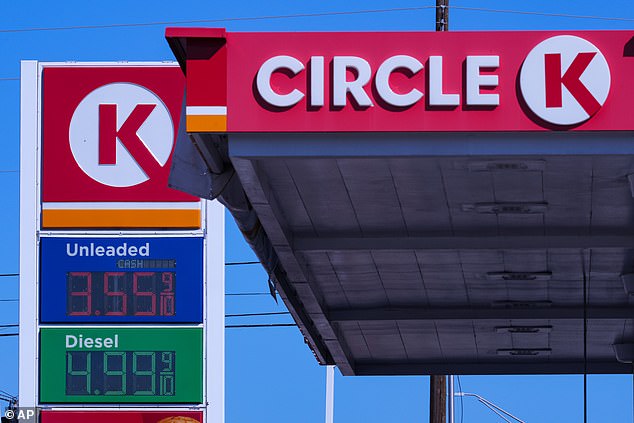
The price for gasoline and diesel fuel are shown at a gas station in Indianapolis today (Monday)
France’s finance minister said the Group of Seven major economies is prepared to release oil from strategic reserves if necessary to stabilize global markets after shipping disruptions in the Strait of Hormuz triggered a surge in prices.
The comments followed an emergency meeting of G7 finance ministers as Middle East producers cut output because tankers were unwilling to pass through the critical waterway.
The oil price surge on Sunday followed the largest weekly gain ever recorded for US crude, with prices jumping more than $40 a barrel in little more than a week.
There were fears the the record price for US oil – $145 a barrel reached in 2008 – was coming back into view.
In fact, Qatar’s energy minister Saad al-Kaabi warned prices could reach $150 a barrel if tankers remain unable to pass through the Strait of Hormuz.
But some investors believe the disruption may prove temporary.
BlackRock strategists said Monday that while the surge in oil prices will likely create volatility in financial markets, it may not derail the broader economic expansion if supply disruptions last weeks rather than months.
Still, spike is already hitting Americans in their wallets.
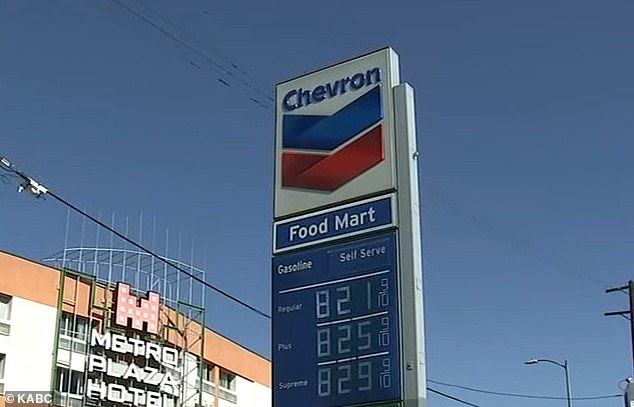
Gas prices across the United States surged to a national average of $3.47 per gallon, with California feeling the strain as prices climbed. At a Chevron station in downtown Los Angeles, prices were among the highest seen this week
The national average price of gasoline climbed to $3.47 a gallon today, according to AAA – up about 16 percent in just a week since the conflict began.
High-cost states such as Washington, Hawaii, and Oregon are seeing gas prices exceed $4 per gallon.
California, which has the highest average in the country is averaging $5.20 per gallon, according to AAA. At a Chevron station in Los Angeles, drivers were facing prices as high as $8.21 for a gallon of regular gas.
Cities such as Baltimore, Maryland, have seen their gas prices jump 55.5 cents in just a week at $3.49 a gallon, according to GasBuddy.
New York is hovering just below the national average, with prices at $3.40 per gallon – up 40 cents from $3.01 just a week ago. White Plains currently has some of the highest prices in the state at $3.48 per gallon.
Oil’s surge comes as the war has effectively closed the Strait of Hormuz, the narrow shipping route controlled by Iran through which roughly one-fifth of the world’s oil normally flows each day.
Kuwait – the fifth-largest producer in the Organization of the Petroleum Exporting Countries (OPEC) – announced precautionary cuts to its output because of what it called threats to ships passing through the Strait.
In Iraq, production from the country’s three main southern oilfields has reportedly collapsed by around 70 percent, dropping to about 1.3 million barrels a day from more than 4 million barrels before the war.
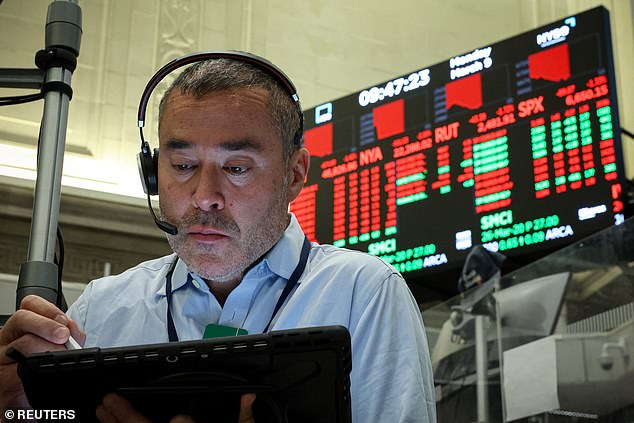
A trader reacts on the floor of the New York Stock Exchange as markets respond to rising energy prices and uncertainty over the war in Iran
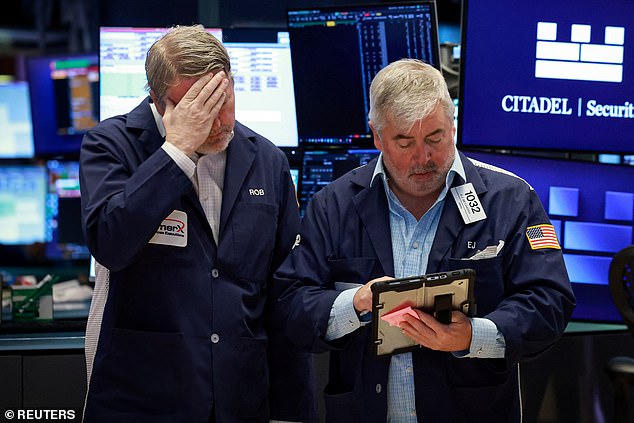
Traders react on the floor of the New York Stock Exchange as markets respond to rising energy prices and uncertainty over the war in Iran
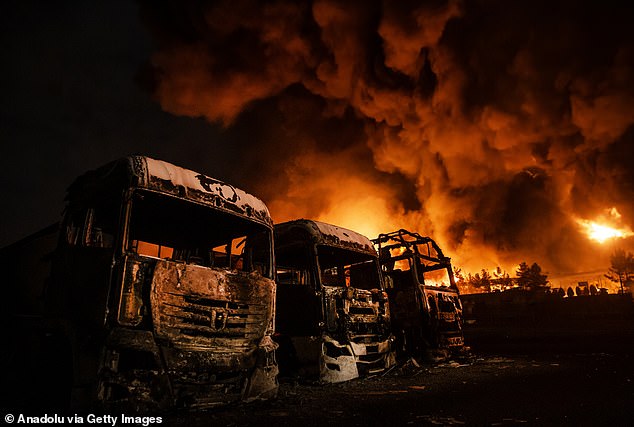
Fire breaks out at the Shahran oil depot after US and Israeli attacks, leaving numerous fuel tankers and vehicles in the area unusable in Tehran, Iran, on Sunday
Join the debate
How are soaring gas prices and oil turmoil changing the way you live and budget right now?
The United Arab Emirates has also said it is carefully managing offshore production as storage tanks begin filling up because oil cannot be shipped out.
The dramatic disruption has sparked urgent talks among major economies.
Finance ministers from the Group of Seven nations – including the United States, Britain, Germany, France, Italy, Canada and Japan – were expected to hold an emergency call Monday morning to discuss whether to release oil from strategic reserves to stabilize markets.
The move would mirror similar emergency actions taken during the energy crisis that followed Russia’s invasion of Ukraine.
Analysts say the situation in global energy markets is unlike anything seen before.
Neil Atkinson, a former head of oil markets at the International Energy Agency, warned the effective closure of the Strait of Hormuz could create an ‘unprecedented energy crisis.’
‘There is no precedent for this,’ he said Monday. ‘If the Strait remains closed and production stays shut in across the region, we are entering a crisis the likes of which we have never seen before.’
First Appeared on
Source link





Leave feedback about this