

Key Takeaways
- US stocks recovered from morning declines after European and Asian peers fell more sharply.
- Oil prices spiked to well over $100 per barrel before paring gains, after major regional producers cut energy production.
- US President Donald Trump said Sunday that higher oil prices were a “very small price to pay” for the destruction of Iran’s nuclear capabilities.
US equities fell on Monday as energy prices remained elevated, amid production cuts and an exchange of strikes on oil storage facilities throughout the Middle East. By midday, stocks were recovering some ground.
The Morningstar US Market Index fell as much as 0.60% after the open, but pared losses back to 0.24% in midday trading.
The Morningstar Europe Index slumped 0.94% in dollar terms on Monday, while Asian stocks closed nearly 3.90% lower. Market volatility, as measured by the Cboe Volatility Index, also spiked above 30 for the first time since April 2025’s tariff meltdown.
“Global equity markets have been dealt a significant blow as we kick off a new week, with traders waking up to the potential consequences of the Middle East conflict that only ever seems to deteriorate by the day,” says Joshua Mahony, chief market analyst at Scope Markets.
“While much of the past week was spent hoping that this would be a short-term conflict that ultimately resolves with oil flowing globally once again, the weekend targeting of Iranian oil facilities spells out a new phase to the conflict that ultimately brings significant consequences for the long-term supply dynamic once the dust settles,” Mahony adds.
Energy Price Spike Continues
Major Middle Eastern energy producers, including Kuwait, Iran, and the United Arab Emirates, cut production amid ongoing strikes in the region, while Bahrain Petroleum Company became the region’s second producer after Qatar to declare force majeure.
Qatar’s energy minister told the Financial Times last week that continued disruption to Gulf energy exports could drive oil prices to $150 a barrel within two to three weeks.
US President Donald Trump wrote in a Sunday post on Truth Social that increased oil prices were a “very small price to pay” for the destruction of Iran’s nuclear capabilities.
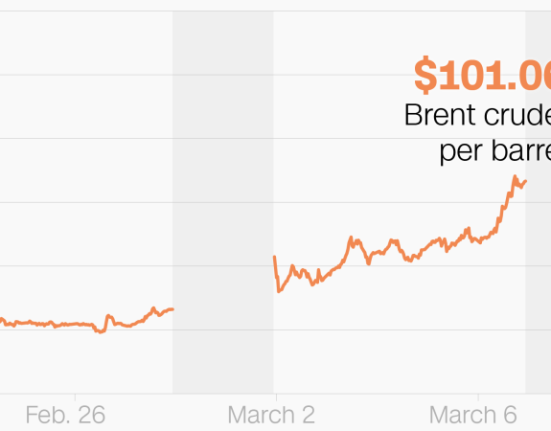
Brent crude oil prices jumped around 30% to nearly $120 per barrel in early Asian trading Monday before moderating after Saudi Arabia reportedly offered 4.6 million barrels of crude via a pipeline to Yanbu on the Red Sea, according to Bloomberg. In midday trading in US markets, Brent crude was up 8% at $100, while WTI crude was up 5% at $96.
On Monday, South Korea’s KOSPI benchmark triggered its second circuit breaker since the outbreak of the war, sparking a wider regional selloff, after a ruling party lawmaker warned that the country’s key chip industry was concerned about higher energy prices and supply disruptions hampering production of critical semiconductors.
Indeed, surging energy prices are driving fears of a broader spike in inflation, which analysts warn could weigh on interest rates. Over the past week, traders have shifted their expectations away from rate cuts and toward likely hikes from the European Central Bank and the Bank of England this year, and potentially fewer cuts from the Federal Reserve.
US Treasury yields ticked slightly higher on Monday amid a broadening global bond rout, with the 10-year benchmark rising 0.02 percentage points to 4.156%. Gold fell 1.5% to $5,091.
“History suggests marked and persistent spikes in the price of crude can trigger persistent inflationary cycles,” Bank of America analysts write in a note. “The initial base case with oil prices around $15 higher than the pre-war level was not particularly concerning for inflation. But the most recent escalation leading oil prices to rise above $100 could become concerning if it proves persistent.”
The United States’ greater energy security has seen it fare better than its European and Asian peers from the recent global rout, with investors reversing a recent ex-US trade and piling into the dollar.
“The US dollar saw strong inflows as investors sold their European and Asian holdings, reversing the earlier rotation trade, and moved back into the US dollar. The dollar has the advantage of naturally benefiting when energy prices rise, as most of the energy trade is denominated in dollars and rising energy prices increase the dollar demand, pushing its price higher,” says Ipek Ozkardeskaya, senior analyst at Swissquote Bank.
First Appeared on
Source link




Leave feedback about this