

February 28, 2026
UN chief condemns escalation as Security Council prepares to meet
The UN Security Council is scheduled to hold an emergency meeting in New York to discuss the US-Israeli strikes on Iran.
Ahead of the session, UN Secretary General Antonio Guterres strongly condemned the escalation in fighting and called on all parties to return to the negotiating table.
“I call for an immediate cessation of hostilities and de-escalation,” he said in a statement, adding that the US-Israeli bombing, as well as Iran’s counterattacks, had undermined global peace and security.
Earlier on Saturday, Iranian Foreign Minister Abbas Araghchi wrote a letter to the council, urging the body to “take immediate action in response to this breach of international peace and security.”
He said Iran would continue to retaliate by all means necessary and that “all bases, facilities, and assets of the hostile forces in the region shall be regarded as legitimate military objectives.”
https://p.dw.com/p/59auA
February 28, 2026
US military: No American casualties reported in Iran’s counterattacks
The US military says it has received no reports of combat casualties after Iran launched hundreds of missiles and drones in retaliation for a major US-Israeli attack.
“Damage to US installations was minimal and has not impacted operations,” the US Central Command said in a statement.
It said the US began striking targets in Iran on Saturday “to dismantle the Iranian regime’s security apparatus, prioritizing locations that posed an imminent threat.”
It said targets included Islamic Revolutionary Guard Corps command and control facilities, Iranian air defense capabilities, missile and drone launch sites, and military airfields.
The statement added that one-way attack drones had been used in combat for the first time.
https://p.dw.com/p/59arA
February 28, 2026
Reports: Iran Guards say Strait of Hormuz ‘basically’ shut
Iran’s Revolutionary Guards say the escalation in fighting in the region means the Strait of Hormuz is no longer safe and is essentially closed to traffic, according to media reports.
In a statement carried by the Tasnim news agency, the Guards said ships had been warned to stay away “due to the insecure atmosphere around the strait because of the military aggression by the US and Israel and the responses of Iran.”
“With the cessation of passage of ships and tankers through the Strait of Hormuz, the strait has been basically closed,” the statement added.
The Strait of Hormuz is a vital shipping route for oil and gas. Its closure is expected to see oil prices spike, with ramifications for the global economy.
Earlier Saturday, the UK Maritime Trade Organization said it was getting reports that multiple vessels had been receiving messages about the strait’s closure.
It said these messages were not legally binding and advised ships to “transit with caution.”
https://p.dw.com/p/59ap4
February 28, 2026
Attack on Iranian girls’ schooI ‘barbaric,’ Iran’s president says as death toll rises
Iranian President Masoud Pezeshkian decried the deadly air strike that hit a girls’ school in southern Iran and killed scores amid US and Israeli bombing on Saturday.
“This barbaric act is another black page in the record of countless crimes committed by the aggressors,” he said.
Iranian media reported a rising death toll on Saturday afternoon, although various outlets provided conflicting numbers.
Iran’s state-run IRNA news agency has reported that at least 57 people were killed and 45 others wounded. Other sources reported 63 deaths. But the Iranian government says the death toll is much higher. Iran’s judiciary’s Mizan Online website quoted the area’s prosecutor’s office as saying that over 80 had been killed.
“The number of martyrs at the girls’ school in Minab has increased to 85,” Mizan Online website reported.
https://p.dw.com/p/59amJ
February 28, 2026
Ships getting reports that Strait of Hormuz is closed, but no confirmation — UK agency
The UK Maritime Trade Operations agency (UKMTO) says multiple vessels operating in the Gulf have reported receiving messages about the closure of the Strait of Hormuz.
The vital waterway connects the Persian Gulf with the Gulf of Oman and the Arabian Sea, and serves as a trade route for a fifth of the world’s oil consumption.
According to the UKMTO, the reports of the Strait of Hormuz being closed could not be independently verified.
There was also no immediate confirmation from Iran, which has repeatedly threatened to close the major oil shipping route in the event of an attack.
Separately, an official from the EU’s naval mission Aspides who spoke to Reuters on condition of anonymity said vessels had been receiving transmission from Iran’s Revolutionary Guards saying “no ship is allowed to pass the Strait of Hormuz.”
If the reports of the closure are confirmed, oil prices could rise sharply, dealing a massive blow to the global economy.
Meanwhile, the US Transportation Department urged commercial vessels to steer clear of the Strait of Hormuz, Persian Gulf, Gulf of Oman and Arabian Sea due to “significant military activity” in the area.
https://p.dw.com/p/59amD
February 28, 2026
Witnesses report explosion at Dubai’s The Palm
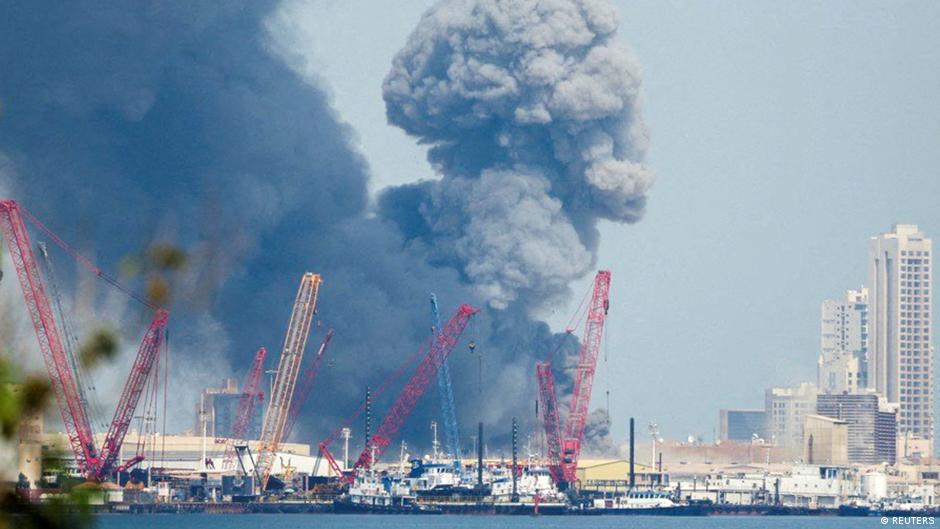
Two witnesses told AFP news agency that they had heard an explosion and seen a plume of smoke above Dubai’s famous man-made island, The Palm, amid Iran’s retaliatory strikes in the Gulf.
One witness said he saw thick black smoke rising from a hotel on the island and heard ambulances rushing toward the scene.
Dubai residents and AFP correspondents in the city heard several loud bangs after the explosion.
The Dubai authorities confirmed that an incident occurred in a building in the Palm Jumeirah area. They said that emergency response teams were deployed immediately and that the site has been secured.
“Dubai Civil Defence has confirmed that the resulting fire is now under control. Four individuals sustained injuries and have been transferred to medical facilities,” the Dubai Media Office said on X.
Meanwhile, a drone struck Kuwait‘s international airport, causing minor injuries to several employees and material damage to the passenger terminal, according to the civil aviation authority.
https://p.dw.com/p/59aYr
West Jerusalem residents talk about impact of war
DW correspondent Tania Krämer has spoken to people in West Jerusalem about the latest conflict between Israel and Iran, erupting just months after the last one in June 2025.
One man, Yonathan, spoke of feeling “pretty stressed.”
“I’ve been here during the last war with Iran, and it was a bit exhausting at a certain point. Just got to the shelter over and over again,” he said.
He said that while his mother was in favor of the war, he could not understand her point of view, and that he was “really against” it.
“I think it’s kind of useless, all of these rounds of Iran. Just Bibi [the nickname for Prime Minister Benjamin Netanyahu] [trying] to keep himself in office,” he said.
Nicola, a female resident of West Jerusalem, said that “[a]ll we can do is stay out of the way and hope it ends as soon as possible.”
She said she supported “being able to live in peace.”
“And if we don’t sleep for a week, but the result is everybody gets peace and freedom, then yeah,” she said. “But it’s complicated.”
https://p.dw.com/p/59aYm
February 28, 2026
Iran could become classic military dictatorship, expert warns
As the US and Israel launched a major attack on Iran, US President Donald Trump urged the Iranian people to “seize control of their destiny” and overthrow the Islamic leadership.
However, Hans-Jacob Schindler, an expert at the Counter Extremism Project, told DW that even if Iran’s supreme leder Ali Khamenei were to die or leave the country, “the regime could still function.”
He warned that the Iranian opposition was unarmed and disorganized. In contrast, he said the Revolutionary Guard had international connections, intelligence capabilities and both military and economic muscle that could allow it to outlast the religious hierarchy which is currently in power.
“So what is possible is that while the regime cannot survive without the Guards, the Guards can certainly function without the regime,” Schindler said.
This could make Iran transition “from a religiously infused oligarchy that we have in Iran right now into a classic military dictatorship,” according to the expert.
https://p.dw.com/p/59aRa
February 28, 2026
Ayatollah Khamenei alive ‘as far as I know,’ Iran’s foreign minister tells US broadcaster NBC
Iranian Foreign Minister Abbas Araghchi has told US broadcaster NBC that Tehran wanted de-escalation and was willing to talk when US and Israeli strikes on Iran come to an end.
“There is no communication right now,” Araghchi said, speaking from Tehran. “But if Americans want to talk to us, they know how they can contact me. We are certainly interested [in] de-escalation,” he said.
“This is a war of choice by the United States, and they have to pay for that,” he added. “But as far as we are concerned, we don’t want war.”
He said Iran, in contrast with the US, was only attacking military installations and that “once the aggression is stopped, we would also stop our self-defense.”
Araghchi also said two Iranian commanders had been killed but “all high ranking officials are alive. So everybody is now in its position, and we are handling this situation, and everything is fine.”
In particular, Araghchi said that the country’s supreme leader and president were alive “as far as I know.”
The foreign minister also criticized the US and Israel for launching the attack despite ongoing nuclear negotiations.
https://p.dw.com/p/59aXP
February 28, 2026
Starmer says UK planes joined ‘defensive operations’ in Middle East
UK Prime Minister Keir Starmer said that British planes were “in the sky today” in the Middle East “as part of co-ordinated regional defensive operations to protect our people, our interests and our allies.”
In a short televised statement, the British leader said that this was “in line with international law.”
Starmer added that Iran should refrain from further strikes and cease violence and oppression against its people.
He also stressed the importance of preventing further escalation and returning to diplomacy.
https://p.dw.com/p/59aWh
February 28, 2026
READ: What are Trump’s objectives in Iran?
While announcing the attacks on Iran on Saturday, US President Donald Trump listed four key military objectives the US was trying to achieve.
“Our objective is to defend the American people by eliminating imminent threats from the Iranian regime,” Trump said in the video message.
“We will ensure Iran does not obtain a nuclear weapon,” he added.
Trump also said the US campaign would obliterate Iran’s ballistic missile program and its navy.
The US president also announced the goal of toppling the Islamic regime, calling on Iranians to take over the government.
DW spoke to analysts about whether these targets can be achieved. Read our full story here.
https://p.dw.com/p/59aRj
February 28, 2026
Trump lost patience with Iran, ex-NATO official tells DW
Former NATO official William Alberque says he was “quite surprised” by the eruption of fighting between the US, Israel and Iran given that there appeared to be progress in their nuclear talks.
“I imagine the US is going to continue to intensify attacks. Israel will as well,” Alberque said in an interview with DW News. “It remains to be seen whether Israel or the United States will attempt any commando insertions … to kill or capture Iranian government officials.”
He stressed that the situation is still very much in the early phase and it was still unclear “how far Iran is willing to escalate and how long and how complex the US operation will be.”
Alberque, who is currently a senior fellow at the foreign policy research institute Pacific Forum, said Tehran had misjudged the situation during recent Oman-mediated negotiations with the US.
“Iran decided to try to continue to build leverage, to continue to move towards nuclear weaponization during these talks, and they lost (US President Donald) Trump’s patience in this occasion,” he said. “They did not build leverage. It was a gamble and it did not pay off.”
https://p.dw.com/p/59aR4
February 28, 2026
Berlin, Paris, London condemn Iran in joint statement
Germany,France and Britain have said they “condemn Iranian strikes on countries in the region” and called for negotiations between the US and Iran to resume.
Notably, the statement did not comment on the US and Israeli attacks on Iran on Saturday.
The three European countries said Tehran “must refrain from indiscriminate military strikes.”
“We call for a resumption of negotiations and urge the Iranian leadership to seek a negotiated solution. Ultimately, the Iranian people must be allowed to determine their future,” they said.
The statement by German Chancellor Friedrich Merz, French President Emmanuel Macron and British Prime Minister Keir Starmer said none of their countries had participated in the strikes but were all in close contact with the US and Israel.
“We reiterate our commitment to regional stability and to the protection of civilian life,” the leaders said, adding that they had consistently urged Iran to end its nuclear and missile programs and to stop its violent repression of its people.
https://p.dw.com/p/59aR5
February 28, 2026
Abu Dhabi says civilian killed in Iranian strike
As several Gulf countries confirm strikes by Iranian missiles on their territory, state media in the United Arab Emirates have reported one civilian death in a residential area caused by falling debris.
The Emirati state news agency WAM said the Iranian strike, which was reportedly repelled along with a second wave of missiles, also caused material damage.
Like a number of other Gulf countries, Abu Dhabi hosts US troops — the Al Dhafra Air Base is home to the US 380th Air Expeditionary Wing.
The UAE said it had temporarily closed its airspace as a precaution.
https://p.dw.com/p/59aP2
February 28, 2026
Cyprus standing ready to help EU nationals flee violence
Cyprus has said it has activated its Foreign Ministry’s emergency action plan to help EU and third-country nationals take refuge from the violence engulfing the Middle East region.
“We are closely monitoring the developments in the region and remain in constant contact with our diplomatic missions on the ground,” Cypriot Foreign Minister Constantinos Kombos wrote on the messaging platform X.
“In light of this situation, the special national plan ESTIA has been activated. ESTIA is the ministry of foreign affairs’ emergency action plan, enabling the safe evacuation of EU and third-country nationals from nearby crisis areas in the wider Middle East via Cyprus.”
“The Ministry’s Crisis Management Department also remains active and ready to respond as developments unfold,” he added.
Cyprus is the EU state that is closest to the Middle East, being barely an hour’s flight from Lebanon, and has often served as a stepping stone for people evacuated from the region when conflicts break out.
https://p.dw.com/p/59aDj
First Appeared on
Source link





Leave feedback about this