

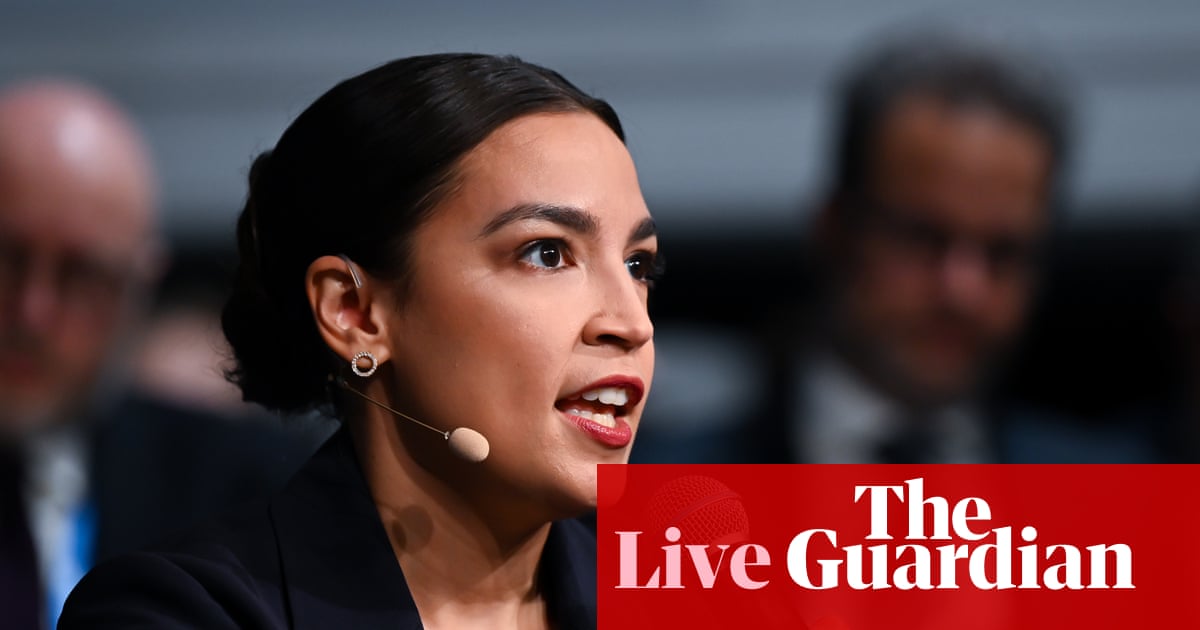
Ocasio-Cortez says unconditional US military aid to Israel ‘enabled a genocide in Gaza’
At a Munich security conference panel which just concluded, Hagar Shezaf of the Israeli newspaper Haaretz asked Alexandria Ocasio-Cortez if she thinks “the Democratic presidential candidate in the 2028 elections should re-evaluate military aid to Israel”.
“To me this isn’t just about a presidential election,” Ocasio-Cortez replied, “personally, I think that the United States has an obligation to uphold its own laws, particularly the Leahy laws.
“I think that, personally, the idea of completely unconditional aid, no matter what one does, does not make sense,” she added. “I think it enabled a genocide in Gaza, and I think that we have thousands of women and children dead … that was completely avoidable.
“So I believe that enforcement of our own laws, through the Leahy laws, which requires conditioning aid in any circumstance when you see gross human rights violations is appropriate,” Ocasio-Cortez concluded.
The Leahy laws are two statutory provisions, named for the former senator Patrick Leahy who introduced them in the 1990s, which prohibit the US defense department and state department from providing funds to “units of foreign security forces where there is credible information implicating that unit in the commission of gross violations of human rights”.
But, according to Charles Blaha, the former director of the state department office that leads Leahy vetting of foreign security units, while state “department officials insist that Israeli units are subject to the same vetting standards as units from any other country. Maybe in theory. But in practice, that’s simply not true.”
Key events
As Trump says regime change in Iran ‘would be the best thing’, US military reportedly prepares to attack
As Donald Trump seemed to endorse regime change in Iran, embracing a long-term goal of his ally, Israeli prime minister Benjamin Netanyahu, Reuters reports that the US military “is preparing for the possibility of sustained, weeks-long operations” against Iran’s theocratic government.
When Trump was asked on Friday: “Do you want regime change in Iran?” the president replied: “Well, it seems like that would be the best thing that could happen.”
Trump then pointed out that the US had deployed a large force to the region. “We have tremendous power has arrived, and additional power, as you know, another carrier is going out shortly, “ he said.
“If we could get it settled for once and for all, that’d be good,” the president said, after describing casualties Iran’s government was responsible for, without saying where.
Asked, “Who would you want to take over?” Trump said: “I don’t want to talk about that.”
“There are people,” he added.
According to US officials who spoke to Reuters, the US military is preparing for what could become a far more serious conflict than previously seen between the countries.
US and Iranian diplomats held talks in Oman last week in an effort to revive diplomacy over Tehran’s nuclear program, which Trump claimed to have “obliterated” in strikes last year.
During his first term, Trump withdrew from the nuclear deal that barred Iran from making nuclear weapons in exchange for sanctions relief even though his own administration had confirmed that Iran was in compliance.
US officials said on Friday the Pentagon was sending an additional aircraft carrier to the Middle East, adding thousands more troops along with fighter aircraft, guided-missile destroyers and other firepower capable of waging attacks and defending against them.
Trump said in an address to US troops in North Carolina on Friday it had “been difficult to make a deal” with Iran. “Sometimes you have to have fear. That’s the only thing that really will get the situation taken care of,” Trump said.
Ordering an attack on Iran would cut against the opposition to “regime change wars” in the Middle East Trump voiced during his first campaign for the presidency, in 2016.
But his ally Netanyahu has spent decades trying to convince a US president to attack Iran.
In 2002, Netanyahu, who was then between terms as Israel’s prime minister, testified to Congress in support of a US invasion of Iraq, arguing that it would bring about the end of Iran’s theocratic state as well.
“It’s not a question of whether Iraq’s regime should be taken out but when should it be taken out; it’s not a question of whether you’d like to see a regime change in Iran but how to achieve it,” Netanyahu said six months before the Bush administration began the “shock and awe” bombardment of Baghdad.
“If you take out Saddam, Saddam’s regime, I guarantee you that it will have enormous positive reverberations on the region,” Netanyahu said then. “And I think that people sitting right next door in Iran, young people, and many others, will say the time of such regimes, of such despots is gone.”
Trump administration releases some frozen funding for Hudson tunnel project
The Trump administration released $30m from the $205m in federal funding it had frozen for the $16bn Hudson Tunnel Project in New York after New York and New Jersey sued to challenge the decision.
According to Chuck Schumer, the Democratic senator from New York, Donald Trump sought to use the frozen funds as leverage, suggesting that he would release the funds if Schumer agreed to get the name of Penn Station in New York changed to Trump Station.
New York and New Jersey went to court after Trump’s Department of Transportation would not commit to releasing the funds.
A US appeals court on Thursday declined to undo a lower court order requiring the funding, which had been frozen in October and forced the project to halt construction last week.
The Gateway Development Commission which is overseeing construction of the project, thanked “New York and New Jersey for their support in restoring our access to the federal funding” in a statement on Friday.
“We have received an initial disbursement of $30 million from the federal government and expect to receive the full $205 million in reimbursement funds,” the commission said. “Construction remains paused for now, and we are working with our contractors to plan how to deploy these funds in the most effective way and get workers back on the job to resume some construction as soon as possible.”
A federal judge, Jeannette Vargas, ordered the federal government last week to release funds for the project to overhaul critical rail infrastructure in New York and New Jersey, which had been frozen by Trump in October.
Jacqueline Sweet
Ro Khanna, a California Democratic representative, read a list of six names on the House floor earlier this week and said they were “wealthy, powerful men that the DoJ hid” in the recently released files related to Jeffrey Epstein. After questions from the Guardian, the Department of Justice said that four of the men Khanna named have no apparent connection to Epstein whatsoever, but rather appeared in a photo lineup assembled by the southern district of New York (SDNY).
Khanna, along with Thomas Massie, a Kentucky Republican representative, pushed the justice department to unredact names in the files, arguing that some names were being unlawfully redacted. Massie claimed credit on X earlier this week for forcing the justice department to remove redactions on a file that listed 20 names, birthdays and photos, including those of Epstein and Ghislaine Maxwell. Khanna then read some of those names on the House floor.
Two of the six men Khanna mentioned are Sultan Ahmed bin Sulayem, who has since resigned as CEO of DP World and an Emirati billionaire businessperson, and Leslie Wexner, a billionaire retail magnate, but the other four names did not appear to have any public profile.
Trump threatens to impose voter ID for midterm elections, ‘whether approved by Congress or not!’
In a series of messages posted on his social media platform from Air Force One on Friday, Donald Trump threatened to impose a requirement that US voters present photo identification before being allowed to cast ballots in the upcoming midterm elections.
This change, Trump insisted, would be made even if Congress fails to pass a law to alter voting requirements in a way that would seem to violate the US constitution, which leaves the conduct of elections to the states.
“There will be Voter I.D. for the Midterm Elections, whether approved by Congress or not!” Trump posted.
“Also, the People of our Country are insisting on Citizenship, and No Mail-In Ballots, with exceptions for Military, Disability, Illness, or Travel,” the president added, untruthfully, since there is no popular majority for banning vote by mail.
In fact, polling conducted last year showed the exact opposite: that 58% of Americans favor allowing any voter to cast their ballot by mail if they want to.
Although the president claimed to have “searched the depths of Legal Arguments not yet articulated or vetted on this subject, and will be presenting an irrefutable one in the very near future” that would allow the federal government to take unprecedented control of elections run by the states, in a second post during his flight to his Palm Beach resort, he offered more hyperbole than facts, is a long diatribe punctuated with all-caps words.
“We cannot let the Democrats get away with NO VOTER I.D. any longer. These are horrible, disingenuous CHEATERS,” Trump wrote.
“If we can’t get it through Congress, there are Legal reasons why this SCAM is not permitted. I will be presenting them shortly, in the form of an Executive Order,” Trump added.
“I hope the Supreme Court realizes, as they ‘painstakingly’ review the very simple topic of Country Saving Tariffs … that these Corrupt and Deranged Democrats, if they ever gain power, will not only be adding two States to our roster of 50, with all of the baggage thereto, but will also PACK THE COURT”, the president posted.
Ocasio-Cortez says unconditional US military aid to Israel ‘enabled a genocide in Gaza’
At a Munich security conference panel which just concluded, Hagar Shezaf of the Israeli newspaper Haaretz asked Alexandria Ocasio-Cortez if she thinks “the Democratic presidential candidate in the 2028 elections should re-evaluate military aid to Israel”.
“To me this isn’t just about a presidential election,” Ocasio-Cortez replied, “personally, I think that the United States has an obligation to uphold its own laws, particularly the Leahy laws.
“I think that, personally, the idea of completely unconditional aid, no matter what one does, does not make sense,” she added. “I think it enabled a genocide in Gaza, and I think that we have thousands of women and children dead … that was completely avoidable.
“So I believe that enforcement of our own laws, through the Leahy laws, which requires conditioning aid in any circumstance when you see gross human rights violations is appropriate,” Ocasio-Cortez concluded.
The Leahy laws are two statutory provisions, named for the former senator Patrick Leahy who introduced them in the 1990s, which prohibit the US defense department and state department from providing funds to “units of foreign security forces where there is credible information implicating that unit in the commission of gross violations of human rights”.
But, according to Charles Blaha, the former director of the state department office that leads Leahy vetting of foreign security units, while state “department officials insist that Israeli units are subject to the same vetting standards as units from any other country. Maybe in theory. But in practice, that’s simply not true.”
Ocasio-Cortez says Ukraine should lead on peace talks but ‘we shouldn’t reward imperialism’
Asked to define what victory in Ukraine should look like, Alexandria Ocasio-Cortez said that the Ukrainians should lead any peace talks. “There’s no conversation about Ukraine that can happen without Ukraine. So they of course lead in terms of setting their terms,” she said. “Overall as a principle, we shouldn’t reward imperialism.
“I don’t think that we should allow Russia or any nation to continue violating a nation’s sovereignty and to continue to be rewarded,” the congresswoman added.
Ocasio-Cortez says radical changes in US foreign policy undermines trust of allies as we ‘play hokey pokey’ joining and leaving agreements
Asked at the Munich security conference about declining trust in the United States as a reliable ally, Alexandria Ocasio-Cortez agreed that it has been damaging to have radical shifts in US policy, as Trump first withdrew from international agreements during his first term, then Biden rejoined pacts only for Trump to return and pull the US out again.
“US foreign policy and some of our more basic and foundational values-based commitments seem to be enacted based on the partisanship of whoever is elected,” Ocasio-Cortez said.
“We play hokey pokey,” the congresswoman continued, “with USAID, with the Paris Climate agreement, with many of our commitments, and I don’t think that is good for the country. I think that what is best is for when we sign an agreement, and we’re a part of it, we stay in it so they know that our commitments are reflective of our nation’s values in a way that transcends partisanship.”
Speaking in Munich, Whitmer focuses largely on Michigan
Despite speculation that she might enter the 2028 race for the presidency, Michigan’s governor, Gretchen Whitmer, has focused her remarks at the Munich security conference largely on the impact of Trump’s trade war with Canada on her own state.
“Michiganders love Canadians and we are absolutely interwoven,” Whitmer said as she discussed what she described as intense anger from Canadians at Trump’s tariffs.
In Munich panel, Alexandria Ocasio-Cortez and Gretchen Whitmer assail Trump for damage to US standing in the world
Two potential Democratic candidates for the presidency in 2028, Gretchen Whitmer, the governor of Michigan, and Alexandria Ocasio-Cortez, the New York congresswoman, just criticized the damage Donald Trump has done to US foreign relations in their opening remarks on a panel discussion now in progress at the Munich security conference that just started.
Whitmer focused on the impact to her state’s economy by the tariffs Trump has imposed on Canada, and mentioned the economic importance of the auto manufacturing that takes place across the border between Detroit and Windsor, Ontario.
Trump has recently threatened to block the opening of a new, Canadian-financed bridge between Detroit and Windsor that he supported in his first term.
Ocasio-Cortez began by saying that the United States is “very much in a compromised position” as a result of Trump’s policies, which have “strained” relations with European allies and abandoned a committment to human rights.
“Tariffs of course have hurt Americans,” she added, and further damaged relations with US allies.
“We are shocked at the president’s destruction of our relationship with our European allies,” Ocasio-Cortez said, “his threatening over Greenland is not a joke, it is not funny, it threatens the very trusted relationships that allows peace to persist.”
“The vast majority of the American people do not want to see these relations frayed,” the New York congresswoman said.
The third member of the panel, defending Trump’s foreign policies is Matthew Whitaker, who served in the first Trump administration and is now US ambassador to the North Atlantic Treaty Organization.
Here’s a recap of the day so far
-
Lawmakers in the House and Senate left Washington as the Department of Homeland Security (DHS) careens towards another as shutdown stopgap funding lapses tonight. Nearly all Democrats blocked a second attempt to pass the annual DHS appropriations bill as negotiations for guardrails on federal immigration enforcement have stalled.
-
Homeland security secretary Kristi Noem announced the end of temporary protected status (TPS) for Yemen on Friday. According to the National Immigration Forum, there are about 1,380 Yemeni nationals living and working in the country with TPS. The designation will officially terminate for Yemeni immigrants 60 days after the notice is published in the Federal Register.
-
The annual rate of US inflation eased in January, according to the latest data consumer price index report from the Bureau of Labor Statistics (BLS). Over the last 12 months, the cost of goods has increased by 2.4% – down from 2.7% in last month’s report.
-
The Department of Justice filed a new lawsuit against Harvard University, accusing it of failing to hand over documents and comply with a federal investigation into alleged racial discrimination in its admissions process. Harvard stressed in a statement that it was responding to inquiries “in good faith” and prepared to engage “according to the process required by law”. The justice department accuses Harvard of failing for over 10 months to comply with the government’s request to provide documents, including applicant-level admissions data, and other records and information pertaining to the investigation.
-
US Citizenship and Immigration Services (USCIS) expects to spend an estimated $38.3bn on a plan to acquire warehouses across the country and retrofit them into new immigration detention centers with capacity for tens of thousands of detainees, according to documents the agency sent to the governor of New Hampshire. The documents, published on the state’s website yesterday, disclose that the Department of Homeland Security estimates it will spend $158m retrofitting a new detention facility in Merrimack, plus an additional estimated $146m to operate the facility in the first three years.
-
A federal judge has ordered the DHS to guarantee that immigrants held at the Bishop Henry Whipple federal building can speak with a lawyer before they are transferred out of Minnesota. Judge Nancy Brasel, a Trump appointee, chided the administration and called its failure to provide detainees at the Minneapolis holding facility a meaningful chance to consult counsel an “unconstitutional infringement”.
First Appeared on
Source link


Leave feedback about this