

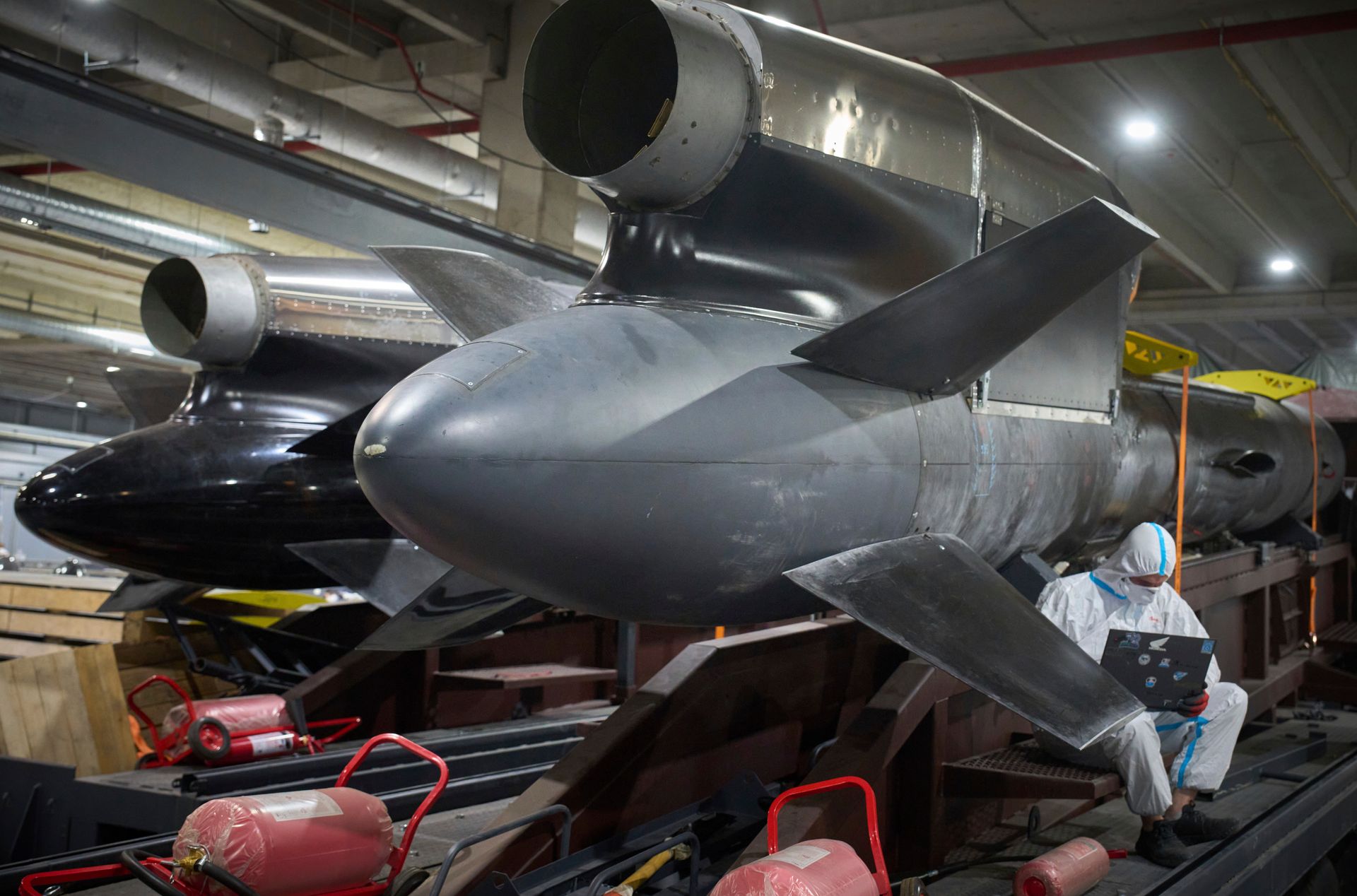
Workers inspect Flamingo cruise missiles at Fire Point’s secret factory in Ukraine, on Aug. 18, 2025. (AP Photo / Efrem Lukatsky)
Ukraine has increasingly reported using domestically produced Flamingo cruise missiles since November 2025, with the General Staff most recently saying it hit a key missile factory in Russia.
While the FP-5 Flamingo’s actual capability has been a subject of debate, the reported strikes on Russian-occupied territories and deep inside Russia may signal that Ukraine could expand its use of the missiles for attacks on high-value Russian targets.
The General Staff on Feb. 21 confirmed using Flamingo missiles in its overnight attack on the Russian state-owned Votkinsk missile plant, located about 1,400 kilometers (870 miles) from Ukraine.
Kyiv has been vocal about Flamingo since the summer of 2025, with President Volodymyr Zelensky calling it Ukraine’s “most successful missile” with a range of 3,000 kilometers (1,864 miles). He claimed then that mass production of Flamingo missiles would begin in the winter of 2025-2026.
Ukraine first reported Flamingo’s deployment in November 2025, but Kyiv remains secretive about the missiles’ details or how they will be used, citing operational secrecy.
Everything released so far from the Feb. 20-21 attack, including videos of Flamingos being launched and target impact, points toward the use of Flamingos rather than other potential weapons, according to Fabian Hoffmann, a Doctoral Research Fellow at the University of Oslo who researches missile technology, nuclear strategy, and defense policy.
“The attack on Friday night (Feb. 20-21) marks the first time that Ukraine has successfully struck a core target of Russia’s missile industry directly using a heavy missile capability,” Hoffmann said in his blog posted on Feb. 25.
While Ukraine has so far heavily relied on long-range drones to strike high-value targets inside Russia, Hoffmann said it would likely also increase dependence on missile systems such as Flamingo to “complement deep strike arsenal,” in efforts to penetrate the Russian air defense.
Outmanned and outgunned on the battlefield, Ukraine has tried to grind down the Russian military’s capability from afar, regularly targeting military targets, oil refineries, and airbases with homemade drones. The direct impact on the Russian army, which is currently on the offensive in multiple axes of the front, is difficult to gauge. Ukraine began to ramp up its long-range drone and missile production as Western allies hesitated to provide deep-strike capability, citing fears of Russian retaliation.
Ukraine’s future reliance on Flamingo depends on the production capacity of its manufacturer, Fire Point, and the missile’s capabilities, Hoffmann said.
A brief period of radio silence followed what appeared to be Kyiv’s “exaggerated advertisement” of Flamingo missiles in summer 2025, Hoffman said, but he added the February strike on the Russian missile plant showed that they can strike high-value targets in the deep rear, protected by Russian air defense.
“The question now is how many missiles Firepoint can produce and provide to the Ukrainian Armed Forces and then how that will affect how many will be launched and what types of targets they will hit,” Hoffmann said.
Several factors may have affected Flamingo’s production capacity.
Russia also appears to have been targeting Fire Point facilities in its attacks against Ukraine. Zelensky said in a Feb. 23 interview that a Russian strike on a Ukrainian manufacturing facility temporarily delayed the rollout of Flamingo missiles, confirming that a factory producing them had been hit.
“There was a delay in production. Later, production resumed, and a certain number of missiles were built,” Zelensky told German broadcaster Tagesschau.
Zelensky stressed that Ukraine expects the Flamingo production to continue increasing despite the attack on the plant, saying that the missiles have already been used in strikes on targets inside Russia.
Flying significantly faster than long-range drones, Flamingo missiles are harder for Russian air defenses to intercept, despite some features that make them vulnerable to Russian radar, according to Hoffmann.
Compared to long-range drones, which typically have a speed of around 250 to 350 kilometers (about 155 miles to 217 miles) per hour, Flamingo missiles — flying at a high supersonic speed of around 1,000 kilometers (about 620 miles) per hour — have a much higher velocity to accelerate into a target, he added.
“(A long-range drone) basically explodes at the outer layers, whereas with Flamingo, you have a pretty decent chance that it will penetrate first into the targeting and then explode, and then you maximize damage that way,” Hoffmann said, explaining how they can penetrate deeper into the targets.
Flamingo’s biggest strength is likely its yield, with a large warhead of over 1,100 kilograms, of which around half are high explosives, which is 10 times that of long-range drones, Hoffmann said.
“So if that thing lands at the target, it hurts a lot more than when you land a long-range drone,” Hoffmann said.
While Ukrainian officials remain vague about Flamingo missiles’ potential, experts say the recent reported results could bolster Kyiv’s efforts to hit key Russian military targets from afar with long-range drones.
“Ideally, from a Ukrainian perspective, you want to continue to build massive numbers of long-range drones, but you also want to move in a direction where you can complement this deep strike arsenal with a heavy missile capability like Flamingo, Long Neptune, and Sapsan,” Hoffmann said.
Fire Point has not been without controversy.
The National Anti-Corruption Bureau (NABU) has been investigating the company over concerns that it inflated the components’ value or the number of drones it delivers to the army, or both, sources with knowledge of the investigation told the Kyiv Independent in August.
Weapon production has been kept a wartime secret, making it difficult for independent investigations to scrutinize money flows. Fire Point confirmed to the Kyiv Independent that the investigation exists but denied the accusations, downplaying its significance.
First Appeared on
Source link






Leave feedback about this