

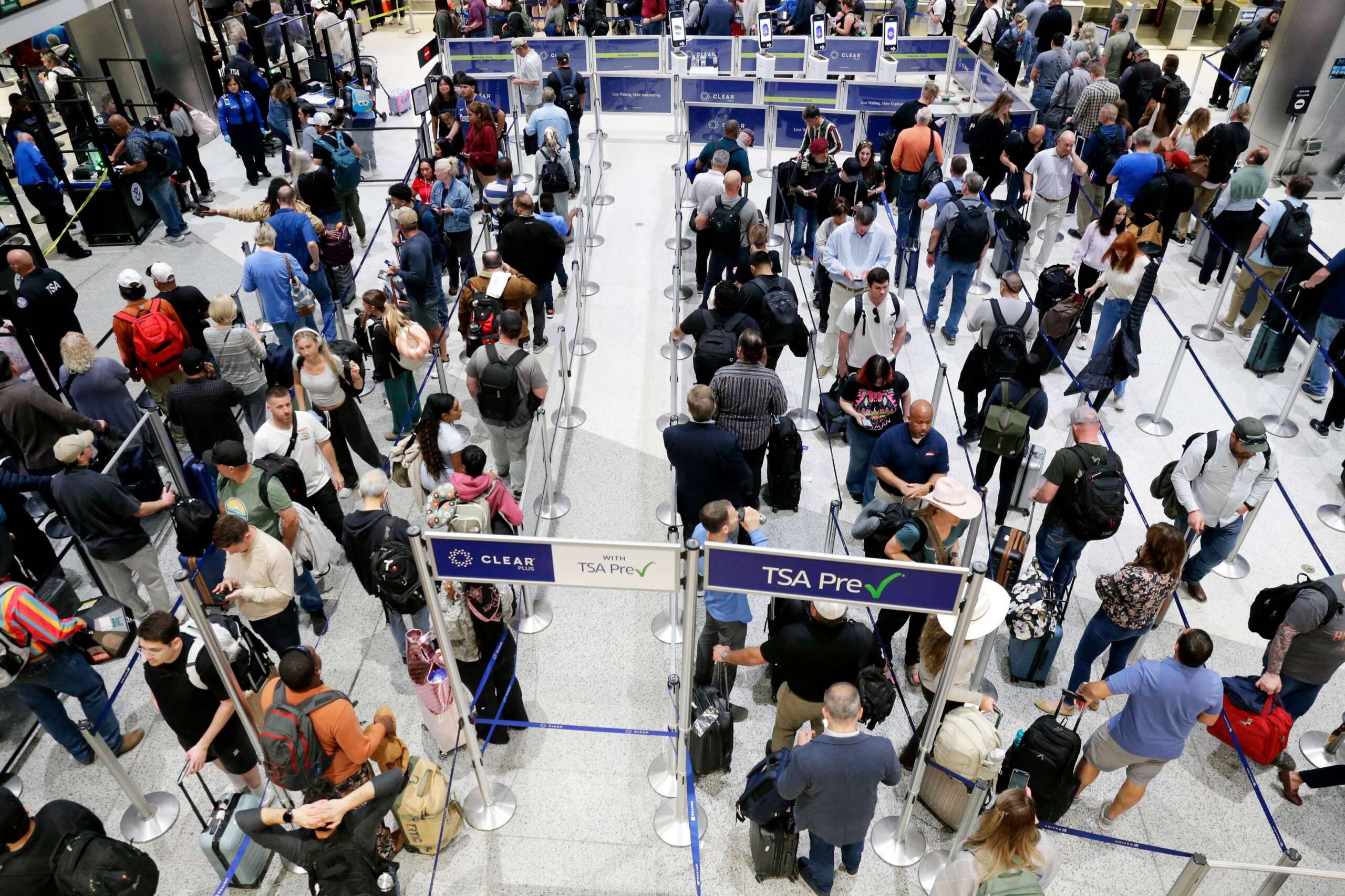
Transportation Security Administration employees say they are at a “breaking point” with TSA staff preparing to miss a third paycheck this week, as employee unions again push for legislation that would ensure federal workers get paid during a shutdown.
The ongoing Department of Homeland Security shutdown stretched to its 39th day on Tuesday. More than 400 TSA employees have left the agency during the shutdown, while thousands more have started calling out of work, leading to long security screening lines at some airports.
The Trump administration has now deployed Immigration and Customs Enforcement officers to airports to nominally help bolster TSA’s ranks. ICE agents are being paid during the shutdown due to funding the agency received in last year’s tax and reconciliation bill.
But union representatives for TSA’s transportation security officers say ICE has done little to help with the situation.
“That’s like giving a person dying of pneumonia a teaspoon of cough syrup,” Everett Kelley, national president of the American Federation of Government Employees, said during a press call today. “It doesn’t address the problem, and it’s not going to work.”
Johnny Jones, the secretary-treasurer of AFGE’s TSA Council 100, called the deployment of ICE officers “a straight-up distraction” to how TSA officers are going to work without being paid. TSA employees and many other DHS staff will miss a third paycheck of the shutdown on Friday, unless lawmakers quickly reach a funding deal.
“The ICE officers are being paid,” Jones said. “This is kind of an insult to the employees. I’ve heard all kinds of negatory feedback in regards to that.”
Aaron Barker, president of AFGE Local 554, which represents TSOs in Georgia, pointed to the Trump administration’s efforts to disband TSA union rights and potentially shift to more privatized airport security screening.
“It has always been about privatization,” Barker said. “I believe this is a play to try to move in that direction, and I just don’t think that this is going to end well with ICE going into the airports.”
Meanwhile, Barker said TSA is likely to see more attrition in the coming weeks, while the agency may have a difficult time recruiting given the difficulties the workforce has faced over the past year.
“It’s going to be hard to recruit people to come to TSA, and you may even still see more officers leave after this,” Barker said. “October is six months away, and we may be facing this same shutdown fiasco again. No one wants to continue to live their life with this amount of uncertainty and undue stress to no fault of their own.”
Many TSA employees had just financially recovered from last fall’s record-long government shutdown when the DHS lapse in appropriations began in February. With bills adding up, some employees have turned to selling plasma, according to Mac Johnson, executive vice president of AFGE TSA Council 100.
Jones noted TSA employees have spent roughly half of fiscal 2026 – which began Oct. 1 – under a government shutdown.
“Most employees live paycheck to paycheck, so they’ve missed these paychecks for the last month and a half, and then before it was a month and a half again, so this is unsustainable,” Jones said.
Sean Root, executive secretary of AFGE Local 1260, which covers airports in California, California, Nevada and Arizona, said many TSA employees exhausted their emergency funds during last year’s shutdown. He said TSA employees appreciate the donations from local communities, but noted even those have started drying up.
“They helped us out a ton during the last shutdown, and it’s not the community’s responsibility to make sure that people can get to work for their jobs,” Root said. “We have another round of rent and mortgages coming up. And these landlords, they don’t want to hear, ‘We’ll pay you later.’”
“There’s only so much that these people can take until there’s a breaking point, and I think we’re at that breaking point,” Root added.
As tepid reports of a potential funding deal broke Tuesday afternoon, Jones noted TSA employees will continue feeling the effects of a shutdown even after it ends. He said it took between 14 and 30 days for TSA staff to receive back pay after the last shutdown.
And he added that back pay doesn’t cover the costs of late fees or other extra costs that TSOs might incur while they’re not getting paid.
On Monday, AFGE and other federal employee unions wrote House and Senate lawmakers to advocate for passage of the Shutdown Fairness Act. The bill would allow agencies to pay federal employees who continue working through a government shutdown.
Meanwhile, Kelley said no member of Congress should fly home for Easter recess until lawmakers come up with a funding deal.
“Do not get on a plane that a TSA officer screened for free and fly home for Easter dinner,” Kelley said.
Copyright
© 2026 Federal News Network. All rights reserved. This website is not intended for users located within the European Economic Area.
First Appeared on
Source link






Leave feedback about this