

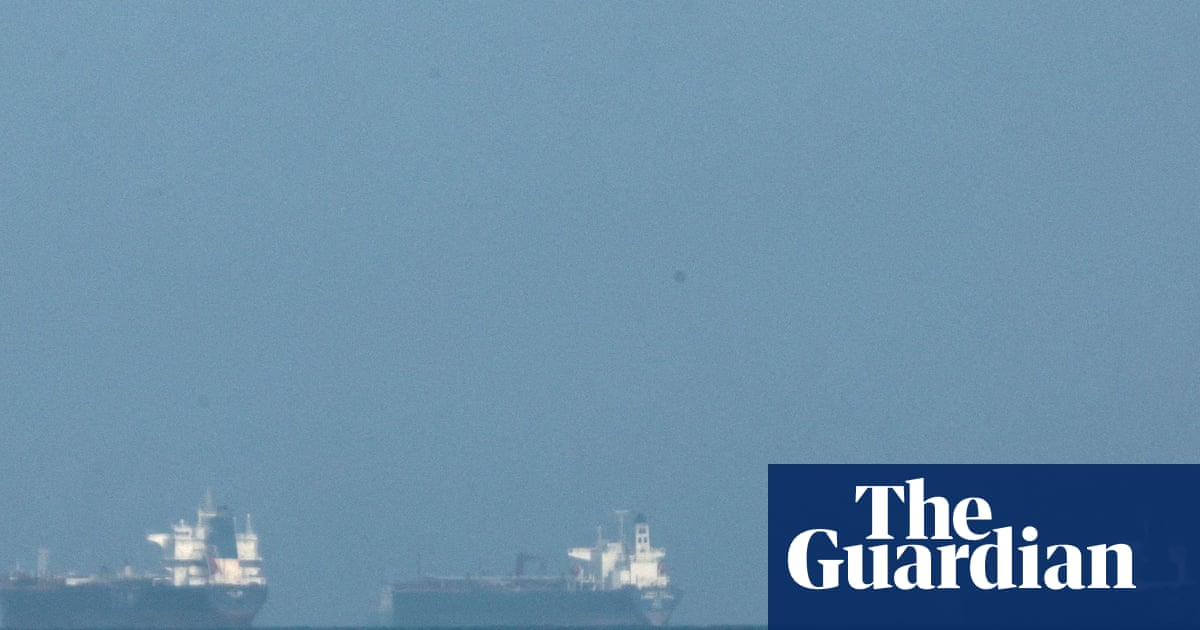
Only two vessels not linked to Iran or Russia have made the “chicken run” through the strait of Hormuz since Donald Trump said he would “ensure the free flow of energy to the world”, according to maritime records.
One of those that braved the journey since the US president’s announcement of emergency measures on Friday went “dark” by switching off its transponder and a second signalled it was Chinese owned and crewed.
The Hormuz sea passage, one of the world’s most strategically important choke points, would normally have about 100 vessels a day either exiting or entering the Gulf. In response to the US and Israeli attacks, Iran has effectively shut the strait, attacking at least 10 ships which were seeking to traverse it in the early days of the crisis.
On Friday, Trump announced a $20bn (£14.85bn) reinsurance scheme to revive shipping through the strait, which he said would come into effect immediately. He followed up by saying that shipowners should “show some guts” by sailing through the war zone.
A small number of tankers and bulk carriers of dry goods have braved the crossing since Friday using a variety of methods to mitigate the risk, records show.
The Shenlong, a Chinese-made vessel operated by Greece’s Dynacom Tankers Management but sailing under a Liberian flag, crossed the narrow strait to exit the Gulf on Friday, according to the data agency Kpler. The vessel switched off its transponder as it approached the strait and then began signalling again near India’s coastline on Monday as it made its way to Mumbai.
A second, Sino Ocean, a bulk carrier that also sails under a Liberian flag, signalled it was “CHINA OWNER_ALL CREW” as it traversed the strait after picking up its cargo from the United Arab Emirates’ Mina Saqr port on Thursday.
Only eight other vessels are believed to have entered or exited the Gulf through the strait over the weekend and they all appear to have links to Iran or Russia.
They include an oil tanker named Dalia that sails under the Iranian flag and an oil/chemical tanker known as Parimal that has been identified by the US authorities as having transported Iranian oil.
On Monday, a tanker known as Cume that has been hit with US sanctions for shipping Iranian crude oil left the Gulf through the strait.
Two vessels carrying liquefied petroleum gas (LPG) also passed through the strait over the weekend: Danuta I, which has been identified by the US as being part of the Iranian “dark fleet”, and HH Glory, which was put under US sanctions for its role assisting the Russian energy industry.
Three other bulk carriers passed through the strait, of which one sails under the Iran flag and two came from an Iranian port.
Other ships may have been passed through by turning off their transponders and using tactics to conceal their movements but the trickle of activity highlights the impact of the war.
Before the US and Israeli attacks on Iran, about 20% of the world’s petroleum consumption and roughly one-fifth of the world’s liquefied natural gas passed through the strait of Hormuz each day.
On Monday oil prices jumped to as high as $119 a barrel, the highest since 2022, before dropping below $90 after Trump said the war with Iran could end “very soon”.
As well as announcing his plan to insure ships making the journey on Friday, Trump had also suggested that naval escorts could be used to provide safe passage for tankers in the Gulf. Insurers have warned that such an escort would probably make the tankers more of a target.
Matthew Wright, the lead freight analyst at Kpler, said the high freight rates that companies could charge meant the insurance premiums were not the main problem. “Even record-high freight rates have failed to break the deadlock,” he said.
“Shipowners are primarily concerned with the risk of missile or drone attacks, and until there is a material improvement in the security environment, flows are likely to remain extremely limited. Iran is still displaying pretty comprehensive capabilities to strike targets and vessels if they want to.
“A diplomatic solution would get flows back in the next one, two, maybe three weeks. China would be the main negotiator there, because the Asian economies are at huge risk. Otherwise we are looking for more than a month to wait for a deterioration of the Iranian capability.
“Then there’s also a scenario in which if Iran operates a more decentralised warfare approach, more akin to what the Houthis did, where they have very, very flat command structures, in which you can take out leaders and they continue to operate very effectively, then this could take months. It’s particularly concerning from energy flows point of view.”
On Monday, finance ministers of the G7 nations said they were ready to take the “necessary measures” to support the global supply of energy but ended a meeting without agreement on the release of strategic crude reserves. If such reserves were released it would be the first time since 2022 after Russia’s full-scale invasion of Ukraine.
First Appeared on
Source link

Leave feedback about this