

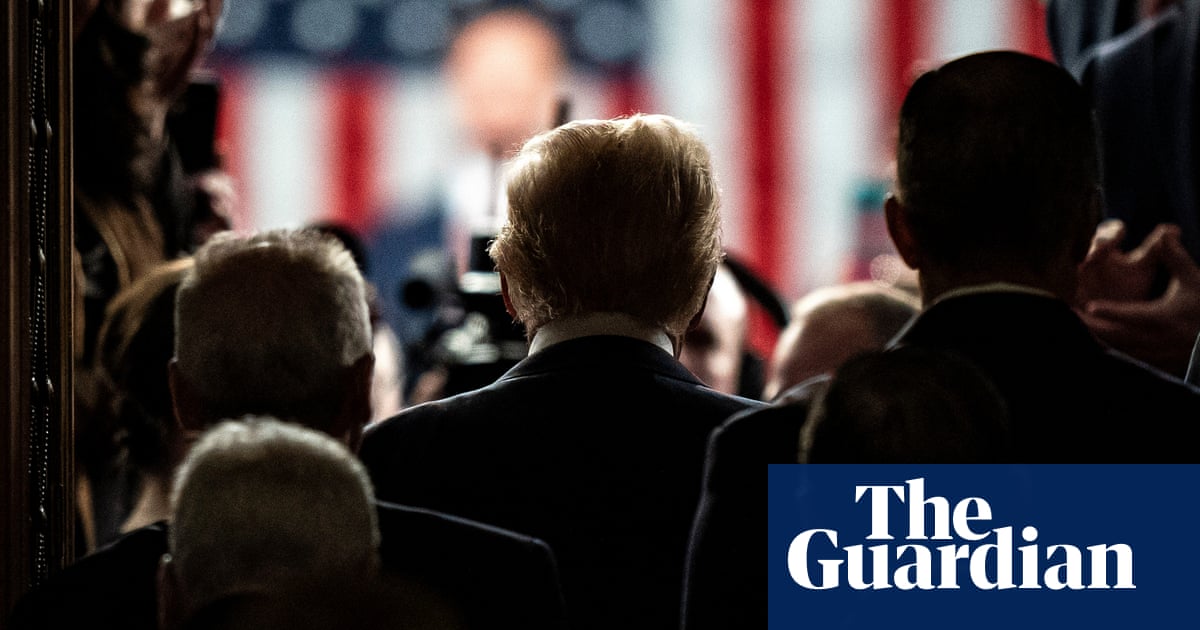
The last time Donald Trump delivered a State of the Union address, it produced the memorable optics of Nancy Pelosi ripping up his speech after he finished talking.
Pelosi’s theatrical gesture at the end of the February 2020 address (his 2025 speech was technically a joint session of Congress, not a State of the Union) eloquently expressed the Democrats’ contempt for Trump’s rosy description of the union he presided over, when he boasted of a booming economy and restoring US strength in characteristic Maga (make America great again) rhetoric.
It is unlikely to be repeated tonight; Republican Mike Johnson now sits where Pelosi sat as speaker of the House of Representatives and is staunchly supportive and loyal to the president.
Yet six years on – and a year and one month into Trump’s second term – the union’s actual state is more contentious than ever and Democratic pushback can be expected inside and outside the chamber.
On a range of issues – immigration, affordability, the economy, tariffs, foreign policy – the country is deeply polarized as the midterm elections loom, with opinion polls showing more voters disapproving of Trump’s performance than approving.
Economy
Figures released late last week showed annual GDP growth in the last quarter 2025 slowing to 1.4%, lower than the 3% forecast by many economists, and down from 4.4% in the previous three months. The slowdown was partly attributed to last fall’s record-long 43-day government shutdown.
The economy has shown more resilience to the shock of Trump’s tariffs policy than some economists feared. Some 130,000 new jobs were added in January and retailers report strong consumer spending.
Yet it is far from the golden age that Trump promised. Ominously for the GOP’s midterm prospects, voters voice dissatisfaction on “affordability” issues – which Trump vowed to tackle in his campaign but has since dismissed as a “Democrat hoax”.
Despite low unemployment and inflation figures, many voters report that the economy feels worse than under Joe Biden, who was widely criticized for failing to adequately tackle rising prices.
Tariffs
Trump’s trademark economic policy, which has seen him impose an extraordinary range of import duties on goods from nearly every country in the world, is now in disarray, thanks to last week’s supreme court ruling slapping it down.
Against that backdrop, the court last week delivered a devastating blow to the tariff regime by ruling that he had exceeded his authority under the International Emergency Economic Powers Act.
The ruling leaves a pall of uncertainty over Trump’s strategy – set out in a “liberation day” announcement last April – of using tariffs to spur an American manufacturing renaissance.
Paradoxically, Trump could actually benefit politically from the rebuff, not least because a majority of voters oppose tariffs and believe they make life less affordable. That view is supported by economic studies suggesting that tariffs add to inflation. Their elimination could also free US manufacturers from retaliatory tariffs from other nations.
The president responded venomously to the court’s ruling, labelling the justices a “disgrace to their families” who voted against the tariffs and speaking of “alternatives” in an angry press conference. Over the weekend he announced 15% across-the-board tariffs under a different legal authority. He is likely to have more to say tonight on a subject so close to his heart.
Immigration
Arguably an even more bigger Trump totem than tariffs, yet this too threatens to turn sour as voters recoil at the aggressive tactics of masked Immigration and Customs Enforcement (ICE) and Customs and Border Protection (CBP) agents on the streets of Minneapolis and other cities.
The deployment of more than 3,000 federal agents to Minneapolis in “operation metro surge” has created acute political problems for Trump. Two US citizens, Renee Good and Alex Pretti, were shot dead as they observed or protested against deportation roundups and were later denounced as “domestic terrorists” by administration officials. An elderly man, also a US citizen, was arrested in his home and taken outside in sub-freezing temperatures because he was suspected of being an undocumented immigrant. A five-year-old boy, Liam Conejo Ramos was pictured being detained by an agent outside his home, and later taken to a facility in Texas with his father before a court ordered their release.
The footage and images from such episodes has created a public backlash. Nearly half of all voters say Trump has gone “too far” in enforcing his immigration agenda, despite solid backing for it at the start of his presidency.
The controversies in Minneapolis prompted an eventual withdrawal of federal forces by Trump’s experienced “border czar”, Tom Homan. But there is scant reason to think that the president is about to perform a retreat on immigration and deportation, issues that have been at the heart of his message since he first declared his presidential candidacy in 2015.
Foreign policy
Trump’s promise of an America first foreign policy that would end distant military entanglements – or “forever wars” – that he condemned previous presidents for is looking distinctly shaky, as a massive US military force prepares to carry out strikes on Iran for the second time in a year.
In a radical change of tone, the president is even reported to be contemplating a major military campaign designed to bring about regime change in Iran, a sweeping ambition echoing the 2003 invasion of Iraq under George W Bush, which Trump has repeatedly criticized as a mistake.
The threat of confrontation with Tehran comes just over a month after a similar standoff with Venezuela ended with Trump ordering a force to snatch the country’s president, Nicolás Maduro – who the administration had labelled a “narco-terrorist”.
In the opening weeks of the year, Trump has also stirred tensions with Nato by demanding that Denmark – a founding member of the alliance – cede Greenland.
The president has postured as peacemaker and openly clamored for the Nobel peace prize, all while claiming – inaccurately – to have ended seven or eight wars. Last week, he launched his much-vaunted Board of Peace, promoted variously as a means to bring peace to Gaza, or more ambitiously, as an alternative to the United Nations. But so far, the US’s traditional European allies have declined to sign up, restricting membership to a group of like-minded, mainly authoritarian leaders.
The rule of law
Under the leadership of Pam Bondi, the attorney general, Trump has eviscerated the independence of the Department of Justice (DoJ) and used it pursue retribution against his political adversaries.
The prosecutions include the former FBI director, James Comey, and Letitia James, the New York attorney general, who filed a fraud suit against him in 2022 alleging that he had inflated his net worth. A federal judge dismissed both criminal cases, on the grounds that the prosecutor who brought the charges had been illegally appointed by the DoJ.
Rampant judicial retributions has been abundant elsewhere, including against Jerome Powell, the chairman of the Federal Reserve, who has found himself under criminal investigation over a renovation scheme at the bank’s headquarters after defying Trump over interest rates.
Then there has been the DoJ’s slow release of the Jeffrey Epstein files in response to an act of Congress mandating that all documents relating to the late disgraced financier and sex trafficker be released in December.
More than two months later, 3m files are still being withheld, without explanation. Those that have been put in the public domain have come with significant redactions, frequently obscuring the identities of those in contact with Epstein while revealing victims’ names.
Crime
Trump claims to have cut murder and violent crime to a 125-year low through his get-tough policy, manifested by the national guard deployments in several Democratic-run cities, including Washington DC.
Yet the facts tell a more complex story. The homicide rate in the US was already on a downward trajectory in the two years before Trump returned to office. After a surge in 2020, the last year of his first presidency, it fell the following year, while much of society was in lockdown during to the Covid pandemic, before jumping again in 2022.
The murder rate is expected to show a fall to the lowest ever recorded in 2025 – four per 100,000 residents, according to the Council on Criminal Justice. Yet this follows two consecutive years of record-breaking declines that occurred under the Biden administration, as the accompanying diagram illustrates.
Health
There is a groundswell of unhappiness over surging healthcare costs, threatened cuts to federal programs like Medicaid, and the end of subsidies previously accorded under the Affordable Care Act, also known as Obamacare.
More than half of Americans have voiced fears that they will be unable to afford essential health care services this year, according to polls.
In addition, the make America healthy again (Maha) agenda championed by Robert F Kennedy Jr, the health secretary, has experienced a backlash amid concerns that his policies have undermined vaccine policies and weakened public health infrastructure through cuts to scientific research funding and weakening environmental regulations meant to combat pollution.
First Appeared on
Source link






Leave feedback about this