

This is a special early version of my weekly Sunday roundup of new political data published over the last seven days.
The United States and Israel launched a new round of military strikes against Iran on Saturday, Feb. 28, and so the most important numbers this week are the ones measuring whether the country is behind the war its president just started. It is not.
I also have a recap of a massive week of Strength In Numbers publishing — including our February poll release, two deep dives on party strategy, and a flash poll on Trump’s State of the Union address.
On deck this week: Tuesday’s Deep Dive will cover exclusive new Strength In Numbers polling data that shows voters hold contradictory opinions on a variety of social and economic issue areas. Given measurement error in surveys, how you ask questions matters a lot for the implications polls have for the public and party strategy.
For now, let’s dig into the numbers on Iran.
Last June, after the U.S. bombed strategic military targets in Iran, I published an article compiling polls that showed just 16% of Americans supported “getting involved in the Israel-Iran conflict,” including just 19% of Trump voters. Then, the public didn’t want a war with the country, with 60% of adults opposing military action.
Eight months later, the public still doesn’t support military action in Iran.
A YouGov snap poll fielded Saturday — the day of the strikes — found 34% of Americans approve of the U.S. attacks on Iran, with 44% disapproving and 22% unsure. The partisan breakdown reflects strong polarization in opinion: Republicans approve 69–12, Democrats disapprove 70–10, and independents lean heavily against — 52% disapprove, 20% approve.
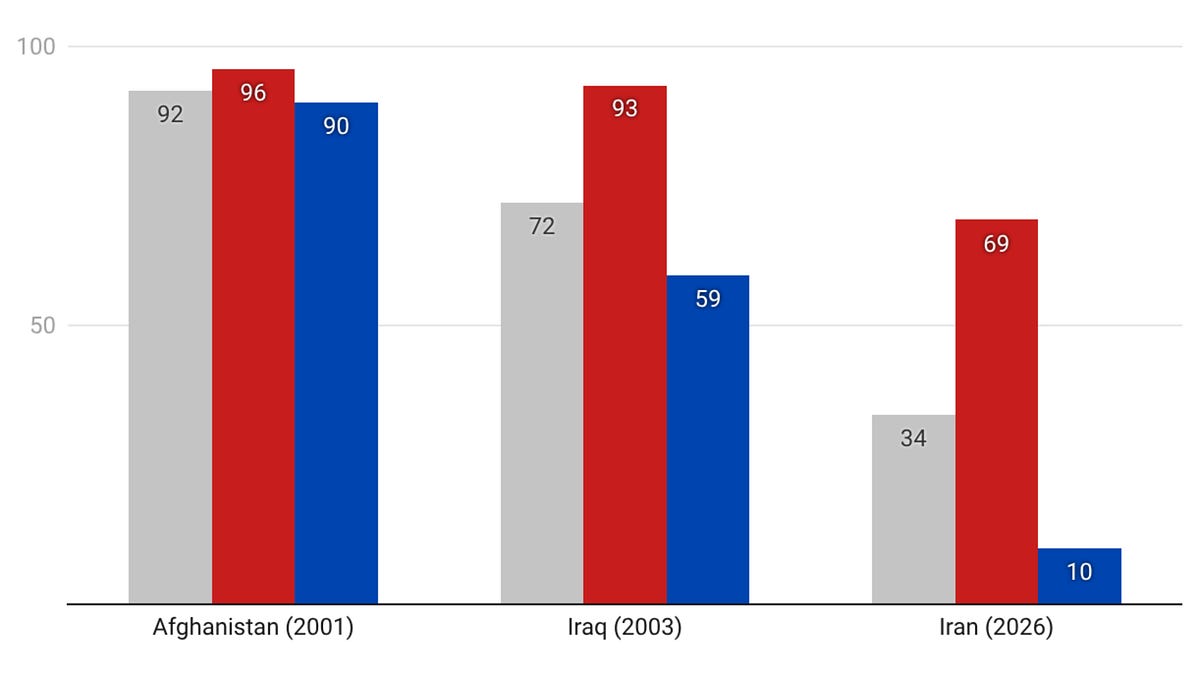
This level of support for a foreign war is incredibly low. In comparison, a Gallup poll in November 2001 found 92% of Americans approved of military action in Afghanistan. And a Pew poll in late March 2003 found 71% supported the decision to use force in Iraq. The YouGov snap poll from Saturday puts approval of the Iran strikes at 34%.
Looking at opinions broken down by party tells a similar story. After 9/11, the partisan gap on Afghanistan was essentially nonexistent — 96% of Republicans and 90% of Democrats approved of a U.S. invasion of the country. And when Operation Iraqi Freedom began in Iraq in March 2003, 93% of Republicans supported the war vs 59% of Democrats.
On Iran, Republicans’ support for the president’s attack is much lower. According to YouGov’s snap poll, just 69% of Republicans vs 10% of Democrats support Trump’s actions.
These numbers represent a small increase in support for U.S. military action in Iran, driven by Republicans rallying very modestly around President Trump. The Economist/YouGov tracker asked about support for military action against Iran repeatedly from January through late February. The numbers barely moved — 33% support in mid-January, 28% in late January, 27% in late February. And now back up to 34%. Unlike Iraq, where there was a mass propaganda campaign to manufacture consent for the war before the invasion began, there’s little sign that Saturday’s strikes budged anyone.
And it’s worth noting that opinion tends to be most favorable to military action at the beginning of a war. Support for invading Iraq started in the low-mid 70 percent range. Trump is starting at half of that in his attack on Iran — lower than where the average American was in 2013.
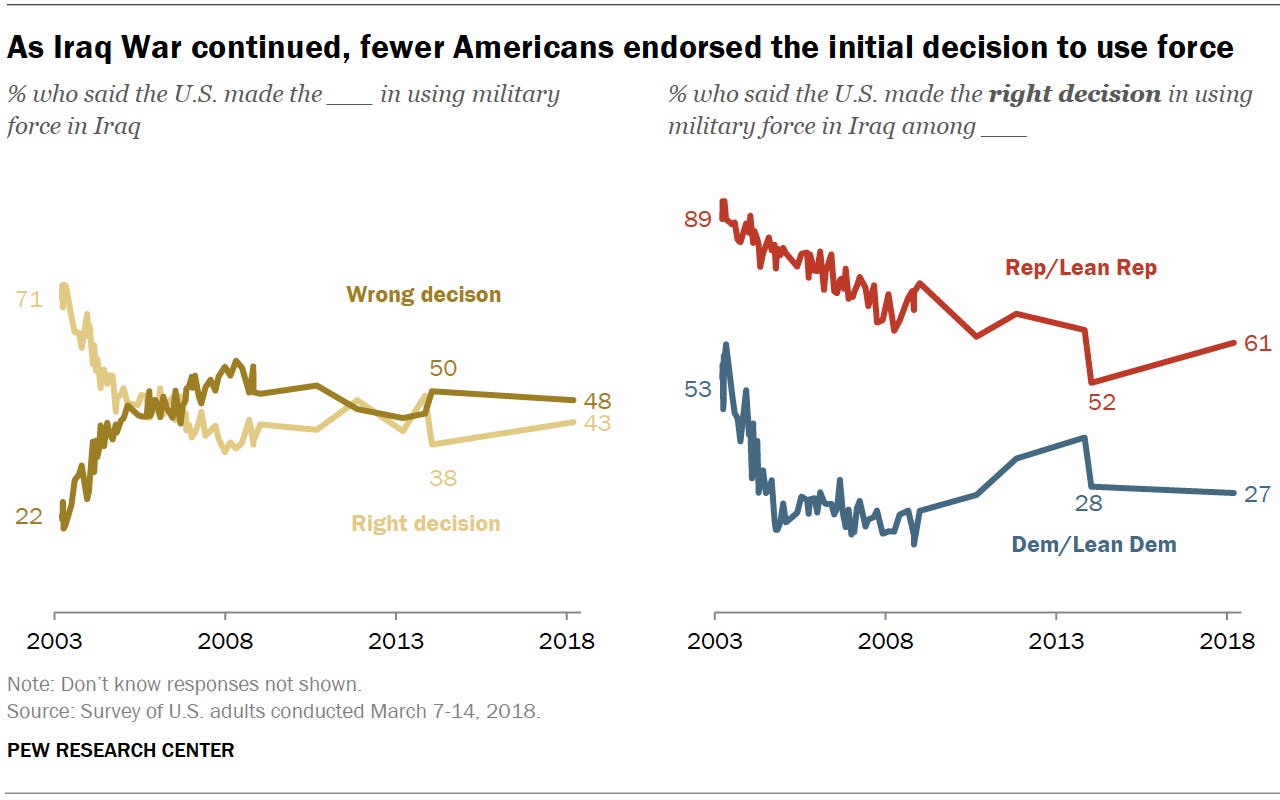
Additionally, when it comes to the partisan breakdown, Trump also starts at around the same level of support Bush enjoyed on Iraq in 2008. While the conflict is playing well with the average MAGA user on Twitter/X, many in the party’s rank and file are opposed. He will have to figure out how to approach an unpopular war — even with his own base — far earlier than his predecessors.
And Trump also broke one of the key promises he made during his 2024 campaign when he said under his presidency, there would be “no new wars.” The GOP tweeted in 2024 that Trump-Vance was the “pro-peace ticket.”

Here’s the upshot: Every modern American president who started a war had the public behind him at the outset. Trump is the first to launch major military strikes against a sovereign nation with more Americans opposed to military action than in favor. If history is any guide, support is more likely to erode than rise. A war most Democrats oppose is one thing. But Trump is beginning from a baseline where even Republicans aren’t fully on board. That’s a precarious position to be in — especially in an election year.
It was a record eight-post week here at SIN. On Sunday, I wrote about the likely political fallout of Trump doubling down on tariffs after the Supreme Court ruled most of them illegal:

On Monday, I wrote about why political journalism needs less punditry and more analytical legwork — and why/how Strength In Numbers tries to do things differently:

Tuesday, I released our February poll with Verasight, with Trump’s approval falling to a new low of 37%, Democrats leading the generic ballot by 10 among registered voters, and Trump’s immigration approval cratering to -15 net:

On Wednesday, I showed that a plurality of Americans would pause deportations to lower housing and food prices, and only 5% would spend a hypothetical budget surplus on immigration enforcement:

On Thursday: Two-thirds of Americans want term limits for Supreme Court justices, and majorities support structural reform to the Court, Puerto Rico statehood, and limits on the pardon power:

On Friday, I wrote about our data showing swing voters think Republicans are more extreme than Democrats — and that Democrats are seen as weak. I did the math on the “fight vs compromise” debate:

And after Trump’s State of the Union address, a flash poll found 57% say the president is focused on the wrong things. The SOTU showed exactly why:

On Saturday, I posted the video of our weekly Strength In Numbers podcast looking at who’s really leading in the Texas Senate primaries ahead of the March vote:

If you’re a frequent reader of Strength In Numbers, I’m confident you will get a lot of value out of a paid subscription. Paid subscribers get access to Tuesday Deep Dives, the full post archive, early access to new data products, and the satisfaction of supporting independent, data-driven political journalism.
My polling averages have moved to a new webpage at fiftyplusone.news, and we have also started sending out a weekly polling update there, which we call The Trendline. Subscribe to 50+1 for polling averages updates.
And that’s it for this week! A lot happened — and I suspect the Iran strikes will dominate the political landscape for weeks to come. Thanks for reading. Strength In Numbers will be back in your inbox Tuesday!
Elliott
Got more for next week? Email your links or add to the comments below!
First Appeared on
Source link






Leave feedback about this