

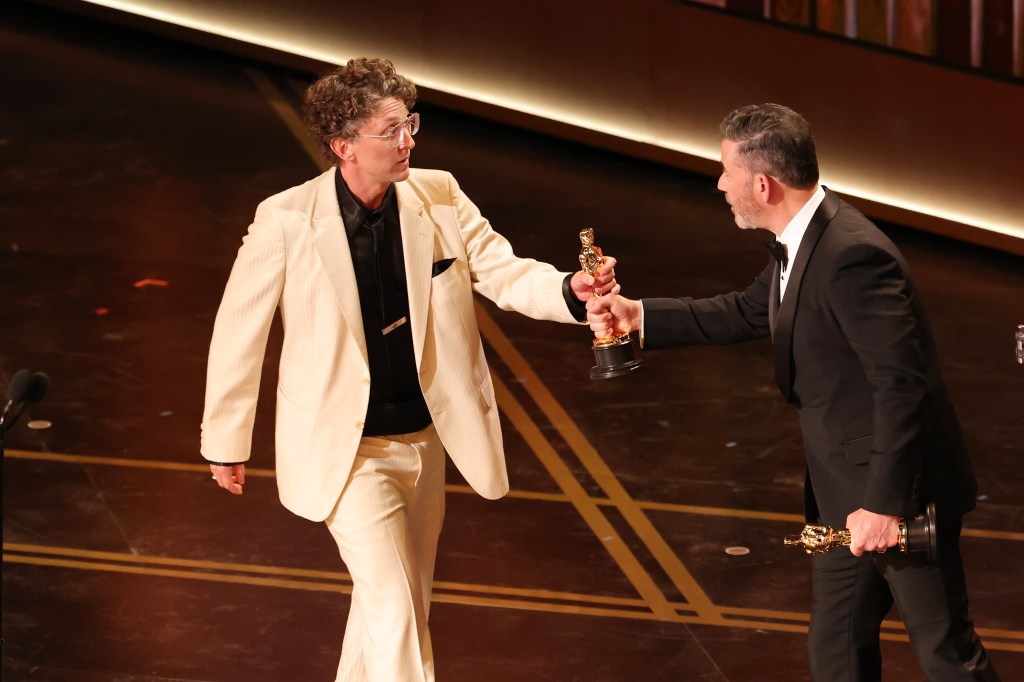
The Oscars got more political this year, not just with the underlying themes of winners like One Battle After Another and Sinners, but the subtle and overt references to the turbulent times under Donald Trump.
At the start, host Conan O’Brien reminded the audience of the whirlwind of wars, threats and polarization, saying, “If I can be serious for just a moment, everyone watching right now, around the world, is very aware that these are very chaotic, frightening times. It’s at moments like these that I believe that the Oscars are particularly resonant.”
O’Brien added, “We pay tribute tonight, not just to film, but to the ideals of global artistry, collaboration, patience, resilience and that rarest of qualities today, optimism.”
A degree of humor and commentary about world events and figures have long been a given at most Oscar ceremonies, but the degree to which those on stage have taken a stand has ebbed and flowed through the years.
Through tonight’s ceremony, there were references to the international makeup of the nominees, the power of movies to unite and the first-time achievements of diverse winners.
RELATED: Oscars TV Review: Hollywood’s Big Night Finally Gets As Big As The Movies It Celebrates
Accepting one of his three awards, Paul Thomas Anderson talked of his children’s generation being one that “hopefully brings us some common sense and decency.”
Joachim Trier, winner for international feature for Sentimental Value, quoted from James Baldwin, that “all adults are responsible for all children, and let’s not vote for politicians who don’t take this seriously into account.”
Two of the tributes to stars who died in the past year, Rob Reiner and Robert Redford, referenced their politics, and their ability to have an impact even if their activism was prone to derision on the right.
RELATED: Billy Crystal Honors The Late Rob Reiner & Wife Michelle Singer In Emotional Oscars Tribute
Others on stage got more specific, whether that be to Gaza, the Iran war or to free speech. Javier Bardem opened his moment as a presenter by saying “No to war, and free Palestine.”
Jimmy Kimmel, ever a Trump foil, gave a taste of his typical late-night monologue. He made a crack about Melania Trump’s documentary, enough to elicit pushback from White House Communications Director Steven Cheung (he called Kimmel a “classless hack,” among other things).
Presenting the documentary awards, Kimmel said, “We hear a lot about courage at shows like this, but telling a story that could get you killed for telling it is real courage. As you know, there are some countries whose leaders don’t support free speech. I’m not at liberty to say which. Let’s just leave it at North Korea and CBS.”
The joke had particular relevance when Kimmel presented the Oscar to documentary feature winner Mr. Nobody Against Putin, about a teacher challenging the Russian propaganda in the invasion of Ukraine.
In a not-too-subtle reference to the United States, co-director David Borenstein said that the movie was “about how you lose your country, and what we saw when working with this footage is that you lose it through countless small little acts of complicity. When we act complicit, when a government murders people on the streets of our major cities when we don’t say anything, when oligarchs take over the media and control how we can produce it and consume it, we all face a moral choice.”
About an hour before Borenstein took the stage, Trump raged on Truth Social about the media coverage of the war in Iran, the “corrupt and highly unpatriotic ‘news’ organizations” and the “late night morons.” He suggested that news entities could be brought up on charges of treason “for the dissemination of false information,” while he praised his FCC chairman for threatening to pull broadcasters’ licenses.
What triggered Trump appeared to be something also on the minds of O’Brien and others in the Dolby Theatre: AI. Trump complained that Iran was producing AI images as a “disinformation weapon,” as the new technology makes it ever more impossible to determine what is real and what is fake.
The president himself has yet to post on the Oscars, but his posts may have only underscored O’Brien’s point about the show: In calling out the chaos of the times, this year’s ceremony was “particularly resonant.”
First Appeared on
Source link


Leave feedback about this