

Sign up for the Slatest to get the most insightful analysis, criticism, and advice out there, delivered to your inbox daily.
It is commonly noted that the United States and Iran are fighting an “asymmetric war,” but it is less widely understood what this means.
The phrase does not mean merely that the two sides are unequal in armed might. (Secretary of Defense Pete Hegseth’s boast that “this is not a fair fight, and that’s on purpose, our capabilities are overwhelming compared to what Iran’s are” is a truism and beside the point.)
Rather, it means that the two sides are, in a way, fighting different wars—that the two sides have different strengths and that the militarily weaker side is mustering its own type of strength to exploit the militarily stronger side’s vulnerabilities.
In this case, the U.S. (along with Israel) is blowing up a lot of Iranian structures with great power and precision. Meanwhile, Iran is blocking traffic in the Strait of Hormuz, through which one-fifth of the world’s oil passes, thus hurling much of the globe’s economy and markets into panic.
The war’s outcome may be decided not in terms of which side unleashes the most firepower but rather which side outwaits the other in its tolerance of pain (as defined in the several ways pain is being inflicted, the most decisive of which we don’t yet know).
Trump had thought there would be no need to wait for victory, much less outwait Iran’s challenge. He hoped, and said so publicly, that Iran would be Venezuela redux—knock off the top leader and the regime would fall, to be replaced either by more pragmatic underlings or by throngs of “the Iranian people” taking over the seats of power. (It turned out there were no pragmatic underlings—or, if there were some, they too were killed by U.S. or Israeli bombs—and the people lack the guns and organization to take power. But that’s another story.
It turns out the Iranian regime has hung on much longer than Trump expected; U.S. intelligence agencies report that it’s nowhere near on the verge of collapsing. Still, in pursuing their asymmetric strategy, Tehran’s commanders made one miscalculation. In response to the U.S.-Israeli attack, they fired some drones and missiles not only at Israel and at American military bases in the region but also at civilian targets in Arab states that host those U.S. bases—including the UAE, Bahrain, Qatar, and Saudi Arabia. The Iranians probably hoped that the Gulf states’ leaders in particular, who have thought themselves immune to the region’s myriad conflicts, would howl and beg their friend Trump to stop the war. Instead, they held firm (a stance abetted by their anti-air weapons, which shot down many of Iran’s projectiles), publicly condemned Iran, and joined the American-Israeli side. Even several European leaders, who had hoped to stay out of this war, felt compelled to send planes and warships, if just to defend their own interests and outposts.
Iran’s President Masoud Pezeshkian apologized to the Gulf states, though Qatari spokesmen say the attacks haven’t stopped, suggesting a rift within Iran’s possibly faltering leadership.
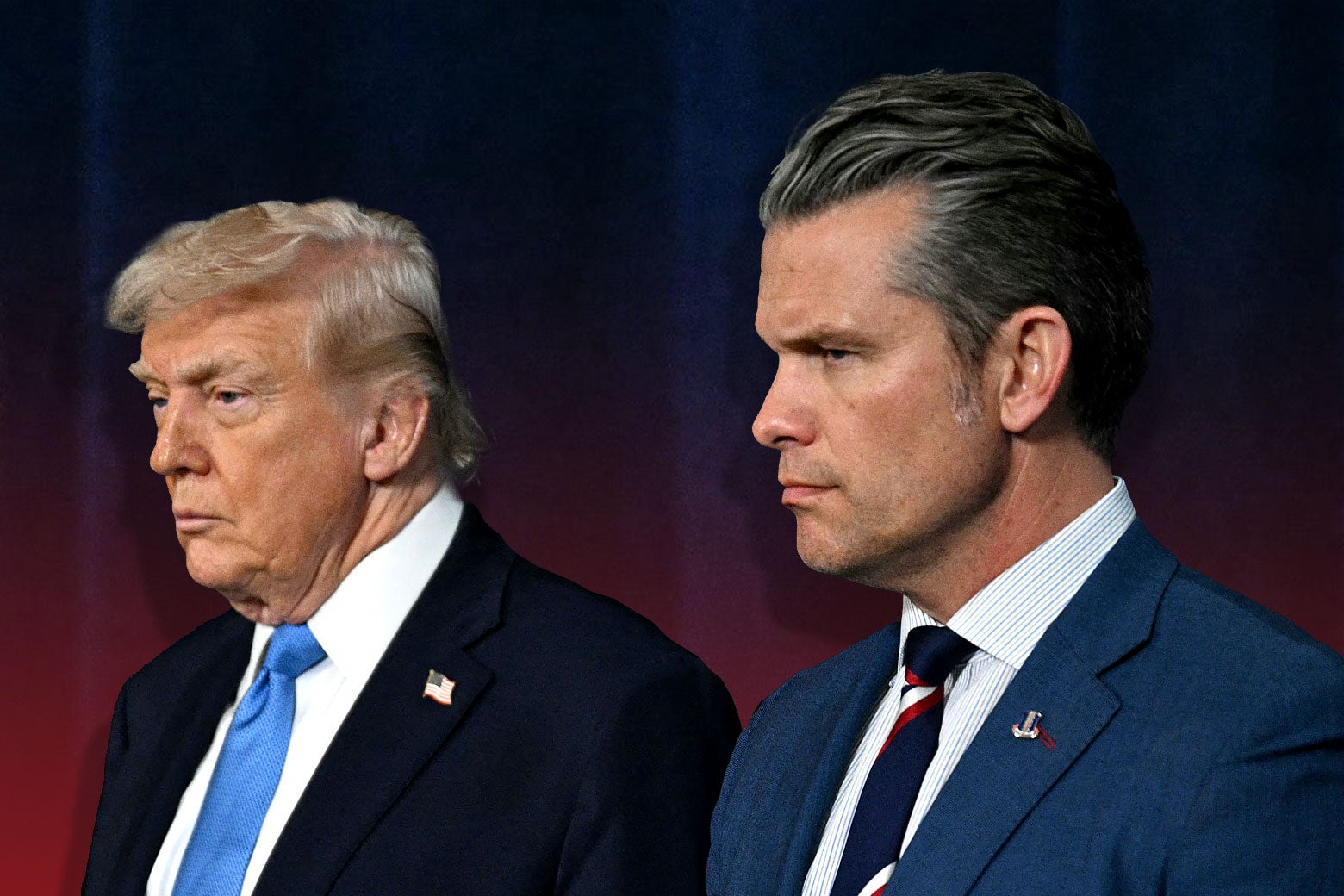
All the same, Tehran’s regime holds the continued advantage of having Donald Trump as its foe. Trump could have exploited Iran’s error by embracing his reluctant allies, but instead he belittled their effort and condemned their lack of enthusiasm. Earlier this week, after Britain’s Prime Minister Keir Starmer dispatched an aircraft carrier and other military assets to the Middle East, at great domestic political risk, Trump posted a pissy screed on social media: “That’s OK, Prime Minister Starmer, we don’t need them any longer—But we will remember. We don’t need people that join Wars after we’ve already won!”
Which leads to another way in which this war is asymmetric (in the more conversational sense of that word): namely, the asymmetry between Trump’s crude concept of war and its true nature.
Take a close look at Trump’s jab at Starmer, trashing his (by most measures overly accommodating) ally for joining the war “after we’ve already won.” Trump thinks he’s won. He said so, with glee, at a rally in Kentucky on Wednesday: “We’ve won. Let me tell you, we’ve won. You know, you never like to say too early you won. We won. We won the bet—in the first hour, it was over.”
What is he talking about? Iran’s regime is intact: the Ayatollah Khamenei’s son, believed to be equally hard-line, ascended to the top job with no sign of struggle; the Revolutionary Guard still rules Tehran’s streets, to the extent anyone does; the Strait of Hormuz is still blocked.
Trump’s delusion seems to stem from the misunderstanding that war is all about blowing up targets. It’s true, U.S. Central Command has blown up a lot—more than 5,000 targets, according to the latest briefings—to the point where, as Trump said, there’s almost nothing left to hit. But wars are fought for political objectives. (This is what Carl von Clausewitz meant when he famously wrote, “War is the continuation of politics by other means.”)
The problem is that Trump doesn’t know what his objectives in this war are. Or, worse still, he has proclaimed many objectives, some of them contradictory with one another, many of them inconsistent with objectives proclaimed by his top advisers, because they don’t know what his objectives are either. One day, it’s regime change (and, even within that goal, sometimes he says the people should rise up, sometimes he says he can deal with more moderate mullahs or officers taking power); other days, it’s to wipe out Iran’s nuclear potential, ballistic missiles, and navy (with nary a word about the regime or democracy).
This confusion causes two sets of dreadful consequences. First, to the extent that Iran’s real or nascent leaders want to end the war, they don’t know what they need to say or do—and if they take seriously the talk of regime change, they see no point in trying to end the war, but will instead bring down as much around them, along with themselves, as they can.
Second, U.S. military commanders, who draw up a list of targets that they need to hit in order to accomplish the war’s objectives, are also left in the dark—so they draw up lists of targets related to all possible objectives. The result, even by strictly military measures, is counterproductive. To achieve some objectives, restraint might be the best approach. For instance, if you just want to stop Iran’s nuclear program or destroy its ballistic missiles and navy, then you need to negotiate a surrender with Iranian authorities. But if you also kill those authorities, you have nobody to negotiate with—and so the war revs to a death spiral.
Could this be Trump’s real objective (if he has one)? It may well be Israeli Prime Minister Benjamin Netanyahu’s. If they can’t usher in a friendlier regime, maybe they see the utter destruction of Iran as the next best thing. They seem to be moving in that direction. Unlike previous wartime presidents, Trump doesn’t care when his bombs mistakenly kill civilians. When reporters have asked him about the Tomahawk cruise missile that killed 175 people, most of them children, at an Iranian girls’ school, Trump has given two answers. First, he said Iranians might have fired the missile (an impossibility). A bit later, he said, “I don’t know anything about that” (though clearly he does).
What do Trump, Netanyahu, or any of the others involved in this war hope Iran looks like at the end of the war? What do they expect it might look like? They have no answer—no consistent answer—to either question, much less some notion of how to maximize the chances of a good outcome (however it’s defined) or how to minimize the chances of a bad outcome.
During World War II, Gen. George Marshall, the U.S. Army chief of staff, created an office to think about the shape of postwar Germany in 1943—two years before the war was over. The war with Iran is nothing like WWII, but Trump and his team don’t even think such an office or an effort is necessary. Before the war started, Hegseth abolished a Pentagon office, which had been created by President Joe Biden, to plan for minimizing civilian deaths in wars. Hegseth probably scoffed at the idea as “woke.” But if you say you’re fighting a war on behalf of a country’s oppressed people, it’s a good idea—in fact, it is an essential element of the war strategy—to think about this problem. The killing of those Iranian schoolchildren—specifically the tainting of America’s reputation caused by Trump’s failure to acknowledge the tragedy, much less to apologize for it—is both a result and a symptom of not only this indifference to human life but this ignorance of strategy in war.
This is the ultimate asymmetry: the fact that someone like Donald Trump is the commander in chief of the world’s most powerful military, that someone like Pete Hegseth is the top official of what he calls “the Department of War,” and that American politics at the moment is so paralyzed that even those near the top of power, who know the awfulness of this mismatch, can do nothing to steer the nation on a different course.

First Appeared on
Source link




Leave feedback about this