

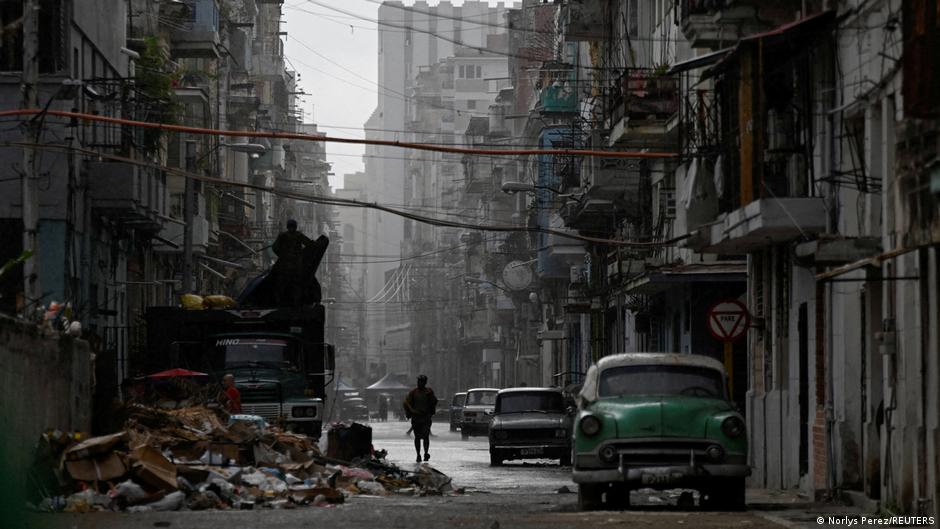
In the past two years, Cuba has experienced four nationwide blackouts; since February 2024, a total of 10 widespread power outages have shaken the economy and nationwide morale. As the US oil blockade takes its toll, the Cuban government has been forced into opening talks with the United States.
US President Donald Trump earlier this week repeated his threats to take over Cuba and said that he could do “anything” he wanted with the island state in the Caribbean. This has heightened speculation that top leaders in Cuba could face the same fate as former Venezuelan leader Nicolas Maduro.
Maduro’s capture at his residence in the Venezuelan capital Caracas in January not only showed Cuba what Trump was willing and able to do but also robbed the regime of one of its closest allies and most important oil suppliers.
Thorny US-Cuban relations
Located some 150 kilometers (around 93 miles) away from the southern US state of Florida, Cuba has been a thorn in the side of the United States since the 1959 revolution led by Fidel Castro. His communist regime consistently opposed the US, which had once had significant influence over the island, and during the Cold War was considered a bridgehead for other communist states such as Russia and China, or countries hostile to the US such as Venezuela.
During his time in office, US President Barack Obama made overtures to Cubaand tried to revive relations with Havana. But these efforts were reversed by Trump during his first term (2017 to 2021) — much to the relief of many Cuban exiles and their descendants, many of whom want the regime to fall. US Secretary of State Marco Rubio is one of the most prominent US citizens of Cuban descent. The Cuban diaspora represents an important voting bloc, particularly in the swing state of Florida.
Klemens Fischer, a foreign policy expert at the University of Cologne in central Germany, told German broadcaster ZDF that Trump’s current escalated rhetoric regarding Cuba was probably motivated by domestic policy.
“It may be an attempt to break free, given that things aren’t going as he wanted in Iran,” he said. “He needs to show that he is a strong president. On the other hand, he must also avoid waging another war.”
However, the US president had already stepped up the pressure on Cuba: It was at his behest that Venezuelan Vice President Delcy Rodriguez completely halted oil shipments to Cuba — which had already dwindled — in January.
The US has also blocked sea routes to the island and threatened countries supplying Cuba with oil with sanctions. According to the Cuban government, the country has not received any oil shipments for three months. Domestic production, which has been declining for years, covered less than 30% of demand in 2024. The increase in power outages is directly linked to this, as Cuba’s electricity comes largely from oil-fired power plants.
Cuba: worst economic crisis in three decades
The energy shortage is just one — albeit significant — aspect of the current economic crisis, said Cuban economist Elias Amor, who lives in Spain. He told DW that apart from a brief period of recovery, the Cuban economy has shrunk by an average 2.75% each year ever since the start of the COVID-19 pandemic in 2020. He said that this had risen to 5% in 2025: “The Cuban economy is in its worst state since the ‘Periodo Especial.'”
The Special Period is the term given by the Cuban regime to the deep recession that gripped the country in the wake of the collapse of the Soviet Union in the early 1990s. Real wages fell by 90% within four years. Fidel Castro’s government introduced temporary reforms, including the gradual opening of the tourism sector, which resulted in a partial recovery. But it was only when Hugo Chavez came to power in Venezuela and the country took over from the Soviet Union as Cuba’s sponsor that the economy really began to recover substantially.
Amor speculated that it was the gradual opening of the Cuban economy over the past few decades that was preventing a crisis akin to that of the early 1990s. However, he predicted that the limited reforms that Fidel’s brother, former President Raul Castro and his successor, Miguel Diaz-Canel, had introduced were unlikely to have a major impact.
“Even tourism will not be able to stem this crisis, as the driving forces of the economy have completely ground to a halt,” he said.
Rubio: Cuban system must ‘change dramatically’
It was massive pressure from both inside and outside Cuba that apparently forced the regime to the negotiating table. Last week, the Cuban president confirmed that talks would take place, as Trump had announced in early March.
Earlier this week, Deputy Prime Minister Oscar Perez-Oliva, a great-nephew of the Castro brothers, stated that Cuba was open to allowing trade with US companies and to allow US-Cubans to invest in Cuban businesses.
US Secretary of State Rubio said that the regime’s efforts were not “dramatic enough.” He said the political and governmental system could not be “fixed” and added that the economy was not “working,” adding that “they must change drastically.”
Despite the dire economic situation, Maria Jose Espinosa, the director of the Washington-based Center for Engagement and Advocacy in the Americas (CEDA) doubts that the Cuban regime is on the verge of collapse.
“The state apparatus — the communist party, the security forces and the military-economic system — remains relatively cohesive,” she said.
Only Castros can introduce real change
Nonetheless, the cracks are beginning to show. For many, Diaz-Canel is considered to be a party official who has lost influence and is effectively interchangeable. According to Ted Henken, a professor at City University of New York (CUNY), only the military — and the Castros — would really be able to introduce fundamental change in the country.
“It is the Castro family that controls and directs negotiations with the United States,” he told DW.
Apart from Deputy Prime Minister Perez-Oliva, whose star is rising, Raul Castro’s grandson Raul Guillermo, known as “El Cangrejo” (The Crab), is also increasingly important.
“Everything points to the fact that they will represent the interests of the Castro family and, in one form or another, lead the government,” said Henken.
He added that he doubted the new generation would usher in structural reforms, and that it would take several years before they were introduced.
This article was originally published in German.
First Appeared on
Source link

Leave feedback about this