

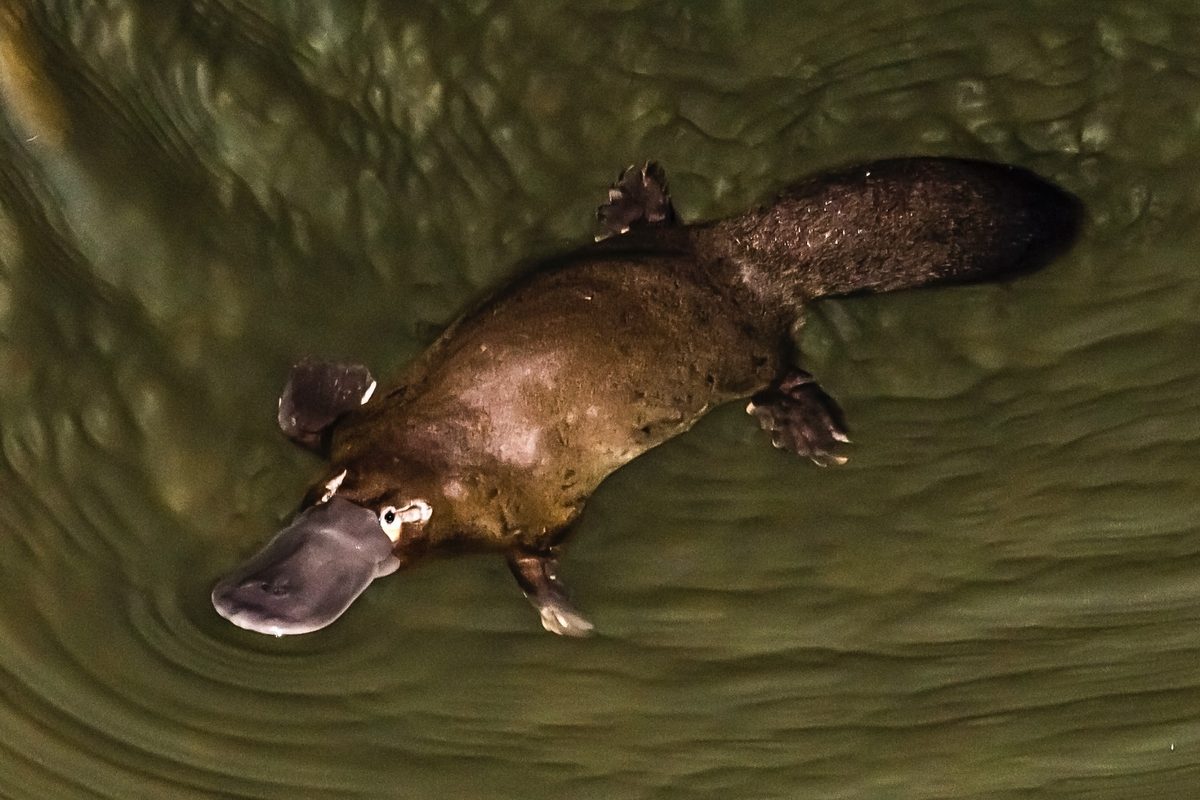
Platypuses, those famously weird, ‘duck-billed’, egg-laying mammals, have another odd string to add to their bow. A study in Biology Letters reveals that tiny, pigment-producing structures inside their cells are more bird-like than mammal-like, raising questions about the evolution of colour.
When European scientists first encountered the platypus, over 200 years ago, they wondered if its duck-billed, beaver-bodied form had been stitched together by pranksters.
Now, we know the platypus is no hoax, but its list of peculiarities continues to grow. Females produce milk but have no nipples. Males have venomous spurs on their hind legs. The animals sense electricity, glow under UV light, and their cells have five times more sex chromosomes than most other mammals.
Researchers wondered if the animal’s melanosomes might be different too. Melanosomes are the tiny pigment-making factories found inside certain animal cells. These petite structures, which are about a thousandth of a millimetre long, tend to be spherical or rod-shaped, and can be solid or hollow.
For more than 50 years, scientists thought that hollow melanosomes only occurred in birds, and that mammal melanosomes were always solid. Then Jessica Leigh Dobson from Ghent University and colleagues used high-resolution microscopy to peer at the melanosomes inside platypus hairs and found they broke the rules.
Platypus melanosomes are hollow and spherical. “This was totally unexpected,” says Leigh Dobson. “Hollow melanosomes have never been found in mammals before, and the combination of hollow and spherical is not seen anywhere else as far as we know.”
In birds, hollow melanosomes organise into nanostructures that produce iridescent colours. Hollowness also increases brightness which helps birds to make more colours, but platypuses aren’t rainbow-coloured. They’re brown. “This doesn’t really conform with what we currently know about how melanosome shape correlates with colour,” says Leigh Dobson. So, her next step is to find out why.
Hollow melanosomes were not found in long- or short-beaked echidnas, which also lay eggs and are close relatives of the platypus. Nor were they found in any of the other 120 or so mammal species studied.
So, maybe something in the platypus’s past explains this difference. Go back in time, and the ancestor of platypuses and echidnas is thought to have lived in the water where it foraged for food. By providing insulation, hollow melanosomes could have been an adaptation to this aquatic lifestyle. Echidnas then evolved as a land-dwelling species, so may have lost their hollow melanosomes, whilst platypuses, which live in the water, retained theirs.
Top image credit: Manuel Romaris/Getty Images
More wildlife stories from around the world
First Appeared on
Source link






Leave feedback about this