

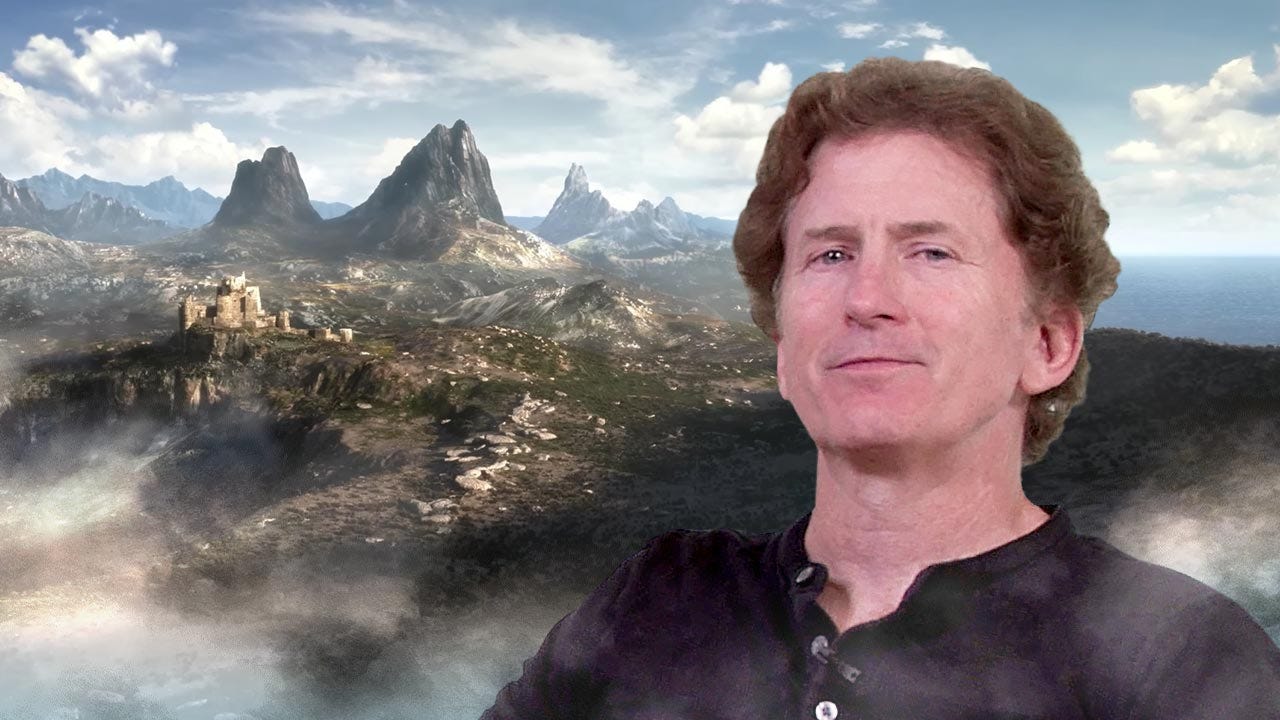
Bethesda Game Studios carries a lot of history with it, so when I visited its office in Maryland to check out what’s new with Starfield’s upcoming overhaul and DLC, there was much more on my mind. Thankfully, I was able to sort through some of that when I talked with studio head and creative director Todd Howard for a one-on-one interview where he gave some insight on Starfield’s path from launch to where it is today and shared some new details about The Elder Scrolls 6 and where Bethesda at with its next massive RPG. But we also discussed RPG philosophy, Creation Engine 3 for The Elder Scrolls 6, and why he just doesn’t want to announce games so early anymore.
You can watch the video version above or the transcript of our conversation below. And if you want to get into the specifics of the content in the Starfield update coming April 7, you can check out my full preview.
[Editor’s Note: The following transcript has been lightly edited for clarity.]
IGN: Take me through how the team got here thinking of how to update Starfield. The game has changed. We don’t do expansion packs anymore, necessarily. There’s still DLC, but you have intermittent updates. So a lot of quality of life changes, extra quests and all that. So take me through the journey of determining how to update Starfield since launch.
Todd Howard: Yeah, it’s a great question because there’s so much in the game, so much that we could do, so much the team wants to do, so much the fans want. And so it’s really figuring out … I think as we went into sort of, as we call it, “Year Two,” there were Creations [Bethesda’s mod system] and the faction quests with Tracker’s Alliance that we had been working on and finding out the right way to kind of bundle those together. And then we have all the other features we want to do from like the “elder” gameplay to ship modules to other things. And then we start looking at, ‘Well, you could kind of chop that up and release them, but is there a collective way we can kind of do these things as one?’ And then you have the story with [new] Terran Armada [DLC].
And that really stemmed from everything we’re doing right now from changing the game more in like a meta way, like the way you play it over many, many hours where it’s 10 or 100, as opposed to just having a questline that you do and then you’re done.
IGN: And a frequent topic that comes up in conversation talking about the trajectory of Starfield is how you communicate with your community, giving them what they want, but also doing something that’s still true to y’all’s vision with Starfield. So, how do you balance that when you have millions of players asking you for a million different things, but then you have limitations, you have things that you want to put in. What’s the relationship been like with folks who have stuck with Starfield since launch?
Todd Howard: Look, we’ve done a whole bunch of updates since launch, but then we clearly have gone through a period where we were kind of quieter as we were putting all this content together because we felt that there’ll be a good time to announce it all at once. But it does kind of feel a little bad for us where you want to tell players, ‘This is what we’re doing.’ But we sort of breadcrumbed, ‘Hey, we’re working on stuff.’ That only goes so far. A community wants to know, but we really start when we’re really ready to talk about it and [confirmed] when it’s releasing to make sure those moments for everybody playing are as exciting as possible, as informative as possible. I guess we’re looking at the community for feedback, too, on what do you want to hear from us. It’s something we’re still… I say we wrestle with it, like when to talk about something.
IGN: I want to talk about the PS5 port, because it’s been, at this point, two-and-a-half years since Starfield’s initial launch. So, why now? Was it technical limitations? Is there anything you could share on the business side that may have been a hurdle to get to a PS5 port, considering Bethesda is under the Xbox banner? Is there anything you could share in terms of how you finally got to a PS5 port after all this time?
Todd Howard: Well, I think after the game came out, it was obviously a question. It was a question in the audience, it was a question for us. We’ve always wanted to do it. I would say that we have a great relationship with PlayStation. We’ve been there for a long time with our games. So, I think with this one, we knew it would be a matter of time. We’ve been working on it for a while, so we still maintained a close relationship. We’re still shipping a lot on PlayStation. People forget with Fallout 76 and its other updates and Skyrim – we had still been doing a lot of PlayStation work, even though Starfield wasn’t there. So we’re just excited to get it out there, to the audience.
IGN: On the topic of the relationship with Xbox and being under that banner – recent changes, drastic changes with Phil Spencer retiring, Asha Sharma taking over. What can you tell me about your relationship so far with new leadership? I know Matt Booty’s still there, so you’re probably still in contact with him a lot, but how are you feeling about this shift in Xbox leadership moving forward?
Todd Howard: Well, look, I’m of two minds, right? I’m excited whenever there are new things and where they’re going in the future with the hardware. I’ve known about that for a while and all the plans. I will say I’m sad to see Phil go. He’s a good friend, he’s one of the key reasons that we’ve been a large part of Xbox, not just after them acquiring us. But even before that, you could see Xbox kind of being our lead platform a lot of the time. And the one thing I really liked, I wish people knew – I’ve sat in so many meetings watching Phil Spencer and Matt Booty look at games and [them] wanting to protect the creative vision and find a path for success. And I’ve seen them do that behind closed doors so many times and I don’t think they get the credit that they deserve for it. They’re great game leaders and Asha’s coming in and everybody thinks so highly of her. So, we’re excited about the future.
IGN: Now you mentioned hardware. Of course, I’m not going to be getting any answers about what the next console looks like, but I guess a more broad question is, as you are in the process of developing The Elder Scrolls 6 and you’re continuing to update Starfield, what is it about a next-gen console do you actually need and/or want?
Todd Howard: That’s a great question. We’ve been fortunate that we see that stuff really, really early and it’s tricky for, let’s say console manufacturers – whoever they are – they have to take a very long view of development when you sort of tape out on a chip, how you make that call with timing and cost, and then what does it look like five or 10 years after that? So it’s a really, really tricky kind of thing to maneuver both technically and business-wise when anyone is making a system like that where you’re going to lock it down. Our approach has always been – and because fortunately we’ve had such a PC audience and we’re doing it more and more going forward – which is to cast a wide net technically, to both take advantage of the very high end, but allow the game to scale down and handle [low-spec]. You look at handhelds now, you look at how popular those are becoming, and I think you’re going to see more lower-powered devices where, say, you’re traveling and you want to underclock that thing in a certain way; we want our games to be able to handle that.
I think more than anything when we look forward, we’re less about, ‘We are going to make the game and tie it to this spec,’ which we would sometimes do in the past, like particularly in the Xbox 360 era where you might be really constrained. Now they’re powerful enough and you’re looking at those different scopes of things where instead of constraining ourselves, we’re widening it, if that makes sense.
IGN: On the question of tech, you’ve talked about sticking with Creation Engine 2 with Starfield, but moving to a third iteration of the engine with The Elder Scrolls 6. What are the key differences when you’re going with a new engine? The Oblivion Remaster was done in Unreal, but you’re sticking to your own guns. You’ve talked about the advantages of having proprietary technology, so what are the things that you need out of Creation Engine 3 as you’re building a new game for it?
Todd Howard: Well, gosh, I don’t want to spoil too much. I mean, you get your whiz-bang rendering shiny pixel stuff that everyone would expect. And I think the change to Creation Engine 2 from where we were for Starfield was such an upheaval for what we were doing. We felt coming out of that, we could have managed that better. So going into Creation Engine 3, I can’t say enough about our tech staff and how they’ve handled that transition so that we can still be making a game while that is going on. And as we look at future tech, I already mentioned casting a pretty wide net and scaling way up and also down – I think there are things outside of the rendering that you would expect as it comes to data systems, how our worlds load, how they load content and present things of high detail close to the camera. There’s a lot of work being done there for how we load our worlds and present them sort of immediately on the screen, how we deal with the scale that we usually work with, how data’s coming in and out.
So there’s some foundational things that we felt we wanted to do to keep doing the things we want in the future. And then obviously, like I said, all of the graphics and rendering of things. But I think a lot of gamers, they’re reacting to what’s on the screen as they should, but a lot of people think that is engine. And so the actual rendering, like the pixel shaders and everything that’s happening, that’s actually a smaller part of an engine than people think. The engine deals with data structures, loading, [character] AI, save states, and the platform [it’s running on]. All of these things that go into an engine are far more than just the final frame.
IGN: A little bit more specific, Starfield will have interconnecting planets, broadening the scope between planets with the Free Lanes update. I know that one of the big criticisms of the original release of Starfield was that there was a lack of exploration in space and Free Lanes is the answer to that. Was that an initial limitation of the tech or did it just take time to figure out how to weave those things together?
Todd Howard: Yeah, it was interesting. Obviously, if you look at Starfield, when you’re in a star system, all that stuff is there. And we had to make a decision in terms of where’s the gameplay, right? So you jump into a system, flying through empty space, how much are we making that fun versus where you jump in? And then same thing when landing on a planet. How are we making that fun? And so we sort of made the decision to focus on the area you jump into and make that ship experience the best it could be. But obviously when you have a spaceship, you’re like, ‘Well, I want to fly to that planet. I want to fly.’ There was that moment of just even flying around the moon that we noticed mods and people doing it like, well, clearly the game can do it.
So we started with [the idea] that you want to be in your spaceship and to fly around a planet or fly smoothly over to that moon or whatever, right? It started there, then we’re going to have this mode where you’re going to go fast.’ Then it was, ‘Well that needs to have some gameplay, what would players expect?’ And that’s where we got into all of the systems that Free Lanes has. And it still is tricky, and finding that balance of, well, it’s empty space and if you’re running into things all the time, then it doesn’t feel like space. It starts feeling like an amusement park of just stuff everywhere. I think the team’s done great with the system in terms of things like your radar beeping and telling you, ‘Hey, there’s something there to go find, it’s up to you to deal with it’ [or just stay on] autopilot.
Actually, I have a lot of fun going into [autopilot] mode and then getting up out of my [cockpit] seat and then the ship is just cruising at these crazy speeds through space. But I’m still able to like [explore the ship]. We had talked about that, wanting to walk around my ship, wanting to talk to the other characters. I want to do all these things in that mode. So yeah, it came out well.
IGN: One of the things I love is picking the brain of people who’ve worked on RPGs for so long is, creating friction for the player and determining what happens with choice and consequence. I had a conversation with Leonard Boyarski leading up to The Outer Worlds 2 about how they think of RPG systems and creating friction for the player. I still say Morrowind is one of my favorite RPGs to this day because I look back on how much I enjoyed figuring things out for myself. A lot of RPGs these days like to streamline things because it can be a more approachable and pleasant experience for players who might not be deep RPG sickos like us. I want to throw that question to you as well, especially as you continue to work on big RPGs. Bethesda does have that history, so as you are building new games, you’re still thinking of how to revolutionize the genre, how do you think about choice and consequence and creating friction for players in a way that is still enjoyable for a broad audience?
Todd Howard: That’s a good question. I don’t know that I agree with the word “friction.” I think it depends on the definition. I think it’s [about] choices that are interesting where you know you chose one path over another, and that can also just be in a character system in terms of how you develop a character. Like, who do you want to be out of the gate? Take Starfield as an example with [character] backgrounds, compared to what we’ve had before. You’re going to start with these skills and you come out and say, ‘Hey, this is the character I want to roleplay.’ And so there’s a pretty healthy debate here I’ll say, with no right or wrong answer. To have a different experience, to make a different character, at what point should you start over? And I think that’s where you could get maybe get into some friction. Where with Oblivion, because it’s remastered, when you play it again, it’s a very clear game where you have a couple hours in, you’re like, ‘F**k, I think I chose wrong.’ And after Oblivion, I felt very strongly about this. And I was seeing this a lot and thinking, ‘I don’t want that in my games.’ I don’t want someone to be like, ‘I made a mistake several hours ago and I have no way of correcting it.’
Which is also why you see the sort of system in Skyrim where you don’t really pick a class. And even in Starfield or Fallout, you’re sort of picking a starting point, but you can kind of go in any direction. So if you feel you’ve made a mistake, you can still correct it. There are other ways to do that also where you get some scarcity. Starfield is a game with a character system where you can eventually get it all, although it’s long, whereas you look at a [Fallout] 76 with cards, there’s a scarcity. A lot of games, RPGs in particular, I think there are games out there that do quite a good job with the scarcity of builds. And so as we look forward, is there a way to have the best of both worlds where you can course correct, but there’s still some scarcity?
IGN: Earlier you’ve talked about the time from announcement to actual release, and how that’s something you’re a little bit more conscious of now. Talk about The Elder Scrolls 6 reveal.
Todd Howard: Just pretend we didn’t announce it. Doesn’t exist.
IGN: And in 2019, last time I talked to you, Starfield was still a ways out, as imminent as it may have felt, various factors happened between then and now. But how do you feel about that now? Are you a little bit more conscious of what you share at what time?
Todd Howard: Very much, yeah. I like to say I always start with when you go and press play, you’re about to play a game. What do you already know? What’s in your head? What’s your excitement level? What are your expectations? And I kind of back up from there. I prefer not to talk about stuff until then. I like to compress that moment when you hear about a game to when you can play it. Those would be on top of each other if I had my way every time. That isn’t necessarily the best thing to do with every game. Sometimes you need to inform people and there are business considerations, etc.
If you look back at the Fallout 76/Starfield/Elder Scrolls 6 announcements [from Bethesda’s E3 2018 showcase], that was really about informing our audience, because when you’re going to do something new, everyone’s going to ask, ‘What about Elder Scrolls 6? What about a single-player game?’ And we did it that way, but it’s not my preference. And I will say, we struggle with the balance because our fans want to know. They’re amazing, and are asking like, ‘Well, what are you doing?’ And,well, we’re working on a lot of stuff. I think if you look at the scale of our studio, we could have 10 times the amount of people to do all this. We’re doing so much and it’s just finding the right times to tell everybody about it. Look at Starfield today; I feel like the Starfield audience has been like, ‘What about us?’ And we had sort of a balance with like, ‘Hey, the end of the Fall was for Fallout the TV show,’ with everything we were doing. And we knew that we were just going to save the Starfield stuff to give it its spotlight during this time. But yeah, it’s a balance.
IGN: We also talked earlier about the way Bethesda scales as a project goes on and contrasting that with the many stories about AAA development being very long and being very expensive. When you look at your time from announcement to release, it looks like that is such a long and expensive process. But you mentioned the way Bethesda scales from pre-production to full production and how that works for you within your scope. Take us behind the scenes of how you’re able to manage those kinds of AAA expectations and some of your thoughts about how that has happened outside of Bethesda?
Todd Howard: For us, we’ve been fortunate that all the games that we’ve done have had big audiences, and many of them still have big audiences. So our prime job is always serving the millions of people currently playing a game. And when we start a new game, we’re usually going to start smaller. And we can have pre-productions – we’ll call it – for like two years, sometimes three years, with a smaller staff to make sure we know what we’re doing before we put a lot of people on it. That might be, not necessarily wasting time, but doing work where everybody feels things might get redone. I think some of that is necessary when you’re making a new game, particularly a new IP. Some of that work is going to get redone. We want to minimize that, and do enough of that work. We’ve been fortunate to sort of have balance, and then once we have some runway, then a lot of the team members and our partners outside are able to come onto a game. We’re at that point with The Elder Scrolls 6 where the bulk of the studio is on it, a lot of our partners are on it, and we know, ‘Hey, this is what we’re doing.’
So, that’s a good place to get to. But more than ever, a game like Fallout 76 going into a 67th update has a full team on that. When you have these very popular kinds of live games, which is new for us, having it to that scale and balancing amongst that, we’re in a good spot now, but that’s been sort of trickier for us to maneuver with these last few years.
IGN: So since we’re on the topic of Elder Scrolls 6, what can you tell me about-
Todd Howard: Nothing.
IGN: -where it’s at.
Todd Howard: I’ve never heard of it.
IGN: Then can you tell me about the lessons you learned in Starfield and how that’s carrying over to The Elder Scrolls 6?
Todd Howard: That’s a fair question, you should ask. I’ll say what I said earlier because it’s sort of a … I want to be careful with what I say about The Elder Scrolls 6, too, because I think everybody wants to know and we want to find a time that we’ll obviously talk about that in depth. But the one thing I’d say is really in the tech as we’re going to Creation Engine 3. Again, the team has done a really incredible job at not just pushing what it is, but how it’s integrated into our development cycle. So, you don’t feel that what we’re doing on a day-to-day basis, like when the game goes down. So, we’re in a fortunate position where the builds of the game are really consistently working every day. Well, not every day, but we’ve had more days than we’ve ever had where the build is good, there’s new stuff in it, and we can play it.
And when you’re making those kinds of technical changes as we talked about, often you’re pulling the rug out from under the team who’s making content. [You don’t want] to be like, ‘Okay, that doesn’t work for this period of time, you’re going to have to wait until we get that working again.’ And we’ve done a really good job of managing that on this game. And with Starfield, we struggled there for a number of years in terms of when we went through the engine change.
IGN: I imagine there are still more ideas in the works and the roadmap is going to be longer for Starfield, too. So after this big update, what are you thinking for Starfield’s future?
Todd Howard: I can just say there’s going to be more. Just like, we have this process of listing all the things we want to do – some of those may come out on their own, some of those may be bundled together in a moment. We still haven’t figured that out, honestly, but we have a list of what we’re doing after this, and we’re excited about it just as well. I also want to say, thanks to our Starfield audience out there who’ve just given us so much great feedback and to the millions playing it. We’re just really, really fortunate with a new game like this.
First Appeared on
Source link


Leave feedback about this