

Astronomers have directly confirmed two planets in the process of forming around WISPIT 2, a star that closely resembles our own young Sun. The discovery makes WISPIT 2 only the second stellar system ever where multiple planets have been caught actively forming, and scientists say it may hold clues to how our own Solar System came to be.
The findings were published on March 24, 2026 in The Astrophysical Journal Letters, led by Chloe Lawlor, a PhD student at the University of Galway’s Centre for Astronomy. The research team employed ESO’s Very Large Telescope and its interferometric counterpart, the VLTI, to obtain what astronomers call direct spectroscopic confirmation, the gold standard in exoplanet detection.
The WISPIT 2 system sits roughly 437 light-years away and hosts a star of about 1.08 solar masses that is only 5 million years old, so young it hasn’t yet begun hydrogen fusion on the main sequence. That extreme youth is precisely what makes it scientifically valuable: the planets are still assembling themselves from the surrounding disk of gas and dust, offering a window into processes that shaped worlds like Jupiter and Saturn billions of years ago.
A Second Planet Hiding Close to Its Star
The first planet in the system, WISPIT 2b, was confirmed last year with a mass of roughly 4.9 times that of Jupiter, orbiting at about 57 astronomical units from the host star. The new planet, WISPIT 2c, sits far closer in, at just 14 astronomical units, and is approximately twice as massive, with estimates ranging between 8 and 12 Jupiter masses.
According to the study, the team used the SPHERE instrument on the VLT to image WISPIT 2c directly, then turned to the upgraded GRAVITY+ interferometer on the VLTI to confirm its planetary nature through spectroscopic analysis. The K-band spectrum revealed CO absorption features, chemical signatures consistent with a young gas giant atmosphere. Co-author Guillaume Bourdarot of the Max Planck Institute for Extraterrestrial Physics noted that the recent upgrade to GRAVITY+ was critical, saying the team “would not have been able to get such a clear detection of the planet so close to its star” without it.
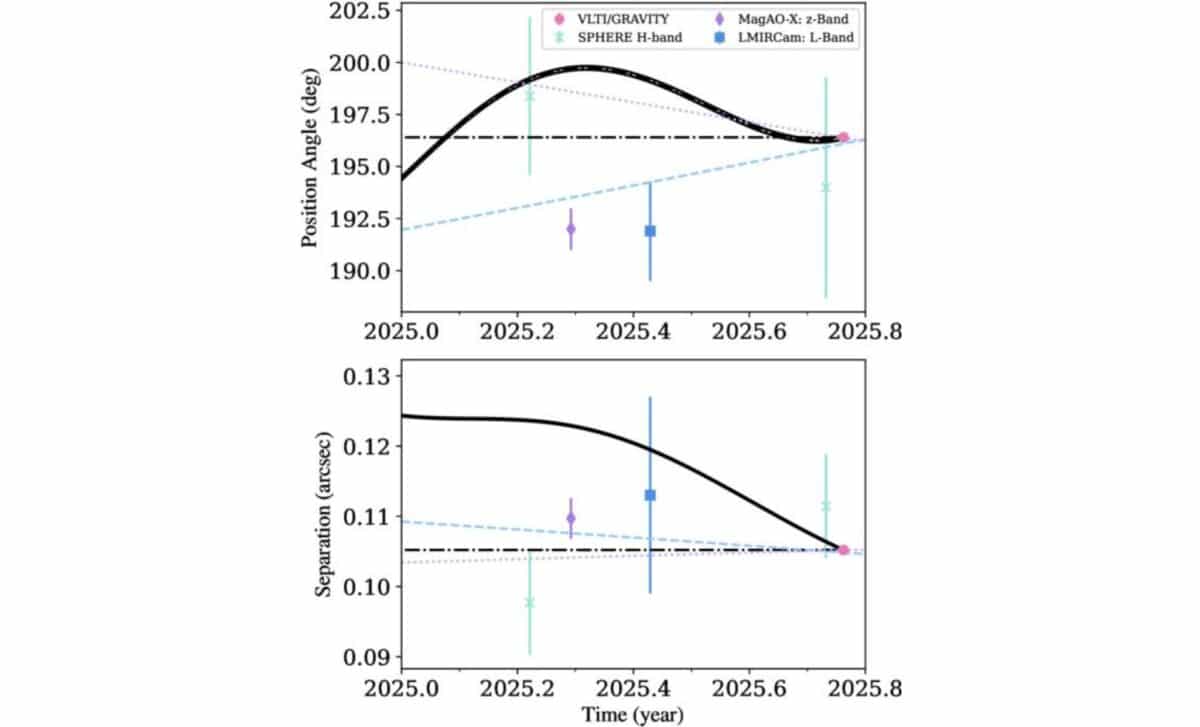
The confirmation process involved ruling out the possibility that the object was simply a distant background star mimicking a planetary signal. By tracking the astrometry of WISPIT 2c across multiple observation epochs and instruments, the team found its motion to be inconsistent with a stationary background source, pointing instead to a gravitationally bound companion in the system.
A Laboratory Unlike Any Other
What sets WISPIT 2 apart from the only comparable system, PDS 70, a young T Tauri star about 370 light-years away, is the extraordinary structure of its protoplanetary disk. While PDS 70 hosts two confirmed planets within a single large cavity, WISPIT 2 features a much more extended disk with multiple distinct rings and gaps stretching far out from the star.
According to co-author Christian Ginski, a researcher at the University of Galway, this architecture means the system offers “a critical laboratory not just to observe the formation of a single planet but an entire planetary system.” Both confirmed planets occupy gaps in this ringed disk, gaps that are thought to form as embryonic planets sweep up surrounding material and carve out lanes of cleared space.
The research paper notes that the broadly similar mass ranges and orbital separations seen in both WISPIT 2 and PDS 70 may hint at what the authors cautiously describe as a “Goldilocks zone” for giant planet formation, a range of conditions in young disks that appears conducive to generating multi-planet architectures. Lead author Lawlor described the system plainly: “WISPIT 2 is the best look into our own past that we have to date.”
More Planets May Be Waiting
The story of WISPIT 2 may not be finished yet. Beyond the two confirmed planets, the disk shows at least one additional gap further out from the star, a gap that has not yet been linked to any detected body.
According to Lawlor, the team suspects “there may be a third planet carving out this gap,” potentially one of Saturn-like mass, inferred from the gap being noticeably narrower and shallower than those associated with the two confirmed giants. Ginski added that ESO’s upcoming Extremely Large Telescope, a 39-meter behemoth currently under construction in Chile’s Atacama Desert, with first light expected in March 2029, may be powerful enough to directly image such a planet.
The paper’s co-author Richelle van Capelleveen, a PhD student at Leiden Observatory and the leader of the prior study on WISPIT 2b, put the broader significance plainly: “This detection of a new world in formation really showed the amazing potential of our current instrumentation.” With two planets confirmed and structural evidence for a third, WISPIT 2 has quickly become one of the most closely watched young solar systems in the sky.
First Appeared on
Source link






Leave feedback about this