

Astronomers have long struggled to understand dark energy, the unknown force believed to drive the accelerating expansion of the universe. Scientists estimate it represents roughly 68 percent of the universe’s total energy content, yet its nature remains unclear. Observations like this newly identified supernova may provide a rare tool for studying how cosmic expansion has evolved across billions of years.
The discovery of SN 2025wny also highlights how gravitational lensing can transform distant cosmic explosions into powerful cosmological probes. By splitting the light of a supernova into multiple images that arrive at different times, lensing creates a natural experiment that allows astronomers to measure the expansion rate of the universe with new precision.
A Supernova Whose Light Traveled for More Than 10 Billion Years
The newly reported event, SN 2025wny, was first detected in 2025 by the Zwicky Transient Facility in California during routine sky surveys. According to research published in The Astrophysical Journal Letters, the supernova lies at a redshift of z = 2.01, meaning its light has been traveling through space for over 10 billion years before reaching Earth.
The explosion belongs to a rare class known as superluminous supernovae, which can outshine ordinary stellar explosions by a large margin. Spectroscopic observations confirmed that SN 2025wny is a Type I superluminous supernova, with absorption features and ultraviolet characteristics consistent with previously studied events.
The brightness of the object initially puzzled researchers. According to the study by Joel Johansson and collaborators, the observed luminosity suggests a magnification factor between about 20 and 50, produced by gravitational lensing from a massive galaxy located at redshift z = 0.375.
A Cosmic Lens Creates Multiple Images of the Same Explosion
Gravitational lensing occurs when the gravity of a massive object bends and amplifies the light of a more distant source behind it. In the case of SN 2025wny, a foreground galaxy acts as the lens, distorting the path of the supernova’s light and splitting it into four distinct images arranged in a cross-like pattern.
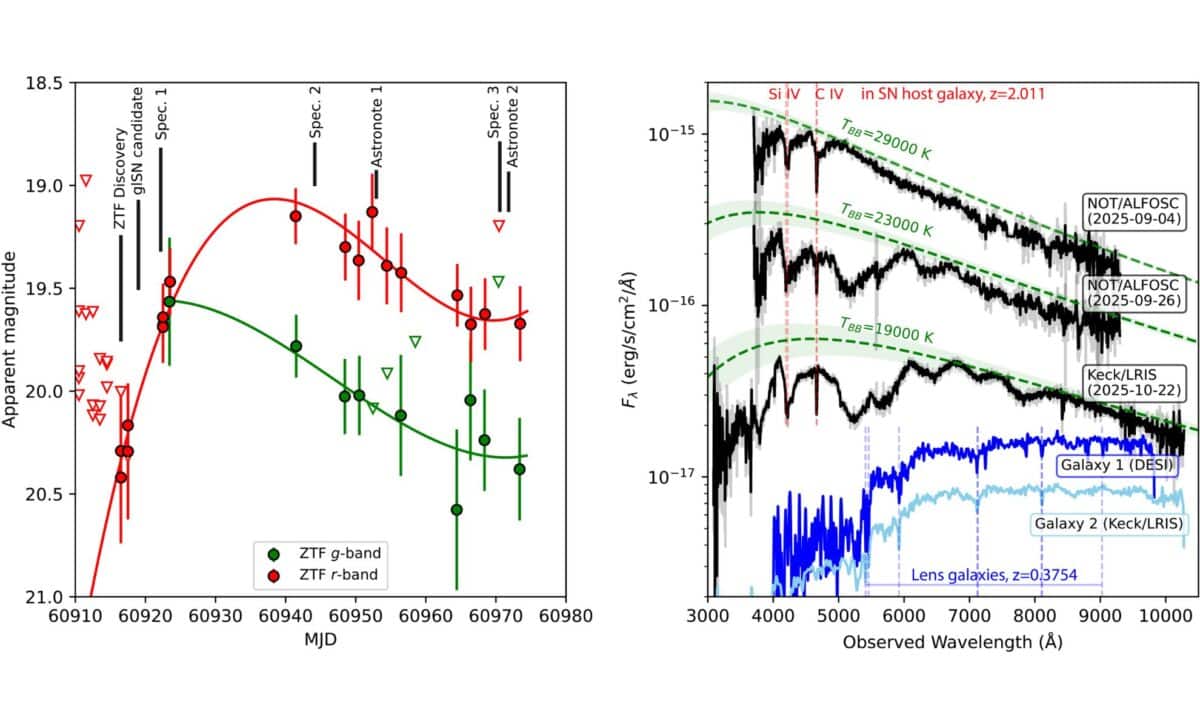
Follow-up observations with the Liverpool Telescope in La Palma revealed the multiple images clearly, confirming that the event was gravitationally lensed. Additional measurements were carried out with major observatories including the Keck telescopes in Hawaii, the Hubble Space Telescope, and the James Webb Space Telescope.
According to Liverpool John Moores University astrophysicist Daniel Perley, events like this are exceptionally valuable because they allow astronomers to observe the same explosion several times, each image representing light that traveled along a different path through space.
Measuring the Universe’s Expansion Through Time Delays
The multiple light paths created by gravitational lensing do not all have the same length. As a result, the different images of the supernova reach Earth at slightly different times. This time delay depends on the geometry of the lensing system and, crucially, on the rate at which the universe is expanding.
Because supernovae evolve over weeks or months, astronomers can compare the brightness changes in each image and measure those delays with high precision. According to Daniel Perley, the time differences between the images are directly linked to the expansion rate of the universe.
This approach may help address the so-called Hubble tension, a long-standing discrepancy between two major methods used to measure the Hubble constant. Measurements based on the cosmic microwave background yield one value, while studies of nearby galaxies produce another.
Researchers believe that detailed monitoring of SN 2025wny could provide new constraints on which value is correct. According to the team, gravitationally lensed supernovae offer an independent technique for measuring cosmic expansion and exploring the influence of dark energy on the universe’s large-scale evolution.
First Appeared on
Source link






Leave feedback about this