

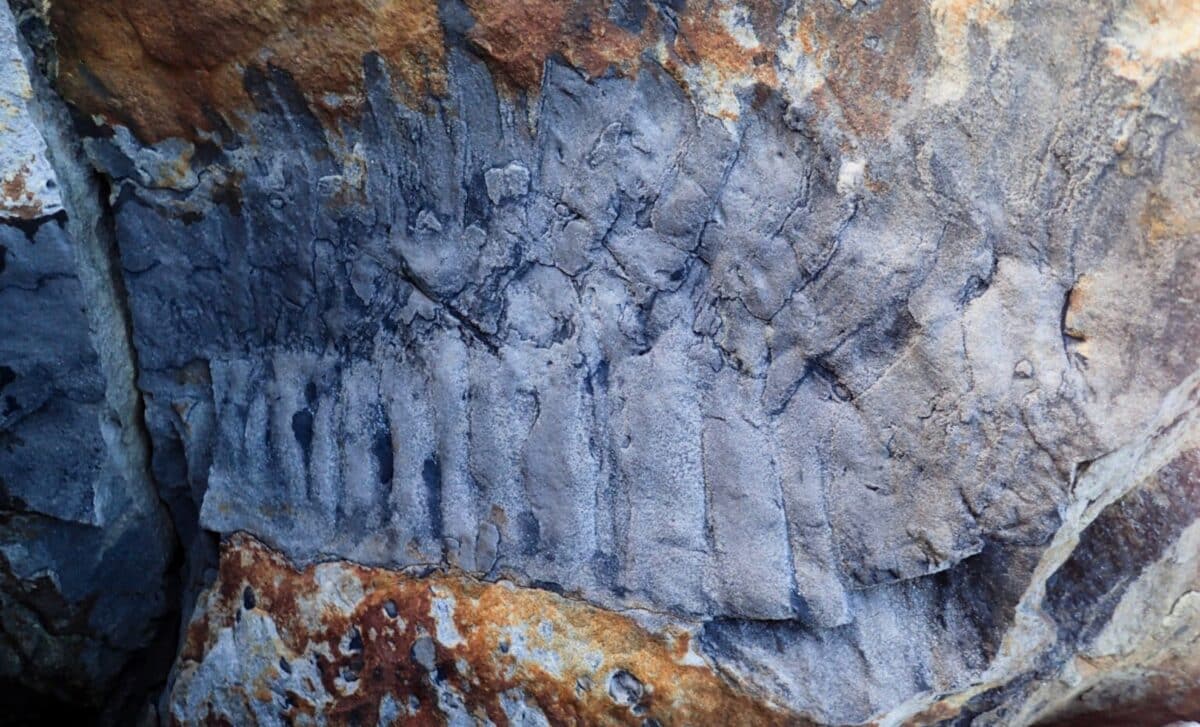
The fossil measured only 4 centimeters, nowhere near the giants that made Arthropleura famous. Yet this small specimen, found at Montceau-les-Mines in France, ended up yielding one of the missing pieces of the puzzle. For more than a century and a half, paleontologists had found body segments, trackways, and incomplete remains without ever getting a clear look at the front of the animal.
On October 9, 2024, a study published in Science Advances changed that. The team led by Mickaël Lhéritier worked on Carboniferous specimens still locked inside rock and used imaging methods to reach what the surface could not show. The site at Montceau-les-Mines, now covered by an artificial lake, lay near the equator at the time, in a tropical swamp environment.
That matters because Arthropleura was no ordinary arthropod. According to the researchers, it lived between about 345 million and 290 million years ago in Europe and North America. The largest individuals are thought to have reached roughly 2.6 to 3.2 meters in length, with body mass estimates around 50 kilograms, figures also reflected in broader coverage of the animal’s scale by SciencePost.
What the Rock Was Still Hiding
The problem was never a lack of fossils, but their condition. Since its discovery in 1854, Arthropleura had been known mostly from fragmentary remains and fossilized trackways. Those clues were enough to confirm that a giant land arthropod existed, but not enough to explain its anatomy, diet, or exact place in evolution.
The researchers first used conventional tomography at a university facility, but the scans did not provide enough contrast to isolate the fine structures of the head. They then turned to the ESRF, the European Synchrotron Radiation Facility in Grenoble, where a multi-resolution approach let them examine the inside of the fossil-bearing nodule. One of the authors, Vincent Fernandez, said the team first scanned the specimen at low resolution and then zoomed in on the most promising areas.
That change in scale revealed features nobody had described before in Arthropleura. The researchers were able to observe mouthparts, antennae, and internal structures that had remained hidden inside the rock. For the first time, the giant animal was no longer a body without a face.
A Head That Did Not Match Expectations
When the 3D reconstruction was finished, the front of Arthropleura showed an unexpected mix of traits. The head was roughly circular and carried slender antennae and stalked eyes. Beneath it sat a pair of mandibles and two pairs of feeding appendages known as maxillae.
This is where the story becomes more complicated. Some parts of that feeding apparatus resembled those of centipedes, the group represented today by predatory chilopods. But the rest of the body pointed in another direction, with an organization closer to millipedes, including two pairs of legs per segment and a body plan very different from that of a fast hunter.
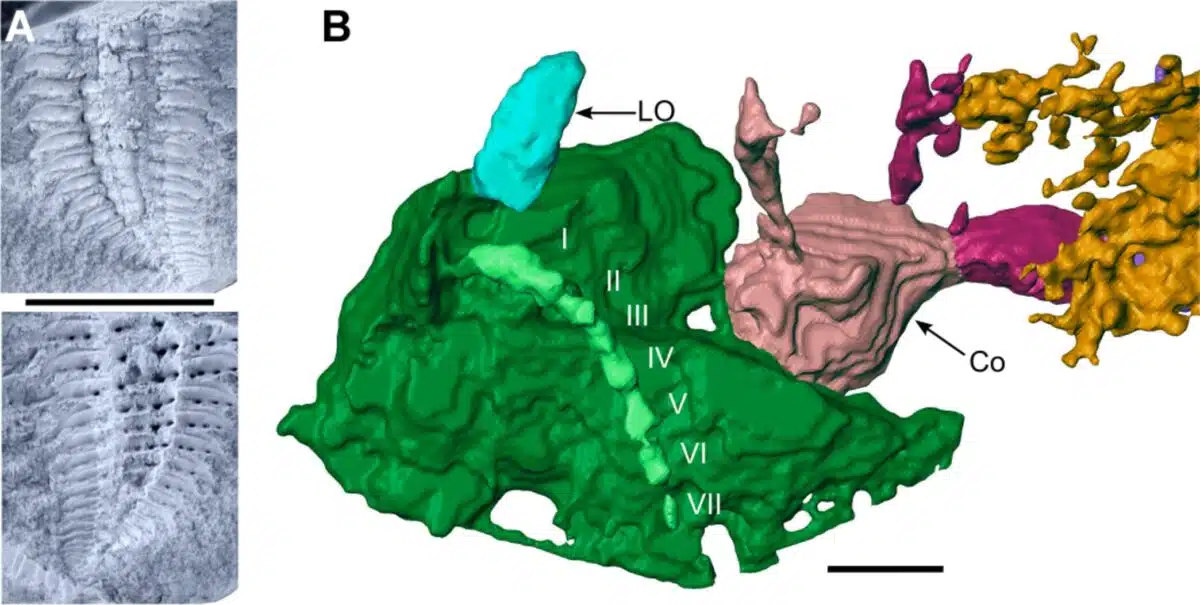
The study abstract indexed through PubMed captured that tension clearly: Arthropleura shared traits with both millipedes and centipedes. That helps explain why its identity resisted classification for so long. As long as the head was missing, every new fossil added more weight to the mystery without resolving it.
The Giant Arthropod Was Probably Not a Predator
The new images also challenge the familiar image of a giant monster chasing prey through Carboniferous swamps. Even though it had some traits seen in carnivorous arthropods, Arthropleura lacked certain structures expected in an active predator. The researchers point in particular to the absence of venom-bearing forcipules, the modified appendages used as grasping hooks by modern centipedes.
The rest of the body supports the same view. With its short legs and apparently slow movement, Arthropleura does not look adapted for rapid pursuit. The team concluded that it was more likely a detritivore, feeding on decaying plant matter on the forest floor.
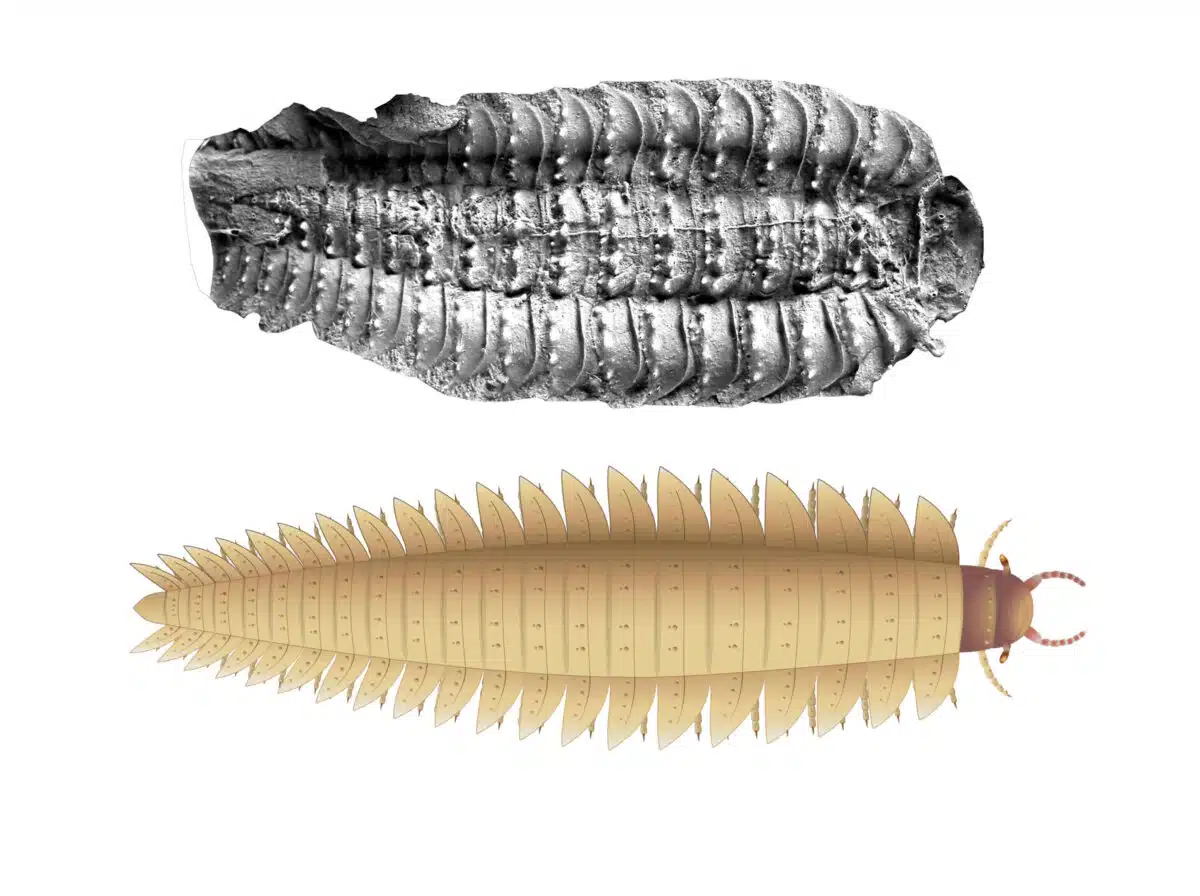
That changes the scene entirely. In the wet forests of the time, Arthropleura may have acted as a giant recycler, moving slowly through layers of organic debris. The specimens studied were juveniles, but even they show a segmented organization that suggests growth through repeated molts, with new segments and leg pairs added over time.
Where Arthropleura Finally Fits in the Tree of Life
The study did not stop at anatomy. The authors also combined morphological data with phylogenetic analysis informed by transcriptomic datasets to test where Arthropleura belongs among myriapods. Their results place the animal as a stem-group relative close to millipedes, while still preserving traits that connect it to the broader millipede-centipede lineage.
In other words, the newly recovered head did more than give Arthropleura a face. It provided an anatomical link between groups whose relationships had often depended on molecular data from living species. That is what makes this 305-million-year-old fossil especially useful: it preserves a mix of features that no living animal keeps in the same form.
The team now plans to return to the more than 100,000 fossils collected from Montceau-les-Mines before the site disappeared beneath water. Other Carboniferous arthropods may still be waiting there with details sharp enough to expand this ancient ecosystem. For Arthropleura, at least, the blank space at the front of the body is no longer blank.
First Appeared on
Source link






Leave feedback about this