

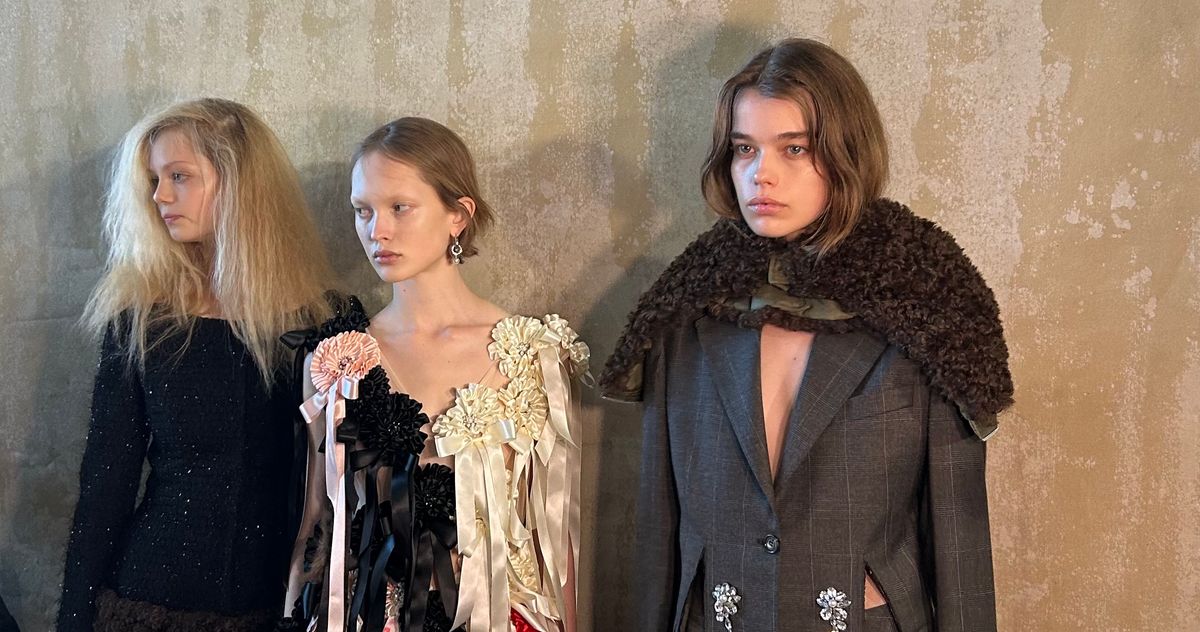
Backstage before Rocha’s runway show.
Photo: Danya Issawi
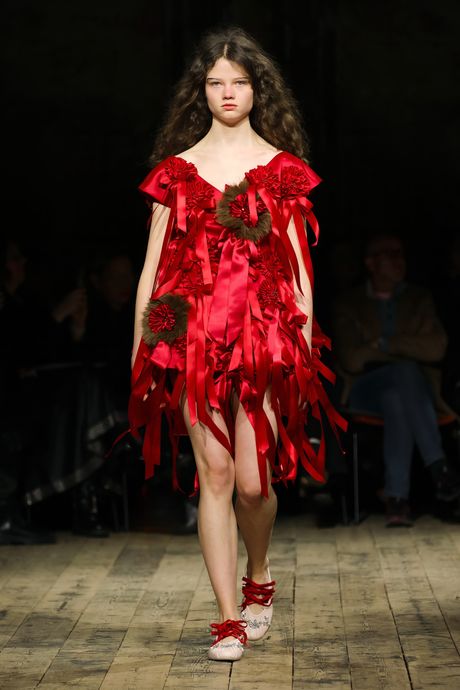
Simone Rocha has set herself apart as a designer who is able to traverse collaborations with brands like Crocs and Moncler and show guest collections with Jean Paul Gaultier, all while maintaining the distinct look of her independent clothing label. Maybe it’s the ribbon trimmings, or the pearlescent finish, or the tulle or the sewn-in flowers, but you just know a Simone Rocha jacket, blazer, dress, shoe, or purse when you see it.
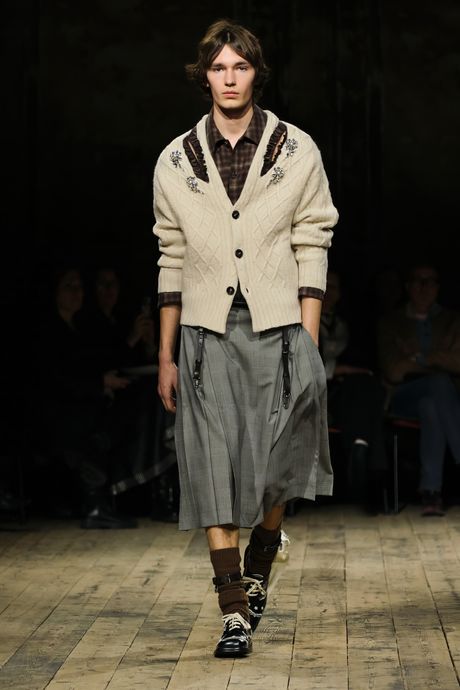
Her clothes have often been described as “feminine,” though she noted there is no singular way to present femininity. It’s something especially palpable in her recent collection, which she showed this Sunday. Where there are ribbons and sequins and frill, there is also rugged tweed and cargo greens and sporty bombers (part of her forthcoming collaboration with Adidas).
Ahead of her fall 2026 collection, Rocha sat down with The Cut to talk about teenage rebellion, “weird sisters,” and her ultimate dream of living a life offline.
I saw a bit of your mood board for this collection, and you have the painter Jack B. Yeats and his sister, Elizabeth Yeats, on it. Tell me about that.
Jack B. Yeats is a very well-known Irish painter, and he is very iconic for these paintings of the River Liffey. Fun fact: He was an Olympian, because Olympic painting used to be in the Olympics, and he won it for Ireland, which is so fabulous. But what really made me interested are these two particular paintings that he did depicting Tír na nÓg, which is this Irish mythicism story about the land of eternal youth. Another thing I found, when I was looking into Yeats, is his two sisters (Elizabeth and Lily). They had set up a printing press and were essentially the Arts and Crafts movement in Ireland. It was all female-led, and they were almost rebels and quite outsiders. They were actually parodied as the “weird sisters.” I found this tradition of these kids and this cast of characters all following this fable to be essentially a mythical thing.
I’m also curious about the horses on the mood board. Who are they? What are they doing there?
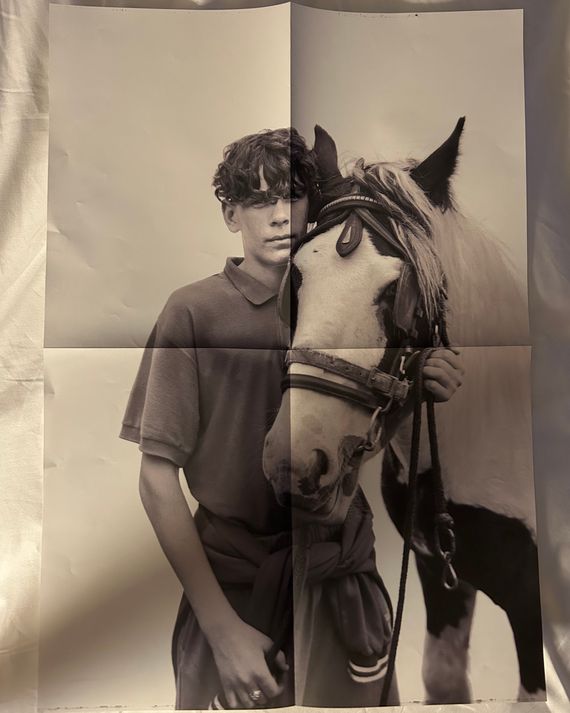
The invitation for Rocha’s show: an image from Perry Ogden’s Pony Kids.
Photo: Danya Issawi
There’s a body of work called the Pony Kids, which was also photographed around the same time when I was growing up in Dublin in the ’90s, and there are these incredibly wistful photos of boys and girls. Tír na nÓg is symbolized as a white horse, so I felt there was a real kinship between the two. And the way that these kids dressed also influenced a lot of the direction of the garments. There’s a lot of equestrian hand-me-downs, but then, for example, they’re paired with sportswear, or paired with outerwear, or paired with underpinnings, like long johns. This approach to dressing is really for yourself, but at the same time, it’s about being on view. Across the collection, the whole color palette feels much more earth-driven and peach-driven and turf-driven. I wanted to ground the fantasy.
Before we move on from your board, Yeats and his sisters grew up with a father who was an artist just as you did. How do you think growing up with a father who is a designer has affected the way that you see the world?
It made it all seem natural and possible. It didn’t feel like an impossible thing to become a designer growing up. I was always really at home in his studio. I was really at home backstage at his shows. That’s the real privilege, to be privy to that environment and feel comfortable in it and feel confident that you can be your own self within it. It was also his creativity, his love of textiles, his love of organic materials. He was very inspired, being from Hong Kong and moving to Ireland and getting very influenced by Irish craft, by hand-knit crochet and hand screen printing. I was very fortunate that was my first introduction — working with people on the team to do the screen prints, learning how to crochet, learning how to knit, and up to the point of learning how to pattern cut when I was in college.
Was there a moment when you knew you wanted to become a designer?
Yes, I went to a fine-arts college in Dublin, and I did a year where I did all different disciplines. I really wanted to be a painter or a sculptor. I was drawing these desperate still lifes of wilting flowers and then making them out of wire. But what was in my head, I just couldn’t make it a physical thing. And then at the very end of the year, I said, “Okay, I’ll do the fashion and textiles module.” I was really into fine-art print, the old type of lithograph print, and I started researching nurses. But then I started printing these images of how you construct nurse hats. And then I started making the hats. Then I blew up the hat, and I thought it made an amazing skirt shape. And then I was like, “Yeah, this is what I should be doing.”
It sounds like at the beginning of your journey in school, there was a bit of resistance toward leaning into designing. Where do you think that was coming from?
I think it’s just a rebellious child reaction.
Your work is often deemed as the pinnacle of femininity, even though, and as you’ve said before, there are so many different ways to present femininity and be feminine. Would you describe your work that way?
As a designer, I think it’s very hard to put words in your own mouth to describe your work. That’s why you do what you do because it says it for you. I kind of stole the three words that describe it from my late professor, Louise Wilson. When she used to see my collections after I graduated, she said that she thought it was “feminine, modern, and strong.”
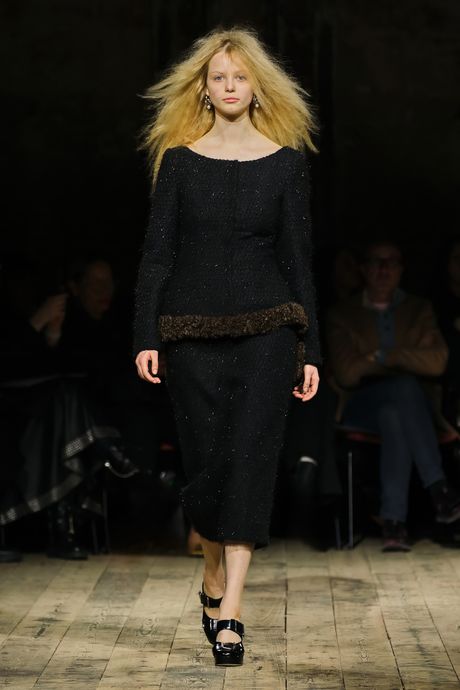
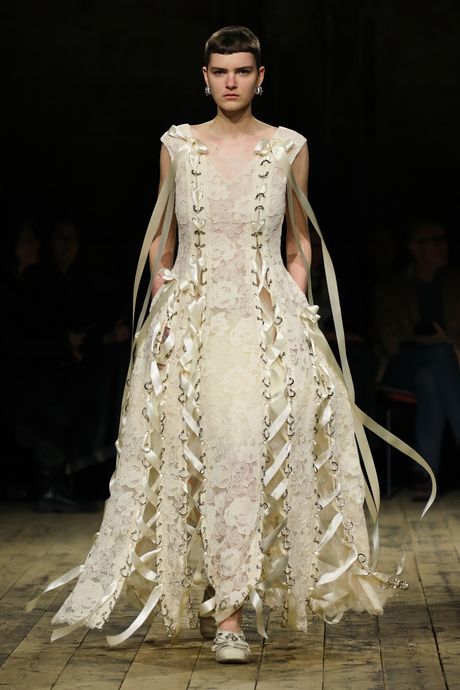
Because your work is so public, have you ever, perhaps earlier in your career, felt worried about what public reception might be toward a collection?
Whether you’re a designer or not, everybody’s personality is now public. Sometimes it’s very difficult. Historically, I’m quite a private person, and it can be challenging that every six months, you’re up for public criticism. That is, I’m not going to lie, intense. But you just have to try and be as authentic to yourself and really try to avoid the noise. It is challenging because you get to show every six months, and you get this huge jolt of energy and excitement and collaboration and congregation, and that is such a high. But then it takes a lot to sustain it. And today, there’s nowhere to hide.
I didn’t really conceptualize the aspect that all of us are public-facing now. Everything is kind of just a panopticon.
The ultimate luxury is not being online. That’s serious desirability there.
You’ve done a collaboration with Crocs in the past, you’re doing Adidas this season, and I’m curious how you maintain your identity while working on projects like that?
I love collaborating. It can be something as unexpected as Crocs, or as unexpected as Jean Paul Gaultier, and they can be two different ends of the spectrum. I love the opportunity to be able to dive into an archive with Gaultier and really create an internal conversation of my work and his work. Or for example, with Crocs, they have such a specific technique and experience and manufacturing, which is so alien to an independent business with an atelier where we do a lot by hand. It almost gives me more license to have creativity than in my own label, actually, because there are no rules and it can be totally unapologetic. I really like the challenge. I’m very excited to partner with Adidas to do this sportswear collection that I’ve actually been thinking about for around ten years, since I was a student.
When I was in college, doing all this learning about myself, I would thrift polo tops in XXXXXL sizes so they almost looked like dresses. And then I would wear these vintage petticoats or tutus, which were always, of course, falling apart and sheer, and I would wear the Adidas rip-offs or I would wear the shorts underneath. And then if I were wearing shorts, I would wear long socks and either men’s or vintage 1940s shoes, because I’ve always had small feet, so I could always buy funny little vintage shoes. I just love bringing together the unexpected. I’ve always loved this collision. No one ever put it into one garment, and I was like, “I want to do it one day.”
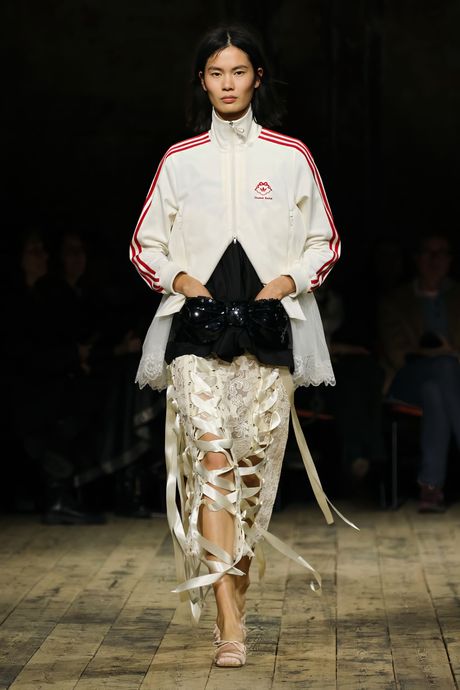
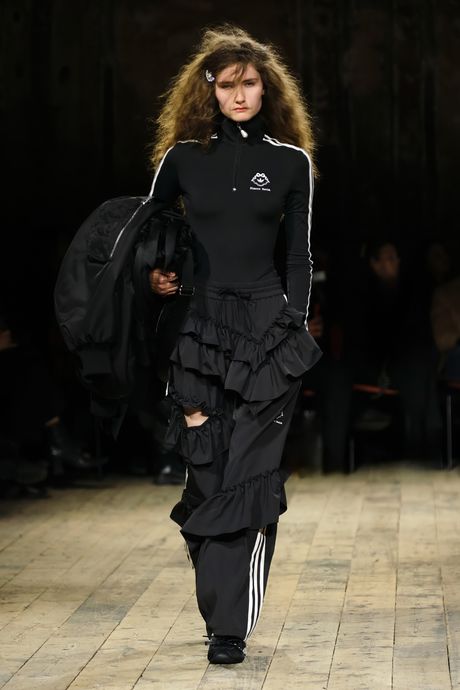
To keep that vision alive, I feel like you must have a strong sense of self and a rich interior world.
Oh my God, in my mind it’s just a low, dull hum, 24/7. You don’t want to actually be in there.
But what I do with my internal monologue is I just write it down 24/7. I write it down in the morning, I write it down in the evening. It’s a real mix. It can jump through ideas, places, emotions, ambitions, negative, positive.
So you’re a journaler. Do you just follow your stream of consciousness?
Exactly. I really need to. I have hundreds and hundreds of notebooks, and they all have little bits on pages, and half of it is actually illegible, but even getting it down helps.
I want to ask about London Fashion Week at large. You’re an independent designer, and it seems like there’s a sense of freedom in that. There are so many wonderful independent designers in London, and I feel like this is the case with New York Fashion Week; there’s this constant conversation about designers in New York and London sometimes decamping for Milan or Paris when they get the chance. What keeps you showing in London?
I will always show where I can put on the best show, where I can do the collection justice. Whether it’s the venue, whether it’s the amount of space. It’s where I can have the resources. I’ve always treated the show as a place that, when you walk into that space, you could be anywhere. I want, when you’re in that space, you to feel kind of displaced. You’re brought into that moment for that hour.
First Appeared on
Source link


Leave feedback about this