

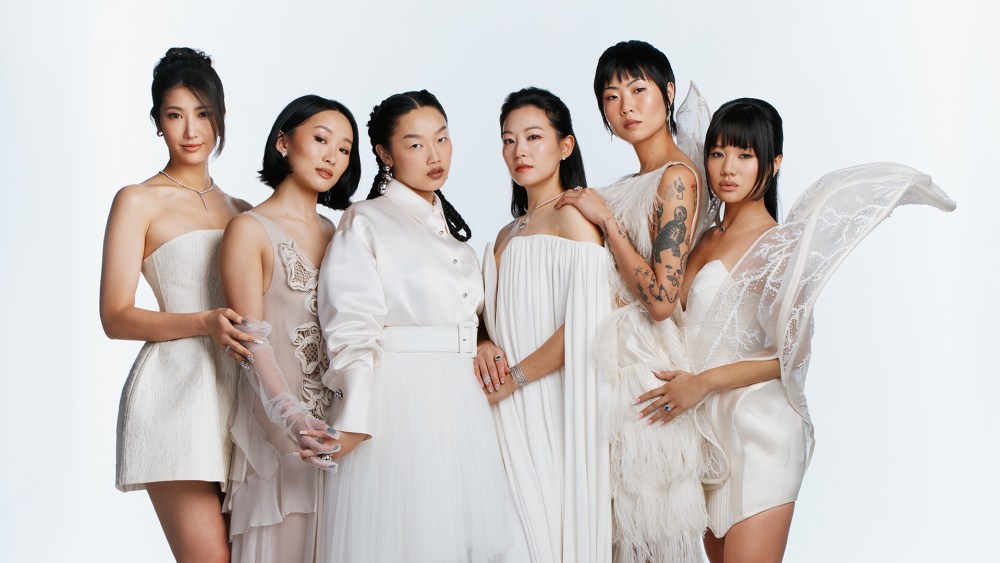
It’s the morning after the Critics Choice Awards, and “KPop Demon Hunters” has scooped up two trophies: best animated feature and best original song for “Golden.” It marks the first big award win of the season for the Netflix blockbuster.
Rei Ami, the singing voice of the film’s Zoey, describes the feeling as “vindicating,” adding that there’s finally “validation. It’s long overdue,” she says. “We worked our asses off. We’ve had the door shut in our faces. We were told we were too little, too much.”
After years of hard work and rejection, the film and “Golden” (written by EJAE, Mark Sonnenblick, IDO, 24 and Teddy Park) have changed the lives of EJAE (the singing voice of Rumi in the film), rapper and singer Ami, singer Audrey Nuna (the singing voice of Mira), and actors Arden Cho (the speaking voice of Rumi), Ji-young Yoo (the speaking voice of Zoey) and May Hong (the speaking voice of Mira). “Golden’s” lyrics: “I’m done hidin’, now I’m shinin’ like I’m born to be. We dreamin’ hard, we came so far. Now I believe,” seem fitting for their personal stories.
Dan Doperalski for Variety
It all began with director Maggie Kang, who helmed the film alongside Chris Appelhans. As a story artist on “Puss in Boots” and “Kung Fu Panda 3,” Kang was driven by a desire to showcase this side of Korean culture “because it didn’t exist.” As the love of K-pop music and Korean food began to rise in America and Europe, Kang recalls, “I felt there was this hunger for Korean content and seeing more culture. I wanted to ride that K-wave and take that opportunity to create something that could embrace all parts of our culture.”
Kang’s determination to tell an authentic story has paid off. Since its release last June, “KPop Demon Hunters” (produced by Sony Pictures Animation) has exploded into a cultural phenomenon, becoming Netflix’s most-watched title over a six-month period with 482 million views. Meanwhile, “Golden” topped the Billboard’s Global Exl. U.S. chart for a record-breaking 20 weeks. Wins at both the Golden Globes and Grammy Awards followed. It was nominated for two Oscars: animated feature and original song (“Golden”).
On a sunny January morning in Los Angeles, EJAE, Ami, Nuna, Yoo, Cho and Hong cozy up together on a cream-colored couch at Netflix’s Hollywood office, sipping iced coffee, jasmine green tea and water. Scheduling conflicts had kept them apart until now. It’s the first time all six are sitting down together to talk about the film’s success and the challenges they’ve overcome.
EJAE, you’ve been with this project the longest. What was it that made you say, “Yes, I want to be a part of this?”
EJAE It was the fact that it was the first Korean-based animated film [from U.S. producers]. I love animation, and I’d never seen animation or anime that had Korea as a background. I’ve seen “Kung Fu Panda” and “Big Hero 6.” There were other Asian cultures represented. I wanted to see Korea, so I was very excited for that, and the story was genius. The fact that they were able to incorporate a concept that could have both historical Korean culture and modern culture mixed into one was genius. And using Korean shamanism as part of a superhero-powered thing in music, I was, “Yeah, I’m sold.”
And for the rest of you?
JI-YOUNG YOO I had a first audition in September of 2022. I read for Rumi first, and six months passed, and I forgot that I had auditioned for it, and they called me back in to read for Mira. Another six months passed, and they called me back in to read for Zoey. And that pattern of several months passing continued.
For my final audition, I went into Sony Pictures Animation and read 25-30 pages. By the time I finished that, between auditioning for Rumi, Mira and Zoey, I think I read the whole script. I did it because I thought it’d be fun, and I thought the project was going to be a really enjoyable time and something that was going to be artistically fulfilling. And it absolutely was.
The reception of it has been mind-blowing. There’s a good lesson in there somewhere about following your passions and what you love. So it’s been a bit of a journey, but it’s been very fun.

Rei Ami, left, and Ji-young Yoo, the singing voice and speaking voice of Zoey, respectively.
Dan Doperalski for Variety
REI AMI I got the audition in late May of 2024 and when the brief came in everyone else had been confirmed. Zoey’s singing voice was last — they couldn’t find her, and I was shocked. I was like, “There are so many talented people who could do it.”
But the only information I got pertaining to the movie was very generic. It said, “KPop girl group, also demon slayers by night, powerful music, and they’re badass and cute.”
With Zoey, the only description I got was that this person needs to be able to sing in Korean and English, but they need to be able to rap extremely fast. I got the material, and it was different snippets of the songs. I recorded on a very cheap $40 mic. I don’t know what this movie is going to do, but it’s everything I love in terms of animation. It’s a Netflix film. It’s music, and it’s based in Korean culture. It’s everything that I am. I said, “OK, let me do this. Let me try.” And I recorded every segment except for the A5 (high note) in “Golden.” I told my manager, Aaron Tropf, “Tell them Rei cannot hit this note. She does not want to hit this note.”
You kept that note in, right, EJAE?
EJAE Yes.
AMI When I went into the first session, I met Michelle Wong, the producer. She said, “When they sent in your audition and your EPK,” which was my TikTok and music videos, they were like, “Oh, we found her.” She told me that story. And I was super honored.
ARDEN CHO I did my very first audition in August 2022, and I auditioned for Celine. I remember seeing the storyline and thought, “This is incredible, and this is so cool.” I got all of Celine’s backstory, so I feel like I came into it knowing more than we’re supposed to. I did a little voice recording on my iPhone. It was so funny because I remember, even in the email, I looked back, and I said, “Here you go. Were we supposed to do more than one take? I just did one.”
But I remember being like, “Let me do my most mature, adult, low-pitched, very mom-like voice.” I listened to it again, I thought, “I sound like Rumi.” I remember when I got the callback, but it was for Rumi. They asked, “Would you be interested?” I thought, “But they know I auditioned for Celine, right?” and they said, “They think your voice might fit better for Rumi.”
It’s mind-blowing that I started recording in December 2023 and then finished a year later. It’s a crazy journey, but I feel super blessed to be able to say that I took a shot for Celine and was super happy to be a part of it, but then to somehow end up the lead. I hope that inspires people that you just never know, and sometimes you might think that you might only be good enough or something, but maybe someone’s got bigger plans for you.
MAY HONG I signed an NDA on June 14, 2022. I auditioned for all of them. I recorded from home. I don’t think I had a setup at that point. The callback is the reason why I bought a mic, because I was just doing it on my phone, and I’d never done voices before, and so I did all three on my phone in my tiny office, and it was so obvious from the beginning that Mira was the one. I also did a bunch of sessions in New York; it really did feel like a playpen with Maggie and Chris. It felt so intimate and fun. I can hear in their voices that they’re seeing it as they’re saying the lines – they have a vision. It was fun to see Chris having his eyes closed a lot when we were doing it. I would do the line that he liked, and he would mark with his finger in the air for him to flag that take.
Audrey Nuna, top, and May Hong, the singing voice and speaking voice of Mira, respectively.
Dan Doperalski for Variety
AUDREY NUNA It was super organic, because I was in the thick of promoting my second album, “Trench,” at the time, and I’d been asked if I wanted to be involved. My No. 1 core memory of this process was when I performed at SXSW in Austin. I played a set, and I remember getting off stage, and I was not feeling good about the set. I had given it my all, but my sound was horrible. I was super sweaty, and I remember someone named Jojo from Sony Pictures Animation came up to me and was so excited, and I didn’t know who he was. He pulled up from the dark corridor and said, “I think you’d be perfect for this thing we’re looking to do.”
I was fixated on the show and a few weeks later, my team asked me if I wanted to hop on a call with Ian Eisendrath, who was executive producing for the project. I was down to hear what it’s about. What sold me when I got on the call with Ian, the first thing he talked about was that it was a movie about Korean American women who are outside the box. They are learning about their identity and who they have to be in this world. From the moment he talked about that core concept, I felt really excited about it, because this was something that I relate to so much, and always walking this tightrope between worlds and trying to understand how I can be more of this or more of that, or rebelling against that in my entire artist project as well. I felt so seen by the concept of the film, and I had to be a part of it. I don’t know where this is going to take me, but I need to be a part of it.
These are all great stories because, in a way, you’re battling demons of rejection, acceptance and being seen, and you end up with this incredible success story. How has this journey helped you battle or overcome some demons?
AMI We’ve been told we were too little, too much. Every step of my career. You think we started this two years ago? No! We’ve been in this game for a long time. To get this recognition — two out of two last night [at the Critics Choice], we deserve it. And all the demons I have to personally fight and be like, “You know what? You are the bitch. You are that girl. You are that shit.” I had to tell myself every single fucking day, even when I didn’t believe it.
CHO On a slightly different note, when you said, this is the first time Variety was having six Korean American, Korean women, Asian women, on the cover, it made me feel emotional, because my entire career, I’ve always felt a bit like being Korean or a woman or Asian American was such an obstacle in this career, in this business, right? I’ve been working for 23 years as an actor, and you get a lot of notes along the way, or you get a lot of things that don’t work out. And I feel like we know — from all of us, from EJAE’s story, from everybody who shares throughout this press run — so much [from each other] that we do have a lot coming into this. You start to hear all these stories of, “Wow, everyone brought so much into it and had the same goal, we just wanted to be seen. We wanted to feel like we belong.”
As Rei said, it is deserving, and it is exciting. Why didn’t we think that we deserved this? We grow up feeling that there’s this expectation of how we should be, and there’s a responsibility of how we should act. But this movie gets to show so many different types of personalities and characters and boldness and fearlessness, and these su- per-hot, badass women who are also goofy, silly and cute. When a guy shows up who’s super smoking hot, things get a little bit cuckoo, and little cray-cray, and all of a sudden they forget that they’re demon hunters, but they’re like, “Ooh, he’s cute.” It’s fun. It just plays that you can be badass, beautiful, soft, and you can still be vulnerable. I love all of that, and I feel all of us in some realms have found some healing in it as the world has. I think that’s what keeps bringing people back to the movie, is that the story is incredibly healing and a connector for everyone.
HONG More than anything between that gap of auditioning in 2022 and getting a callback, it was less about “Did I not get it?” and being disappointed. First of all, I am able to forget that I sent in an audition. That’s a skill we need to have. When I got the callback, I thought, “Yes, this is being made.” I thought it had died, and it wasn’t going to happen because when I read that script, I was excited that it even existed and had come far enough for auditions to begin. We grew up with so little …
CHO We never had an opportunity to see Asian girls like that. Even Maggie said it took so long, and there were so many obstacles. And I think there were many points that I’m sure it felt like maybe it’s not going to happen.
EJAE, left, and Arden Cho, the singing voice and speaking voice of Rumi, respectively.
Dan Doperalski for Variety
EJAE It was really hard. It was so new in every way. There had never been representation, and this whole hybrid of pop and musical. It was new in every way: Maggie’s first film as a director, Ian’s first time doing animation and K-pop, Mark [Sonnenblick’s] first time doing K-pop, my first film, [music producer] Black La- bel’s first time doing a film. It was very interesting to see everyone come together and work on this incredible story. We had to fight a lot, and I think every single person can understand that part. But because of that struggle, and all the demons that we had to deal with, that’s what made the movie so beautiful and genuine. I think that struggle was needed. I think all those demons were needed for this film, because through that, we were able to find depth in our writing and acting. It hit home. Looking at what Rumi is going through, I was able to relate to that. I think it was really about knowing that your demons will be there no matter what, and just knowing how to navigate, and not to hide that anymore.
NUNA The archetypes of the women who are represented in this film … I feel the special thing about this project, in terms of people being able to take something away and be like, “OK, this is how I can,” as EJAE said, “approach my relationship with the demons that I have.” I think a huge part of that is understanding that the three characters, their demons, are also different. Rumi, who’s a perfectionist, that leads to a lot of the darkness and her shadow side. Zoey doesn’t feel enough. Mira has this very tough exterior to defend herself against a world that doesn’t accept her. When you see different types of those struggles being represented, it gives such a nuanced and humanistic view of the human experience, and the fact that it is through Korean culture is an honor of a lifetime.
HONG I very much expected that people would be like, “Oh, I love how badass Mira is.” But a lot of people show up and they’re like, “I love how soft she is.” It’s so nice that that is the feedback, that people see that human side.
You’ve had so much feedback on the film, but is there a story that has stuck with you?
EJAE I met someone who was saying how much he loved the film because he was transitioning. He said, “This movie made me confident to make this choice to transition.” I was like, “Wow.” Accepting who I am and being confident in who I am, both my flaws and my good, that’s how much it gave life to his life. So that was really impactful.
HONG It’s resonating with the queer community. I’ve met a lot of people who are transitioning that say, “I’m done hiding.” A lot of parents of autistic kids tell me that this is one of the first movies that kids have been able to sit through. Someone told me the other day that their nonverbal autistic kid spoke as a result of the movie. It’s intense to have that shared with you, because you know what it means to you, but then when you feel how it’s impacting other people that deeply, there is a weight that you walk away with too, and I’m so humbled by that.
YOO We began this year in a state of only [known]IP works. Musicals and stories around people of color and women don’t work. All of these preconceived notions we had of what films work in today’s mar- ket. And I think what’s been exciting to hear is a lot of filmmakers feel reinvigorated that we’re only one movie away from rewriting all of the rules of how we make the industry work. At every step of this process, the film has broken some notion of what we thought the ceiling was like. We didn’t think a streaming movie that had been out for a few months could top the box office for one week- end. We set a record for the most number of songs from a movie soundtrack on the Billboard Top 10. None of these things were things that we thought were still possible in the industry, or at least, a lot of people around me have felt that. So it’s been lovely to hear young and seasoned filmmakers talk about how the movie has been inspiring in terms of what the rules are in Hollywood right now.
Dan Doperalski for Variety
It’s also inspiring seeing how Korean culture, from the food to music, has been embraced by non-Koreans. What does that mean to you to see that?
NUNA At the premiere, everyone was laughing and having a jolly time. I’m sitting there bawling my eyes out, because it hit such a deep nerve of pain and trauma that we’ve all experienced, of being first generation or from immigrant families, and having to step into rooms where you’re just not welcome at the end of the day. Experiencing that as a kid, especially with food for me – specifically with bringing gimbap to school and kids being, “Ew. What is that? That’s gross.” As a kid, you’re in such a vulnerable place where you don’t understand where it’s coming from or why.
We grow up and we learn to assimilate into a world that doesn’t accept you, or hopefully decide not to assimilate in that way. I think it’s really interesting the types of things that move me when it comes to the film, because it’s the deeply personal things that seem like small details to me that are the ones that hit the hardest.
YOO Major props to Maggie. Chris once said, it takes a lot of guts to be who you are, but it also takes a lot of guts for Maggie as a first-time director, asking to make this movie more Korean. She had to fight for it. Every bit that they fought to keep in the movie pays off.
Maggie told the story about how in her elementary school classroom, Korea wasn’t on the map. I remember kids around me not understanding that there were countries outside of China, Japan and Asia. It’s exciting to know that kids won’t have to go through something like that.
HONG The retroactive healing that Maggie and Chris provided for all of us.
EJAE We are so thankful to Maggie for being determined to bring this story to audiences and for creating these characters, but she also created this incredible sisterhood.
CHO I feel it’s so important and meaningful, and Maggie talked about this a lot: these accolades and these wins are so crucial because everybody risked so much to be so culturally specific to fight for these things. Now we’re validated. I feel as Asian Ameri- cans, we’ve had many wins in this industry. With “Crazy Rich Asians,” everyone’s “Oh, my gosh. Is it changing?” With “Shang-Chi,” they were, “Is it changing?” But it’s still such a risk if your movie is Asian American, it’s such a risk if it’s a woman. I hope that this is the movie changes the game for filmmakers.
AMI We’ve had to fight — and you can talk to our parents and our grandparents, they’ve suffered under imperialism. They’ve had to fight famine. So when we see these girls have an obsession, love and appreciation for food, it’s because that runs deep in our culture, food is our language and love. It’s how we apologize, it’s how we connect and build community, and to see that, and to see Maggie fight for that, and for that to be finally accepted, respected and kept in the film — huge win!
HONG It is vindicating. This is the ultimate Korean revenge film.
CHO Culturally, I’ve noticed a lot of people who aren’t Asian or immigrants didn’t really understand why Rumi felt like she had to listen to Celine so much and obey and respect so much. Every interaction with Celine, I found that unless they were a minority, people were like, “Hmm, that’s weird. Why don’t you be like, ‘F you, I’m out,’” It was so interesting, because it made me have deeper conversations of culture. Our culture is so much about respect, honor and doing the right thing. I realized we have this repressed weight and stress. It’s trauma. In Korean, there’s a very common saying that means “You just have to do it.” I found that finally talking about and having these conversations, at least for minorities, has been super healing. I really love the respect in Korean culture. I love that and forever will love that, but I think there’s still a healthy mind.
EJAE I heard from a Korean director who said that if it were made by a Korean director, it would not be the same. The fact that it was made by a Korean Canadian means that we were able to make a film like this that can resonate with both Korea and the world, because our perspective of Korea is also very different.
CHO This movie is now, and I feel this is the beginning of showing the world that K-pop, K-fashion, K-beauty … The K is …
AMI … It’s no more. Drop the K.
MAY HONG: Styling: Akua Murray-Adoboe; Makeup: Grace Ahn/Day One; Hair: Lauren Palmer Smith/Forward Artists; JI-YOUNG YOO: Styling: Wayman + Micah/The Only Agency; Hair: Rena Calhoun/A Frame Agency; Makeup: Allan Avendano/A Frame Agency; ARDEN CHO; Styling: Amanda Lim/The Only Agency; Makeup: Sangwon Jeon; Hair: Steven Mason/Exclusive Artists; EJAE: Styling: Kate Li/The Only Agency; Makeup: Kevin Cheah/Opus Beauty; Hair: Mark Alan Esparza/Kramer and Kramer; AUDREY NUNA: Styling: Danyul Brown/The Only Agency; Makeup: Ashley Ysabelle/The Only Agency; Hair: Antoine Martinez/Paradis Agency; REI AMI: Hair: Darren Hau/Opus Beauty; Makeup: Chloe Forbes/Opus Beauty; Styling: Ayumi Perry
First Appeared on
Source link

Leave feedback about this