

Sign up for the Slatest to get the most insightful analysis, criticism, and advice out there, delivered to your inbox daily.
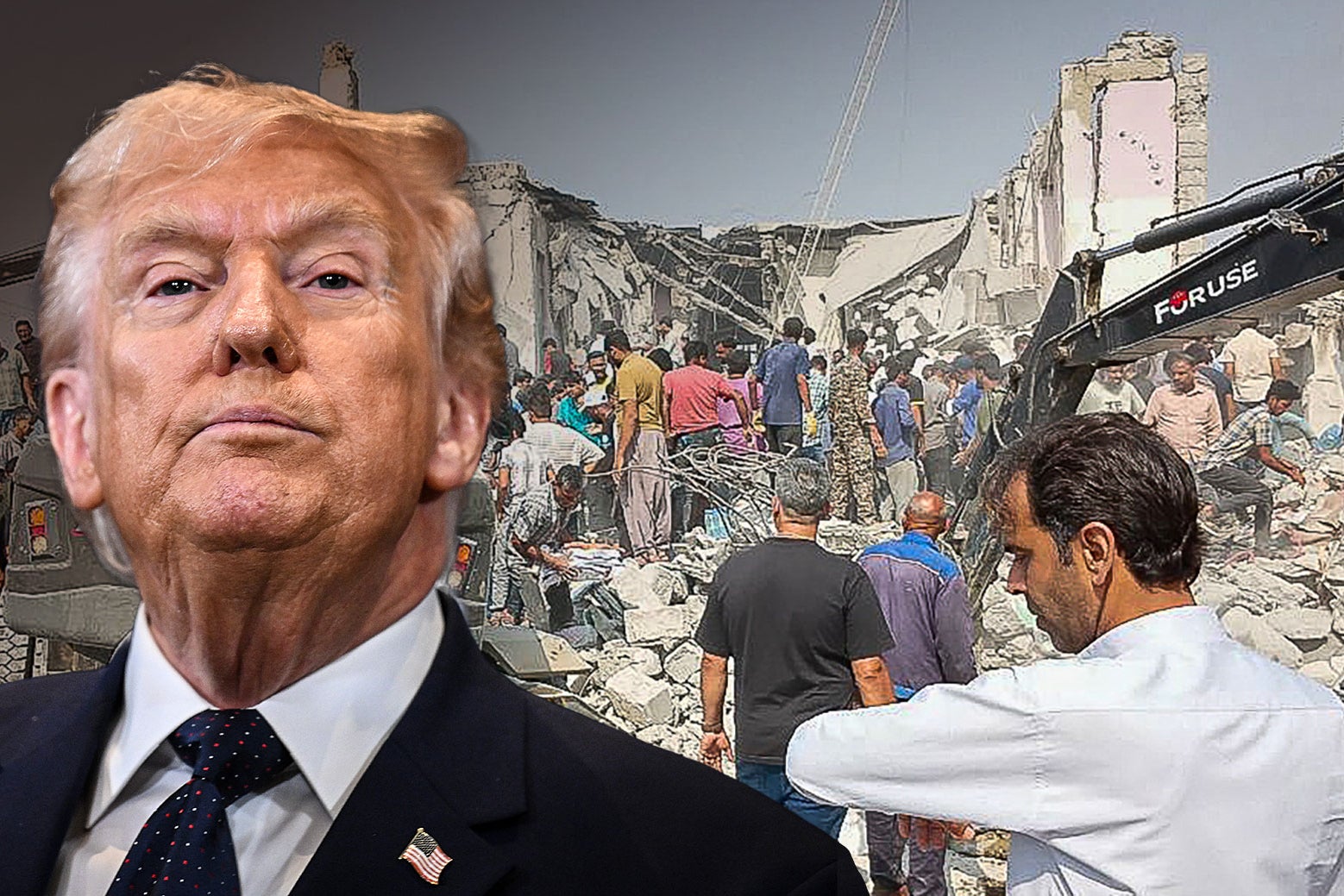
There are many appalling things about the ongoing war in Iran, but one of the worst so far is President Donald Trump’s persistent avoidance of responsibility for the missile attack that hit a girls’ school, killing at least 175 Iranians, most of them grade-school children.
Video footage clearly shows the damage was done by a Tomahawk cruise missile. In his press conference Wednesday, Trump said that the Tomahawks are “generic” weapons (untrue, they are quite distinctive) and that many countries have some, including Iran (very untrue), suggesting—even stating explicitly—that Iranians themselves might have fired the missile.
There are precedents for how to handle these sorts of incidents. During the war in Afghanistan, when U.S. troops accidentally killed a civilian (a frequent occurrence), they went to the dead person’s family, apologized, and gave them some money. In 1999, during the war in Serbia, when U.S. planes mistakenly bombed the Chinese Embassy in Belgrade, killing three employees and injuring 20, President Bill Clinton phoned Chinese President Jiang Zemin to apologize, stressing that it was an isolated error, not a deliberate attack on China.
In other words, it is possible—under previous presidents, it has been policy—to admit to making horrific mistakes in wartime, and even to compensate for the damages. A soldier, even a president, can do so without appearing weak or suggesting doubts about the wider war. In fact, refusing to take responsibility raises the possibility that the killings were deliberate. No doubt many Iranians, who have been told for decades that America is Satan, believe that Trump and his airmen deliberately attacked a girls’ school—which will make a peaceful resolution to this war all the more difficult.
Ten days into this war, it is clearer than ever that when it comes to weighing the ends and means of the conflict (what its goals are, and how much death and destruction he’s willing to inflict to obtain them), Trump is making it up as he goes along.
In the course of a few hours on Monday, Trump couldn’t maintain a consistent cover story about the war’s broad outlines. In a phone interview with CBS News, he said, “I think the war is very complete, pretty much. They have no navy, no communications, they’ve got no air force.” As a result, the U.S. is “very far” ahead of his initial four-to-five-week estimate of how long the war would last. Because of this remark, oil prices, which had been soaring, plummeted—and the stock market, which had been tanking, recovered much of the day’s losses.
But not long after, in a press conference at Mar-a-Lago, Trump said, “We’ve already won in many ways, but we haven’t won enough. … We’ll not relent until the enemy is totally and decisively defeated. … We could call it a tremendous success right now … or we could go further. And we’re going to go further.”
Compounding the confusion, around the same time as Trump’s war-is-almost-over CBS interview, the “Department of War Rapid Response” account posted on X, “We have Only Just Begun to Fight,” parroting Defense Secretary Pete Hegseth’s words on CBS’ 60 Minutes, “This is only just the beginning.”
Asked at the press conference which assessment was right, is the war almost over or just beginning, Trump replied, “Well, I think it could say both. The beginning, it’s the beginning of building a new country.”
This is at best evasive. When it comes to the question that was asked—How is the war going?—it cannot be at the beginning and near the end. And when it comes to building a new country, Trump hasn’t laid out the vaguest vision, except that “the Iranian people” (all 90 million of them?) should rise up and take over (against the arms of 190,000 Revolutionary Guards?) and that he—Trump—should have a say in picking the new leader.
In any case, Hegseth has said the big difference between Trump’s regime-change policy and that of President George W. Bush in Iraq is that Trump’s doesn’t involve endless, futile efforts at “nation-building.”
Analysts, journalists, and pundits who try to parse the Trump administration’s policy in this war should give up. There is no policy. More than that, there’s not really a Trump administration. There is only Trump, his impulses, and the members of his Cabinet who try to keep up with them. For instance, after Trump said the war was almost over, Hegseth tried to walk back his comment that it was closer to the start, saying, “It’s not for me to posit whether it’s the beginning, the middle, or the end. That’s his, and he’ll continue to communicate that.” Hegseth is right on this point, but then why did he posit it to begin with?
Oh, for the days when a president and his Cabinet held National Security Council meetings to hammer out at least the semblance of a coordinated policy.
Similarly, last week, Secretary of State (and acting national security adviser) Marco Rubio said the goals of the war are to disable Iran’s navy, destroy its ballistic missiles, and make sure it can never build a nuclear weapon. Yet Trump continues to talk about regime change or at least killing the next series of leaders, as long as they don’t meet his standards of acceptability. “We want a system that can lead to many years of peace,” he said at his Monday press conference, “and if we can’t have that, we might as well get it over with right now.”
This seemed to reprise his March 7 post on social media: “Under serious consideration for complete destruction and certain death, because of Iran’s bad behavior, are areas and groups of people that were not considered for targeting up until this moment in time.”
A president’s words, especially in wartime, should send a signal—to friends, foes, neutral observers, and fellow citizens—of what is desired and what to expect. Trump’s words send a muddle of signals, unleash a flood zone of noise. He doesn’t know what he wants or how to get it, and therefore even if the Iranians or our allies or anybody else wanted to help him, it’s not at all clear what they should say or do.
And so U.S. and Israeli bombs and missiles keep smashing up stuff and killing people. This is unleashing mayhem, not prosecuting war. As Carl von Clausewitz famously put it, war is the continuation of politics by other means. In other words, wars are fought for political ends—and fought in a way designed to bring about those ends. Trump is confusing about both, probably because he doesn’t have a clear idea himself about either.

First Appeared on
Source link




Leave feedback about this