

Far from major coastlines, a wide stretch of water in the Southern Indian Ocean has long drawn the attention of oceanographers for a simple reason. The sea surface there is unusually salty. Persistent sunlight and steady evaporation remove large amounts of moisture from the water, leaving dense salt behind and creating one of the most saline regions in the Southern Hemisphere. For decades, this area served as a reliable marker in the study of global ocean chemistry.
Ships, buoys, and research expeditions have sampled these waters since the middle of the twentieth century. The measurements helped scientists understand how salt moves through the ocean and how it influences the density of seawater. In that sense, the region became a natural laboratory for studying ocean salinity, one of the fundamental properties that shapes how water circulates around the planet.
When researchers began comparing the most recent measurements with older records, however, the numbers did not line up as expected. Gradually, the surface water in this historically salty region appeared to be losing some of its defining characteristic. At first the differences were small enough to look like natural variability.
But once scientists combined observations from several decades into a single dataset, a clear pattern began to emerge. The change suggested that the ocean in this region was receiving a steady influx of freshwater, altering the balance that had kept the area consistently saline for generations of oceanographers.
Six Decades of Observations Reveal a Large Change
Researchers from the University of Colorado Boulder analyzed more than sixty years of ocean measurements to understand what was happening in the region. Their work, led by Weiqing Han and published in Nature Climate Change, examined observational records together with computer simulations to reconstruct long-term salinity trends across the basin.
The analysis showed that the area dominated by high salinity has shrunk substantially over time. According to the study, the region covered by the saltiest surface waters has declined by about 30 percent over the past 60 years. Scientists describe this as the fastest large-scale freshening trend recorded anywhere in the Southern Hemisphere.
The magnitude of the change becomes clearer when scientists estimate how much freshwater must have entered the ocean to dilute the salt. Gengxin Chen, a visiting scholar in the Department of Atmospheric and Oceanic Sciences at Colorado and a researcher at the Chinese Academy of Sciences, calculated the volume required to produce the observed shift.
Chen estimated that the freshening is equivalent to adding roughly 60 percent of Lake Tahoe’s freshwater each year to the region. That steady input gradually reduces the salt concentration of surface water that once remained strongly saline due to evaporation and limited rainfall.
Freshwater Arriving From the Indo-Pacific
At first glance, increased rainfall over the Indian Ocean basin might seem like the most obvious explanation for the change. Yet the researchers found that precipitation trends in the area are not large enough to account for the amount of freshwater required to produce the observed decline in salinity.
Instead, the team traced the water to a vast reservoir known as the Indo-Pacific freshwater pool. This region stretches across the Tropical Pacific and parts of the eastern Indian Ocean, where persistent rainfall keeps surface waters naturally less salty than average.
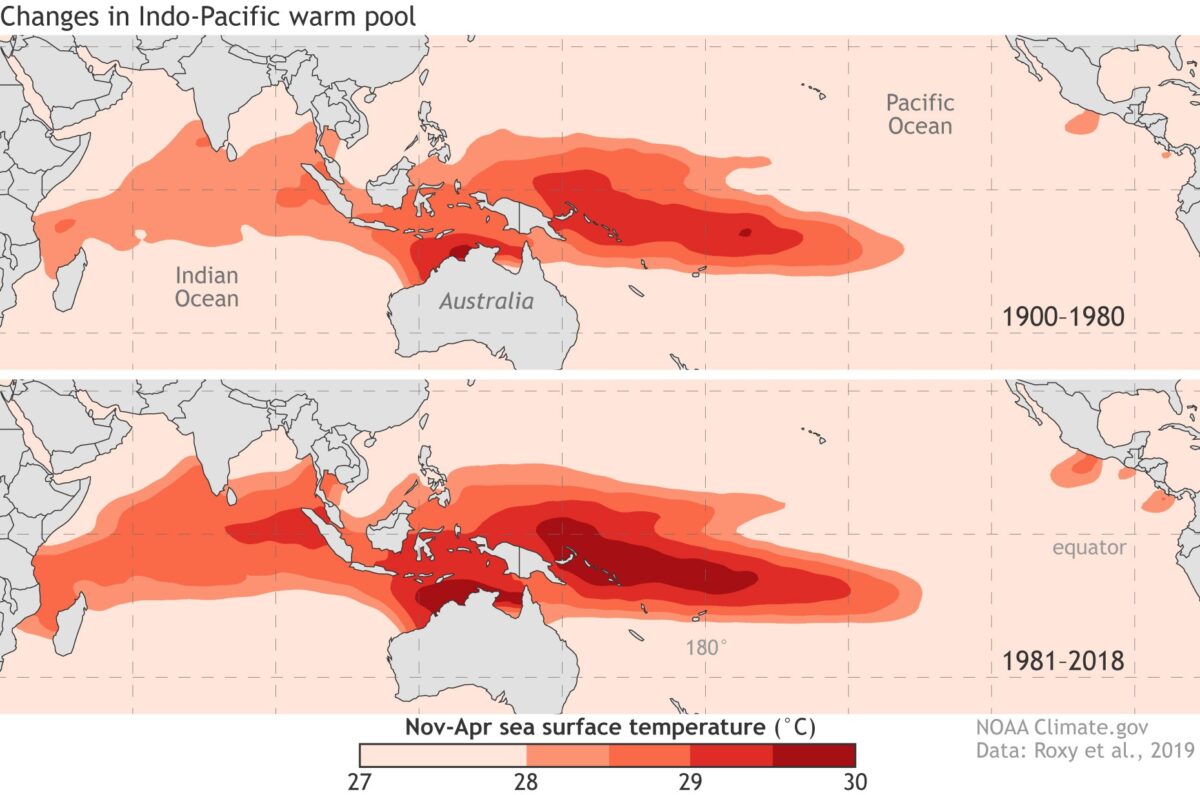
Using ocean circulation simulations, the scientists found that shifts in atmospheric circulation patterns have altered how currents transport water across the Indo-Pacific region. Stronger wind systems are now pushing portions of this freshwater pool southward, allowing it to spread into waters that historically remained much saltier.
Over time, that gradual transport dilutes the saline waters of the southern basin. The process does not occur through a single dramatic event but through steady movement of surface currents that redistribute freshwater across thousands of kilometers of open ocean.
Why Salt Matters for Global Ocean Circulation
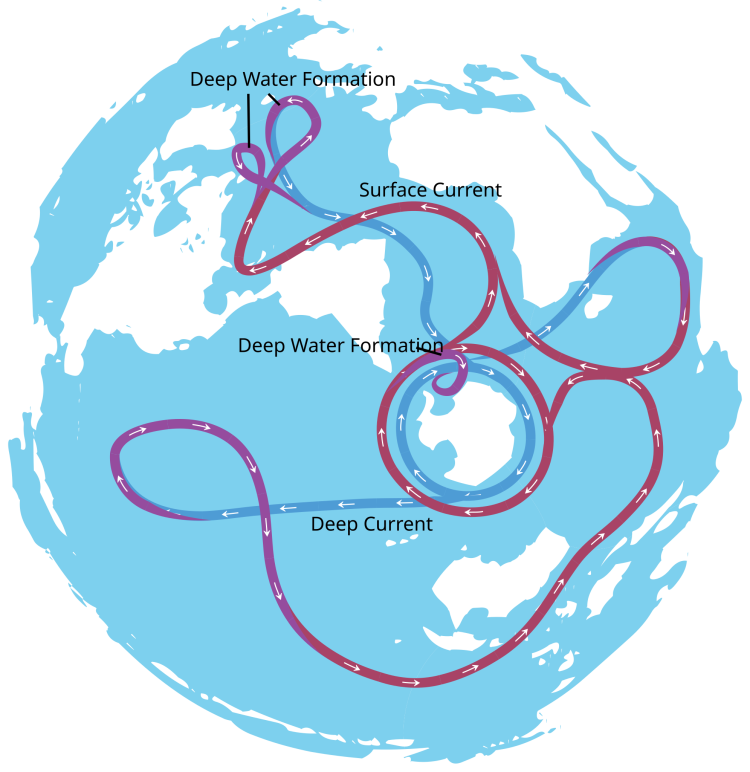
Changes in seawater salinity influence more than just local ocean chemistry. Salt content directly affects the density of seawater, which determines whether water sinks, rises, or remains near the surface. These density differences help drive the slow global movement of water known as thermohaline circulation.
One of the most important parts of that system is the Atlantic Meridional Overturning Circulation, often abbreviated as AMOC. This large current system carries warm, salty water northward through the Atlantic before cooler, denser water sinks and flows southward at depth.
Another study led by Pedro DiNezio, also at the University of Colorado Boulder, examined how rainfall patterns responded during periods when this circulation weakened in the past. By reconstructing climate conditions from the last 17,000 years and combining them with modern climate simulations, the researchers explored how changes in ocean circulation can influence tropical weather systems.
Their analysis found that a slowdown in the Atlantic overturning circulation can significantly alter rainfall across tropical regions. In some of their simulations, parts of the Amazon rainforest experienced rainfall reductions approaching 40 percent when the circulation weakened.

The freshening observed in the Southern Indian Ocean does not directly slow the Atlantic circulation. However, the research highlights how shifts in salinity and ocean transport can reflect broader changes in how water moves through interconnected ocean basins.
The study concludes that the high-salinity region in the Southern Indian Ocean has shrunk by roughly 30 percent since the mid-twentieth century, marking the most rapid basin-scale freshening trend detected in that hemisphere.
First Appeared on
Source link






Leave feedback about this