

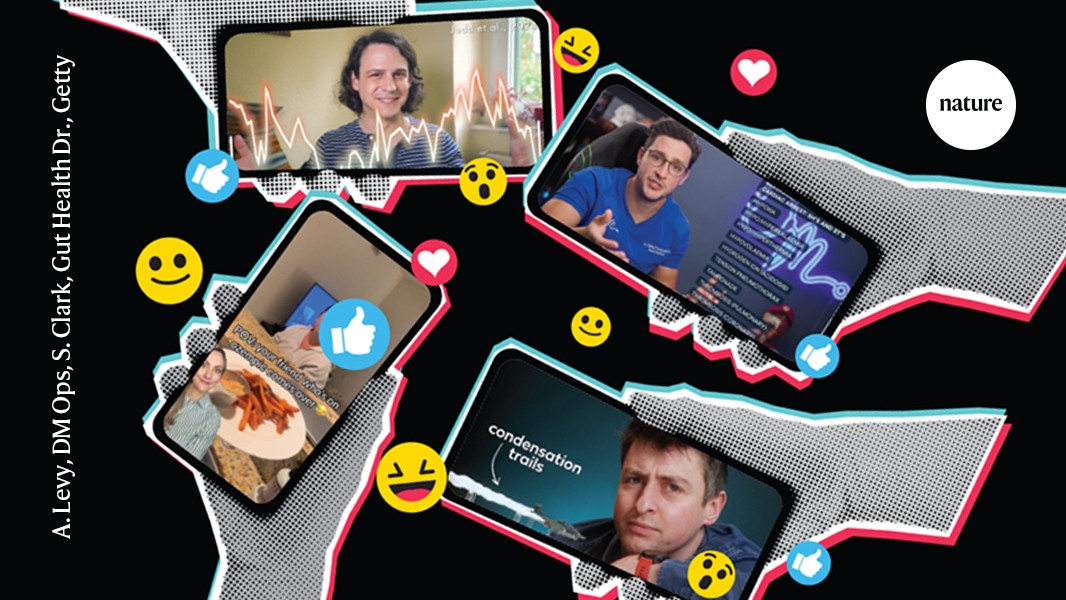
One of Simon Clark’s most popular TikTok videos begins with him playing the part of a clueless climate contrarian. Adopting the overconfident tone that is common among social-media influencers, he proclaims: “Renewables are a scam!”
The ‘PhD influencers’ logging lab life on TikTok and Instagram
Cut to the real Clark, who has a PhD in stratospheric dynamics and uses the handle @simonoxfphys, as he dismantles several myths about renewable energy using a deadpan style and a torrent of charts. The video, with almost 180,000 views, is an effort to fight misinformation by meeting people where they are, he says.
Clark started making YouTube videos more than 15 years ago as a master’s student in physics at the University of Oxford, UK. He wanted to help others learn about getting into elite universities and navigating the collegiate system. After he got his PhD from the University of Exeter, UK, he decided to make content creation a full-time career. “The natural thing in my field was talking about the climate crisis,” he says, “the physical causes behind it, the solutions we have to it, and increasingly at the moment, why we aren’t implementing those solutions.”
Clark is now also on Instagram, Facebook and the live-streaming service Twitch, where he leans on his scientific credentials to both communicate science and combat misinformation. He is one of many scientists and medical experts who are countering the flood of anti-science advice and rhetoric across social-media platforms.
According to a 2025 report by the Reuters Institute in Oxford and the University of Oxford, 65% of people worldwide now consume video on social media1. Increasingly, many individuals, especially young people, get their news from these platforms. But a lot of that ‘news’ is created by anti-science influencers who build loyal followings, using their position as opinion leaders to promote climate denialism, conspiracy theories, vaccine scepticism, autism myths, sham treatments and other pseudoscience.
A study last year, for example, analysed nearly 1,000 Instagram and TikTok posts about controversial medical screening tests. It found that the posts were overwhelmingly misleading — and that the people posting often had financial interests in the treatment2. Another study analysed the 100 most popular TikTok videos on attention deficit hyperactivity disorder and found more than half to be misleading3. Yet the videos collectively had more than 280 million views.
To counteract this deluge of bad information, Clark and other pro-science content creators are taking strategies straight out of the influencer playbook.
Building audiences
Social scientist Louisa Ha at Bowling Green State University in Ohio says that content creators who intend to mislead use clear tactics: “They pretend to be authentic, trustworthy and knowledgeable,” she says. They blend facts with misinformation to make it hard to tell what is credible. “The best lie is one that mixes seemingly authoritative sources and some facts with false data and false arguments and appeals to people’s beliefs and fears,” says Ha.
Whether a video provokes people to engage with it matters more than the video’s accuracy, or even whether people agree with it, says Clark. The longer people linger on a video and the more they comment, the more likely it is that lots of people will see it.
Can giant surveys of scientists fight misinformation on COVID, climate change and more?
Encouraging such engagement is a tactic that Clark uses. In 2020, he made a 40-minute YouTube video on the debate over nuclear power, focusing on why some people see it as the best low-carbon technology whereas others say the risk of catastrophe is too great. He knew that the topic would be controversial. “I imagine that no matter what I say, I’m about to piss a lot of people off,” he says in the video. And he was right: it has more than 500,000 views, and nearly 6,000 comments.
Comments tend to be highly valued by engagement algorithms. Some creators do simple things, such as wearing a shirt backwards, so that viewers will post a comment pointing it out, says Clark. “It’s stupid”, he says, “but it works, so I guess it’s not stupid.”
Misinformation abounds in the health and wellness space. As a registered dietician, Megan Rossi was struck by how many of her patients took diet advice from blogs and other online content. Frustrated by the lack of good science information, she started her own gut-health focused Instagram account @theguthealthdoctor in 2015, featuring video explainers about topics such as bloating, fibre, exercise and sleep, as well as offering recipe suggestions. (She has also developed a food brand and started a company that sells live bacteria supplements.)
Rossi leans into her credibility as a research fellow in nutritional sciences at King’s College London, often referring to herself as a “gut specialist/dietician”. She says that she’s careful to give advice based only on peer-reviewed evidence, and she typically cites her sources. Commenters often say things such as “very helpful” and “great info”, and thank her for not engaging in fearmongering.
The advent of social media has created communities that can more easily connect across time and space, and so has introduced a new type of opinion leader, says Amelia Burke-Garcia, director of the Center for Health Communication Science at the University of Chicago in Illinois. What’s important, says Burke-Garcia, who has been working with influencers in the public-health space since 2008 (“although we didn’t call them influencers then”), is to support credible voices and evidence in these communities.
How to speak to a vaccine sceptic: research reveals what works
In a qualitative study published last year, Burke-Garcia, public-health researcher Amy Leader at Thomas Jefferson University in Philadelphia, Pennsylvania, and their colleagues asked ten influencers of colour who had children aged 9 to 14 to spread the word about vaccination against human papillomavirus4. The influencers, whom the researchers provided with a fact sheet, created emotionally charged posts that acknowledged parents’ fears and used storytelling to describe their personal journeys towards a vaccination decision. Surveys of people who follow these influencers, Burke-Garcia says, revealed that the followers were more likely to consider vaccinating their children after hearing from someone to whom they could relate.
This relatability can help content creators to grow a loyal following. UK creator Emanuel Wallace, better known as Big Manny (@big.manny1), says that relatability, as well as authenticity, have been fundamental to his work. In his efforts to make chemistry and other science topics fun and accessible to young people, he has gained more than two million TikTok followers — and has made videos on the platform with Prince William and with Stranger Things star Millie Bobby Brown.
His videos show him doing science demonstrations ranging from standard classroom ones — what happens when you burn magnesium — to those requiring sophisticated set-ups and equipment. One video shows a chicken breast being exposed to the insides of a lithium battery. “This chicken breast represents you,” he says, before it bursts into flames. It’s a powerful warning about the dangers of swallowing a lithium battery.
His expertise as a former secondary-school science technician comes through, even with his casual approach: “I don’t really look like a typical scientist. I don’t wear a lab coat. Sometimes I might have a tracksuit on. And I use colloquial terms in my speech,” he says. “I just be myself.”
Quashing misinformation
When it comes to fighting misinformation, content creators take various approaches. Clark favours “pre-bunking” rather than debunking, which he finds less effective. He tries to reach a broad audience with solid facts that leave no room for ambiguity: “This is like vaccinating them against misinformation”.
Others have gained a reputation for challenging misinformation head-on. Russian–American creator Mikhail Varshavski, better known online as Doctor Mike (@doctormike), spends half of his week as a family-medicine physician and the other half creating content for his 14.6 million YouTube, 5.3 million Instagram and 2.7 million TikTok followers. He aims his content not just at people who agree with him, but also at those who haven’t thought much about their health care, who have been hurt by the system or even who disagree with modern medicine.
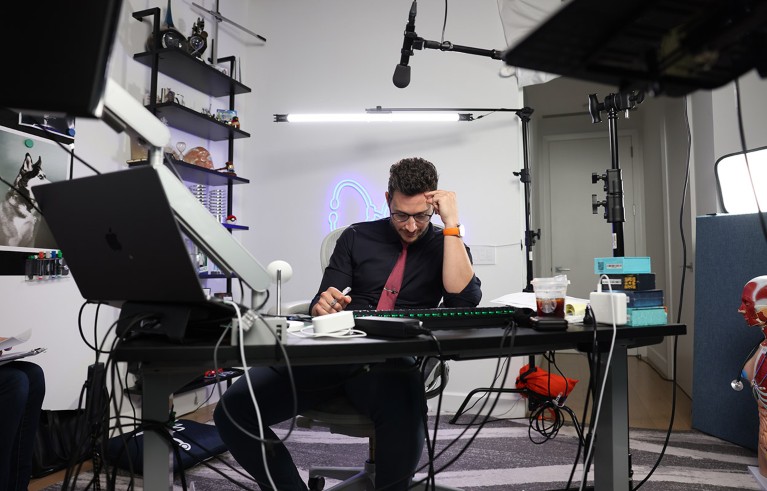
Doctor Mike wants to get accurate health information to people who disagree with him.Credit: DM Operations Inc.
First Appeared on
Source link


Leave feedback about this