

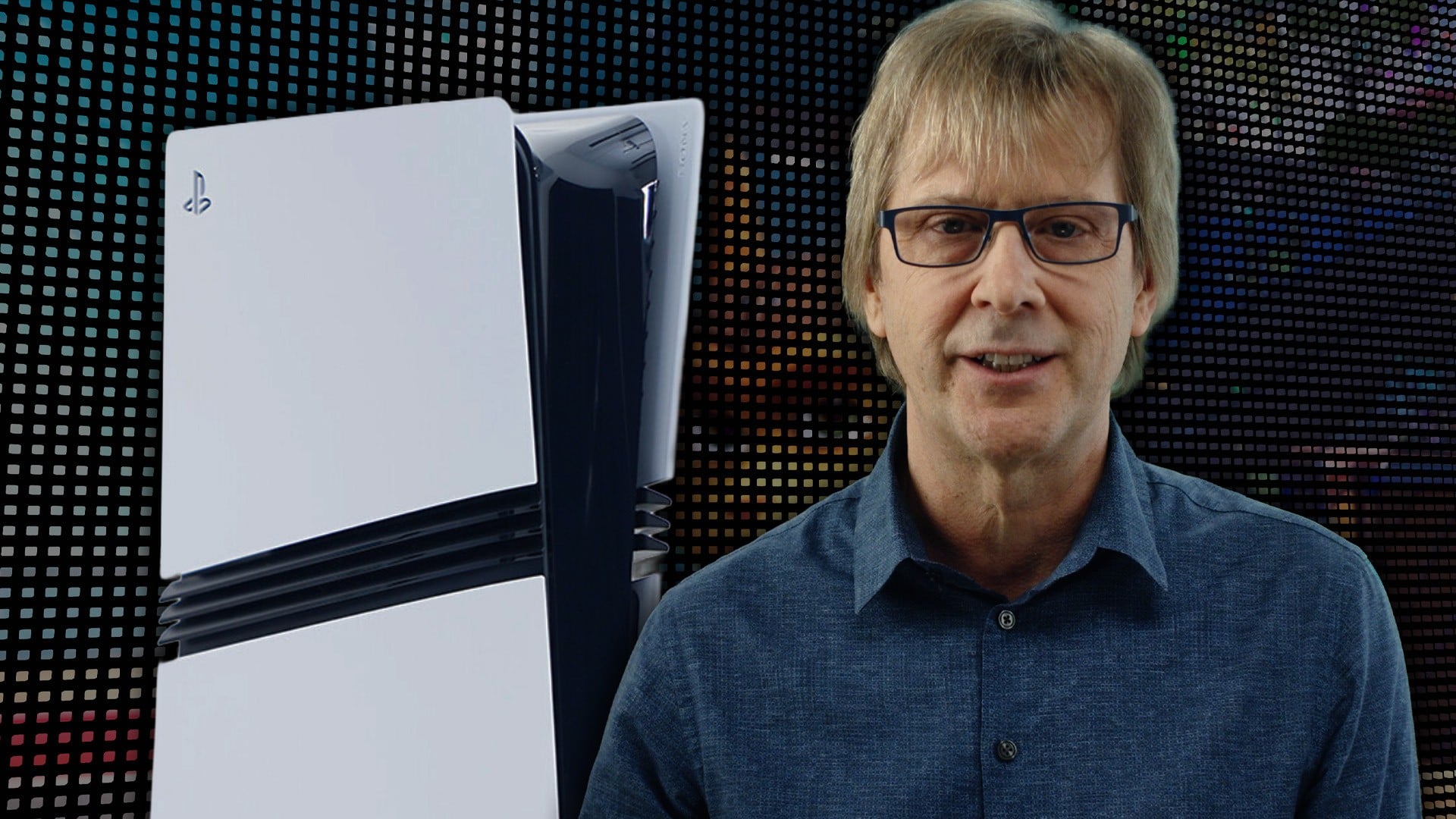
Just over a year ago, we shared exciting news directly from PlayStation 5 lead system architect Mark Cerny that Sony intended “to have something very similar to FSR 4’s upscaler available on PS5 Pro for 2026 titles as the next evolution of PSSR.” Just over a year later, the promise has been delivered and the quality upgrade can be transformative. This is the technology we hoped for, duly delivered, and when the opportunity arose to share some questions with Cerny about the revised PSSR, we didn’t need to be asked twice.
Based on the recently released Project Amethyst update, Sony looks to be moving to hardware convergence with AMD, but in today’s PlayStation 5 Pro, the console uses custom machine learning silicon which means that the FSR Redstone can’t just be used on the console as is. Looking back, Cerny was still optimistic about a PS5 Pro version of the technology, despite the differences. Back then he said that “The peak performance number for PS5 Pro is 300 8-bit TOPS without sparsity, which compares very well to the recently released AMD GPUs. We don’t believe sparsity is useful for this particular upscaling algorithm.”
So how did it turn out? “FSR Redstone and the new PSSR have somewhat different implementations due to the underlying hardware, eg FSR Upscaling uses 8-bit floating point and PSSR uses 8-bit integer,” Cerny shares. “The MAC counts (ie the amount of math involved) also vary a bit, and training data is similar but not exactly the same. None of the above factors seem to make too much difference in results; as both SIE and AMD have just released their refreshed models, it will be an excellent test of how closely we can match our systems.”
Cerny has previously talked about how PC upscalers are designed for different jobs: consoles target specific, locked performance targets (eg 30fps, 60fps, 120fps) while the general outlook is different on PC, where the proliferation of VRR displays generally favours running uncapped, so we were curious if this impacted anything to do with the implementation of the jointly developed upscaling algorithms.
“In practice, the same model is used but it’s trained on different data, eg if targeting a 2:1 fixed upscale then the training data used is just for that upscaling ratio – and that different training results in different parameters,” Cerny shares. “Having said that, not seeing too much difference in results, the various flavors in the updated FSR Upscaling really are rather close to the new PSSR.”
Prior statements from Cerny about upscalers serving a slightly different purpose for consoles than PC did make us wonder if any consideration had also been given to the overall context in which the technology is trained. A “lean in” PC gamer typically sits close to their monitor, while the traditional home of the console is in the living room.
“When John Linneman talked about how ‘image quality sensibilities’ differ between console and PC, it did certainly make me sit up and take notice,” says Cerny. “Is there a significant difference? Should we be approaching training and evaluation of models differently? Definitely will be reflecting on that point.”
The increase in quality of the new PSSR up against the old is highly impressive – in all of the tested titles we’ve looked at so far, overall quality is higher while the most egregious issues seen in the first-gen PSSR are all but eliminated. The question is the extent to which the extra quality may come at the cost of performance – as seen when comparing DLSS 4.5 to prior versions of the technology, for example. Not only does Mark Cerny straight-out address the question, but reveals the result had a direct impact on whether the system level ‘Enhance PSSR Quality Level’ option would be implemented at all.
“I’m glad you brought that up! When Oliver interviewed me and Mike Fitzgerald in 2024, I was a bit uncertain about whether there could be a user option to upgrade all PSSR-supported titles to the new PSSR – the key issue being that for that option to make sense, the new PSSR would have to be faster than the original one,” Cerny replied.
“We made that our target, and ultimately managed to achieve it – the new PSSR is something like 100 microseconds faster than the original. Which in turn allowed us to implement the ‘Enhance PSSR Image Quality’ option to force-upgrade all PSSR-supported games. If you use it, frame drops should become oh-so-slightly rarer.”
Cerny’s statements are borne out by the data. In looking at Monster Hunter Wilds, for example, we found that the balanced mode in both old and new PSSR options ran at effectively identical performance levels when tested across as close to like-for-like content as we could find. The difference was so slight that even in the dynamic resolution-driven performance mode, each version of the game could be seen dropping the an almost identical number of frames in stress points.
Previously, Sony told us that the games we saw at Sony were patched by developers, but the situation is a touch more nuanced.
“Patching games can be a fairly tedious process, so the recent system software included a driver update that recognizes the eleven titles we announced (eg Silent Hill 2) and substitutes the new PSSR. In all cases this was done at the request of the developers, and was based on their broad QA of their games,” Cerny reveals.
“Going forward, a few titles will be patched – that patch will move to the new PSSR, and simultaneously do some tweaking of the input data fed into PSSR. This is the best strategy when it’s apparent from that broad QA that game-side adjustments are needed for ideal image quality (eg changes to the mipmap bias, or to the calculation of exposure).”
With that said, the ‘Enhance PSSR Image Quality’ mode is made possible because the newly upgraded PSSR works on the same inputs as the original (“That allows for a quick transition from one to the other,” says Cerny), so the new version is effectively a drop-in replacement.
But it is an option – and one that users can toggle off. “For a few of the titles we found that turning on the ‘Enhance PSSR Image Quality’ feature provides wonderful overall improvement to the title, but also causes aliasing in a few scenes, eg instability in light sources smaller than a pixel in size,” adds Cerny. “Personally I’d turn it on in such a case, as 99 percent+ of the game is better, but it’s a choice we each need to make individually as gamers. I’m guessing the PS5 Pro community (and yourselves) will quickly have some guidance on what is best to do on a title by title basis.”
For the record, we’ve now looked at over 20 games outside of the whitelisted titles and although there are some oddities in some titles, it’s a net win overall – but could the feature be expanded still further, upgrading the override with updated future versions of PSSR?
“The current strategy is that it will be fixed, ie even if there are updated network parameters for the most recent PS5 Pro games, those parameters will not be applied when the Enhance feature is used. That allows the PS5 Pro community to provide clear guidance on how and when to use the Enhance feature – conversely, if the parameters were continually being updated then that guidance would be much harder to provide,” Mark Cerny explains. “Having said that, we are in very early days here at PlayStation with these ML libraries, and I’m certain our strategy will evolve over time.”
“Just to clarify a few things about the collaboration with AMD, the new PSSR uses the same core co-developed algorithm as FSR Redstone’s Upscaling (to avoid confusion, I’ll use the new names today rather than FSR4). FSR Frame Generation is also based on co-developed technology (or as my good friend Jack Huynh puts it, ‘co-engineered technology’). I’m very happy with how that work is progressing, and an equivalent frame generation library should be seen at some point on PlayStation platforms,” explains Cerny.
But in the short term, PS5 Pro moves a significant step closer to delivering the kind of package we’d hoped for in the past. The implementation of the new PSSR in Resident Evil Requiem and Crimson Desert demonstrates to us that the technology plays a key role in providing strong differentiation between the standard PS5 and PS5 Pro. Both of those games are fine on the base console, but they are transformed on the enhanced model. However, AMD is making rapid progress with its suite of FSR Redstone technologies and we should assume that the “next generation” FSR Diamond will also form part of the Project Amethyst partnership.
But the question is, are current Redstone technologies like ML frame generation and ray regeneration a good fit for PS5 Pro? How does Sony gauge which features come to Pro and which are reserved for whatever comes next – presumably PlayStation 6?
“Great questions, particularly considering that FSR Frame Generation is technology that was co-developed between SIE and AMD, we’re intimately familiar with it,” Cerny says. “All I can say is that we have no more releases planned for this year. And that I look forward to discussing this more in the future!”
First Appeared on
Source link





Leave feedback about this