

Sign up for the Slatest to get the most insightful analysis, criticism, and advice out there, delivered to your inbox daily.
On Tuesday, Texas Democrats will go to the polls to pick their party’s nominee for a U.S. Senate seat. Texans haven’t elected a Democrat to the Senate since 1988, but changing demographics and widespread disgust with President Donald Trump and his Republican Party have put the state in play this year. That’s particularly true if Republicans, who also vote today, pick their leading candidate, who comes with massive personal and legal baggage.
Democrats are choosing between strong candidates, both of whom strongly oppose Trump, but who represent diametrically opposed theories of power, as well as very different views on what the Democratic Party needs now. And the election itself is raising old questions in a high-stakes context: What does it mean to be “electable,” and how do race and gender shape perceptions of what a respectable, powerful person looks like? When the GOP has gone low and then lower, should Democrats still take the moral and strategic high ground, or take the fight into the muck? In an increasingly post-factual world where fewer people get their news from reliable sources, is social media attention-grabbing evidence of a narcissistic campaigner, or a smart, modern campaign? And perhaps most importantly: Is the Democratic path to victory through appealing to the base, or pulling in new supporters?
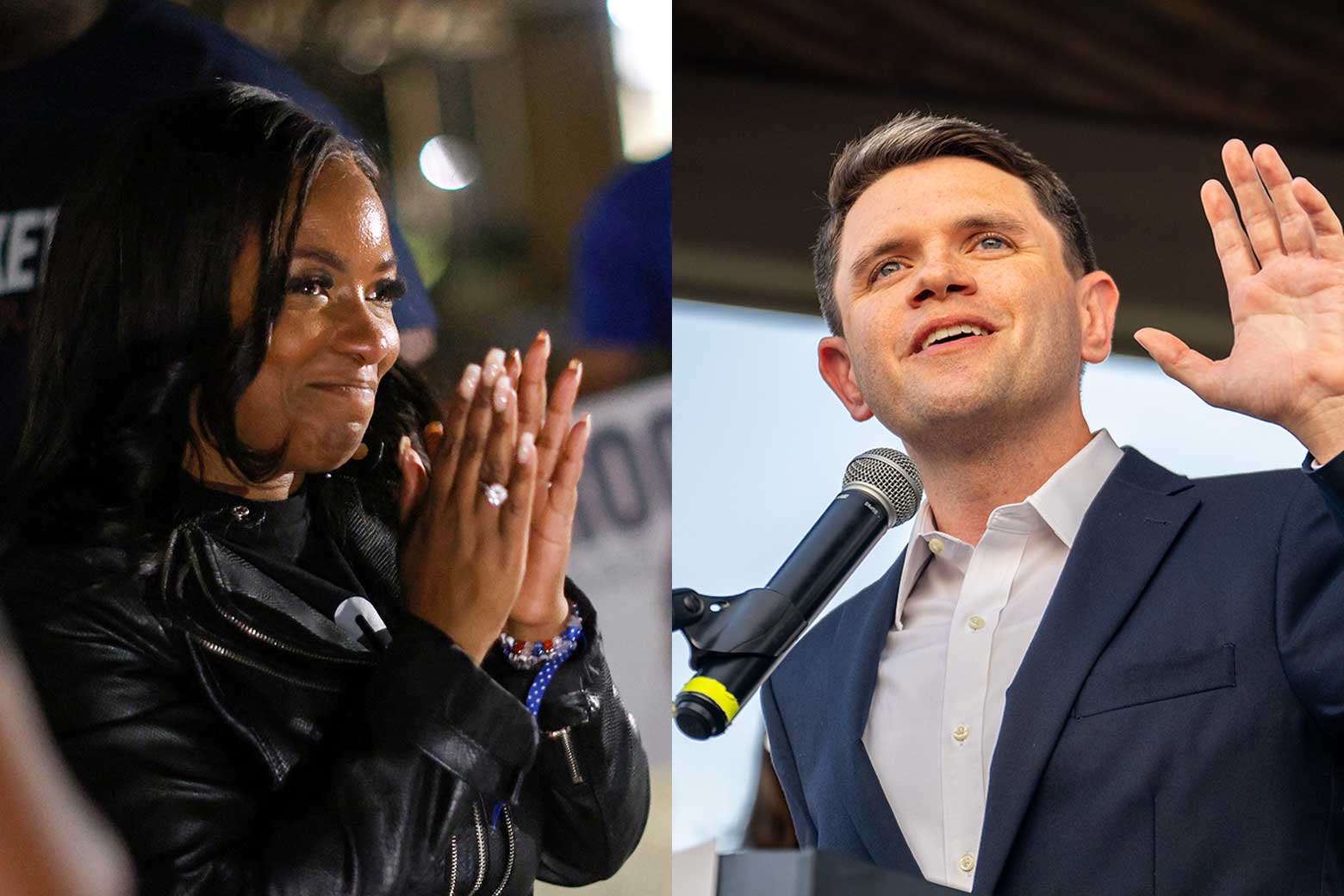
Texas voters are deciding between two young Democratic rising stars, Jasmine Crockett and James Talarico. Crockett, 44, is a lawyer and U.S. congresswoman who catapulted to viral fame when she responded to an insult from congresswoman Marjorie Taylor Greene by ridiculing her “bleach-blond bad-built butch-body,” a phrase she has since attempted to trademark and used to sell campaign merch. Talarico, 36, is a seminarian and Texas state representative who injects progressive Christianity into his politics and has had his own viral moments, most recently when CBS News refused to air his interview with Stephen Colbert. (Colbert posted it on his YouTube channel, and it quickly amassed millions of views and raised $2.5 million for the Talarico campaign.)
Polling on the race doesn’t point to a clear front-runner. Crockett has led several polls, at times by a wide margin. But this weekend, the highly respected Emerson College poll gave Talarico a solid lead. In short, the race appears extremely competitive. It should be: Both Democrats are strong and inspiring candidates who can make a legitimate argument for why they’re the party’s best option for this fall.
But elections are binary choices, and given the realities of Texas and my own hunger to return to a more decent and productive politics, Talarico seems to me the better candidate. I think Crockett is primed to lose statewide (more on “electability” in a bit), and I worry that she’s adopting some of Trump’s worst behaviors, effectively normalizing them on both sides of the aisle and threatening to further degrade American political life.
There’s a lot to like about Crockett. Democrats want a fighter, and she does know how to land a punch (and create a spectacle). She often goes viral on social media for using congressional hearings to go after the president in ways that are amusing, pointed, and digestible for short-video viewers. Unlike so many hapless Democrats who seem entirely lost in this political moment, Crockett has a scrappy and fearless energy to her. When other politicians try to respond to Trump in kind, they often come across as a bit try-hard, a lot cringe. Crockett is much younger, smarter, and funnier than Trump and is a more natural interlocutor. Trump might call her “low IQ” and a “lowlife,” but she always seems to maintain the upper hand.
Democrats need more highly effective and humorous critics of Trump, and Crockett is among the best. But among prominent Democrats, she’s also the one who most emulates his style of politics. That gives her an edge in social media wars. But it’s not where Democrats should take the party.
Crockett, despite throwing very effective jabs, is less graceful when it comes to taking criticism. Last week, her team had armed security kick Atlantic reporter Elaine Godfrey out of her campaign rally, ostensibly because Godfrey wrote a critical profile of her a few months back. Crockett supporters found much to dislike about Godfrey’s profile, including the focus on Crockett’s eyelashes and nails, race and class signifiers that Godfrey (I think troublingly) homed in on. Taking issue with the profile, even condemning it and vociferously panning it, is fair game. Removing critical journalists from your campaign rally suggests a lack of commitment to transparency and a troubling self-exemption from scrutiny.
Crockett had previously attempted to kill the profile, becoming angry when she learned that Godfrey had talked to other members of Congress without Crockett’s permission—standard journalistic practice—and telling Godfrey that she was “shutting down the profile and revoking all permissions.” That, of course, is not how any of this works, and it was a foreboding sign of Crockett’s commitment to a free press, not to mention her understanding of the First Amendment. Crockett’s team also, according to Semafor, called the Capitol police on CNN reporter Edward-Isaac Dovere for alleged “trespassing” when he tried to visit her campaign office—again, standard practice in political journalism.
Crockett’s team has, bizarrely, denied that Godfrey was removed; Godfrey has released an audio recording that suggests otherwise. Crockett herself told a reporter that Godfrey is dishonest and lost a defamation case. “It is sad that there is any news outlet that would actually have her on staff,” Crockett said. According to Godfrey, this did not happen. Crockett often claims to be “always with the receipts.” I’d be curious to see them here.
The attacks on critical media outlets are quite Trumpian. Trump notoriously and dangerously tars the press as “the enemy of the people.” He has also kicked journalists out of events and news conferences and the press room. When Trump has done this, liberals have objected. But many Democrats are also fed up with what they see as a biased media landscape—and may find themselves cheering, not questioning, Crockett’s behavior, even if it seems less than aboveboard.
Crockett is charismatic and likeable; the more I listen to her on podcasts, television shows, and the campaign trail, the more appealing she gets. And I also find myself internally cheering when I see videos of Crockett’s clapbacks and Trump attacks. It’s not politics as I would like politics to be. But as far as politics in today’s abysmal, gutter context go, Crockett is at least a fun fighter to watch.
But Talarico might be what America needs. Like Crockett, he is genial and charming. But his approach to politics is quite different. For elder-millennial politics-heads who grew up wanting to be C. J. Cregg and cried tears of joy when Barack Obama won, he feels like a comforting throwback to what American politics used to be—or, perhaps more accurately, what we used to imagine American politics could be.* I still want a politics of thoughtfulness and respect, of considered debate rather than social media gotchas, of an embrace of a free and sometimes hostile press and public outrage when our leaders do not act in accordance with the gravity of their position.
I am not sure if this is evidence of maintaining standards and principles in a world swiftly doing away with both, or of spectacular naiveté, but I’m not ready to give up on it.
I’m also adamant that Democrats should pick the candidate with the best chance of a surprise win in November, which could give Democrats an edge in the nationwide fight to recapture the Senate. Assessing which candidate fits that bill in the Texas Democratic primary has been made all the more complicated by the politics of race and gender, being as it is a competition between a Black woman and a white man. Criticizing Crockett is invariably met with accusations of racism and sexism, some of them legitimate and necessary, some specious and weaponized. When two guys on a podcast said that they didn’t back Crockett because she was making the campaign about herself, the backlash was swift and intense, and culminated with the predictable self-abasing pledge to “do better.” Concerns about Crockett’s rally-the-base strategy and her statewide electability in long-red Texas have similarly been dismissed as racist and sexist code.
This is complicated territory. “That’s racist” is not just a cudgel—it’s often a factual assessment. And Crockett has faced an absolute onslaught of racist and sexist attacks. “Electability” has often been shorthand for “racists won’t vote for a Black person” or “sexists won’t vote for a woman”—theories that turn into self-fulfilling prophecies.
Our perceptions of who is electable and what power looks like are shaped by race and gender—white men have had a near-monopoly on political power in America for centuries, and so when a white man runs for office and speaks in a cadence familiar to those who lived through the Obama years or watched The West Wing, it sends an invisible signal of authority and familiarity. That creates a disadvantage for women, and for nonwhite women in particular. Few people hear Jasmine Crockett, or any woman, speak and think, “She sounds like John F. Kennedy”—or Ronald Reagan, or Bill Clinton, or Barack Obama, or any other storied presidential orator, because all storied presidential orators, like every single American president, have been men (and, with a single exception, white men).
And so it’s complicated to talk about Crockett’s “electability.” That’s particularly true because polls suggest she leads Talarico in constituencies where the party as a whole has struggled. Among non-college, suburban, and rural Democratic voters in Texas, a University of Texas poll from early February put Crockett up by double-digit margins over Talarico: plus-24 among non-college voters, and plus-38 among rural ones. She also has much broader name recognition than Talarico despite being outspent in advertising by several million dollars. The enthusiasm for Crockett is deep and genuine.
To win in Texas, where Republicans outnumber Democrats, Crockett has to do more than just turn out her party’s voters; she has to convince moderates, conservatives, and independents to take a chance on her too. And in the UT poll and others, Talarico fares far, far better with independents. The Texas poll gives him a 20-point edge there. In the Emerson poll, independents broke for Talarico 62 percent to 35 percent.
Several things can be true at once. Crockett can both be the subject of a wave of racist and sexist attacks and also have real flaws that are fair to point out. Similarly, it can be true that our discussion of “electability” is warped by our centuries of structural oppression and it can be true that Crockett is less likely to help Democrats capture a crucial Senate seat.
Texas Democrats are lucky that they are choosing between two strong candidates. Regardless of who wins, Democrats nationwide need to do some soul-searching. Can we expect our strongest fighters to hit hard but still fight fair? Is there any expectation that Democrats will try to return to a politics of going high, or are we committed to getting as low as we need in order to win? Fundamentally, this is a question about the future of American politics: Are Democrats going to adapt to our new political moment by replicating some of the worst aspects of it—the hostility to the press, the personal insults, the flexible relationship with the truth—or are we going to try to reshape it into something better?
Correction, March 3, 2026: This article originally misspelled the name of TV character C.J. Cregg.

First Appeared on
Source link


Leave feedback about this