

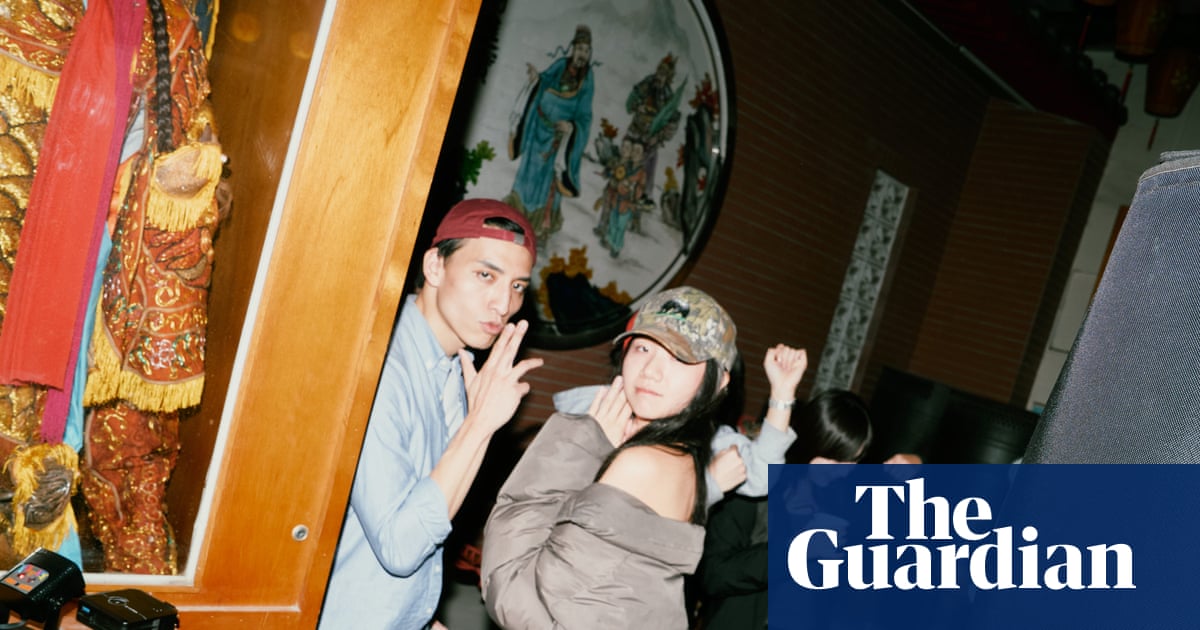
When Andrew Dawson brings a sound system to Puji Temple in Tainan, Taiwan, for lunar new year celebrations, its deities keep watch. Behind the plywood speaker stack hangs a circular plaque of Caishen, the Chinese god of prosperity. Around the corner from the dub and reggae street party, families burn long incense sticks for the site’s patron religious figure, the thousand-year-old Chifu Wangye, a prince who died sampling well water poisoned by the plague gods to save his own villagers.
To some, partying in a religious site like this might seem sacrilegious, or at least insensitive. But Dawson has been doing this for three years with his Temple Meltdown party series, inspired by religious sites and their role as vibrant centres of civic life: to him, the marriage of underground music to these spaces felt like a natural next step. “Every temple in Taiwan is very different because each of its founders has a unique vision or dream. But the interesting thing is that there is always a plaza area outside where people can gather, cook, hang out with their friends,” says Dawson, who is half American and half Taiwanese and also goes by 陳宣宇 or Chen Xuan Yu. The scene at his Lunar New Year party is no different, with people swaying, smoking, and some feeding each other skewered pieces of Taiwanese fried chicken on the dance floor.
Scenes like this are hard-won in Taiwan, which, until 1987, spent four decades under martial law. Citizens were subjected to surveillance, curfew, and bans on public cultural events and dance halls, enacted by the former ruling Kuomintang government. Even after the military rule was lifted, certain human rights journals still reported “no dancing on the streets” due to updated national security laws with “a significant number of restrictions on freedom of assembly and association, and on political rights”. Social conservatism thereafter remained strong, aided by sensationalist headlines around recreational drug use at parties in the early aughts, and frequent police raids of nightlife establishments have persisted.
But in temples, “there is a lot of variety and creativity, not certain roles you have to follow,” says Dawson, who has returned back to his mother’s home town to partner with Puji’s lantern festival for today’s event. There are plenty of other potential venues besides: Taiwan has more temples per capita than any other country, and Tainan itself boasts one of the highest densities of temples in the world, where Buddhist, Taoist and traditional folk customs have fused so closely together that their rituals and architecture are almost indistinguishable.
Archi Tsai, a Tainan local who provides the speaker stacks, shows me a photo of his handmade Formosa Sound System in front of the signature red swallowtail eaves of a different temple. “What Andrew is doing is very special because you can only see this here [in Taiwan],” he tells me in a mix of Mandarin Chinese and English. Unlike many religious sites in the west, temples are often left unattended and face on to the street with their doors wide open, making acts of worship spontaneous, accessible, and heavily interconnected with daily life. “Growing up, this is just what we do. On holidays, during the mid-autumn festival, new year, if you want to do well on exams, or when you have a bad day, you stop by and bàibài, or pay your respects.”
Tsai’s sound system project was instigated by a trip to Croatia’s Outlook festival in 2014. Before, he had never heard such low-end frequency sounds and, suddenly, “I was addicted,” he said. When he returned home, Tsai spent years fervently teaching himself about its constructions through YouTube and odd internet forums before he summoned up the courage to create his first subwoofer with the help of his friends Ah Tsui, a woodworker, and Ah Siong, a sound professional. The resulting system is a robust, four-way stack with heavyweight sub bass, ideal for reggae, dub, and bass music. It took almost 2 million TWD (£47,000) to build, about seven years’ worth of significant contributions from his own salary.
Tsai and Dawson are among those actively shifting public opinion around social propriety. “Back in Taiwan’s history, people thought if you drank alcohol, if you partied, people thought you were immoral and would be jobless,” Tsai says. “But we are changing this kind of mindset from the older generation.”
There is reason for confidence. Tainan is known as the Phoenix City for its geographic shape and for its constant thriving and reinvention under former Dutch and Japanese colonial forces. Puji Temple was constructed at the heart of a network of streets as a feng shui tactic to prevent the prosperous phoenix from flying away. At a location as mythologically significant as this, Taiwan’s underground rings in the new year under the most auspicious of blessings. “This is our religion, and this is our culture,” Tsai says, “so doing this music event, in front of the temple, is very close to our lives. I love it.”
First Appeared on
Source link






Leave feedback about this