

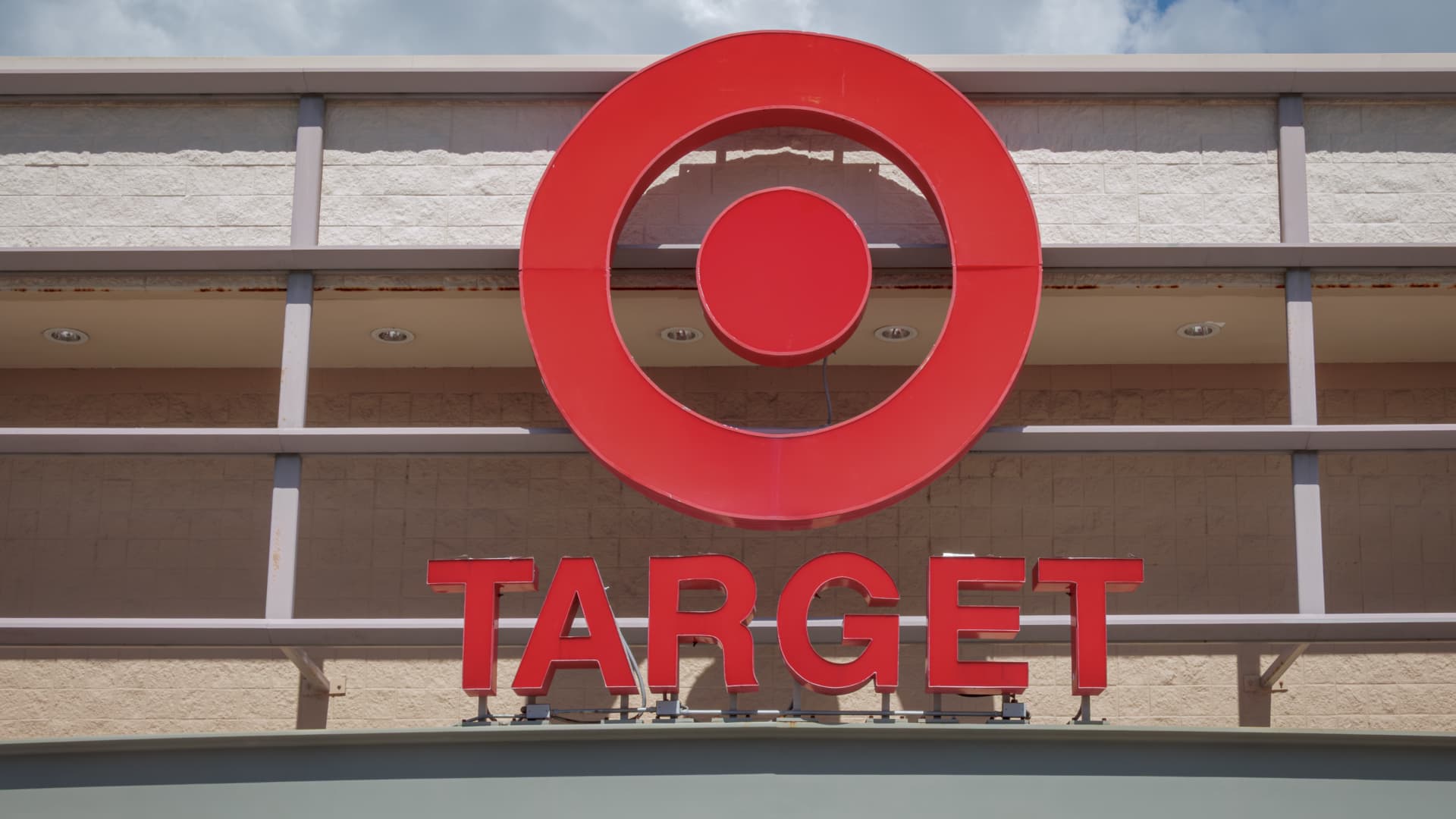
Sign at the entrance to a Target store in Venice, Florida.
Erik Mcgregor | Lightrocket | Getty Images
MINNEAPOLIS — Target on Tuesday posted another quarter of falling revenue and customer traffic at its stores, even as the company touted stronger sales in some of its key merchandise categories.
The big-box retailer, which is in the middle of a turnaround effort, said sales and traffic trends picked up in the last two months of the holiday quarter. Then sales turned positive year over year in February, which is the beginning of the current quarter.
In a news release, Target CEO Michael Fiddelke described that inflection as “an important milestone on our path back to growth this year” and said it reinforces “my confidence in the momentum we’re building and the future we’re creating together.”
For the current fiscal year, Target expects net sales to rise about 2% compared with the prior year and anticipates that metric will grow in every quarter of the year. That net sales growth for the year would reflect a small increase in comparable sales, the retailer said. The company added that its new stores and non-merchandise sales, such as advertising and membership, would contribute more than 1 percentage point of growth.
Target said it expects full-year adjusted earnings per share to range from $7.50 to $8.50. Its adjusted earnings per share for the most recent full year were $7.57.
Fiddelke, who stepped into the company’s top role on Feb. 1, will try to persuade Wall Street that the retailer is on track to end its sales slump at an investor meeting on Tuesday morning at its Minneapolis headquarters.
Here’s what the company reported for the fiscal fourth quarter compared with Wall Street’s estimates, according to a survey of analysts by LSEG:
- Earnings per share: $2.44 adjusted vs. $2.16 expected
- Revenue: $30.45 billion vs. $30.48 billion expected
The big-box retailer missed Wall Street’s revenue expectations for the fourth quarter, despite analysts already anticipating weaker sales. Its quarterly revenue dropped about 1.5% from $30.92 billion in the year-ago period.
For four quarters in a row, customer traffic across the company’s stores and website has fallen.
Target’s net income for the three-month period that ended Jan. 31 fell to $1.05 billion, or $2.30 per share, compared with $1.10 billion, or $2.41 per share, a year earlier. Excluding one-time expenses, including legal settlement gains and business transformation costs, Target’s adjusted earnings per share were $2.44.
Target is trying to end several years of disappointing results driven by a mix of company missteps and economic factors. Its annual sales have been roughly flat for four years, after a significant jump in annual revenue during the Covid pandemic.
Shares have dropped by nearly 32% over the past three years, as of Monday’s close, though they have risen nearly 16% so far this year. The company’s stock closed on Monday at $113.17, bringing its market cap to $51.24 billion.
As it tries to turn its business around, Target cut 1,800 corporate jobs in October, marking its first major layoff in a decade.
Some of Target’s customers told CNBC they are shopping elsewhere after noticing changes like sloppier stores and lackluster merchandise, or objecting to the company’s social stances, like its rollback of major diversity, equity, inclusion initiatives. The company acknowledged backlash to its DEI decision had hurt sales and led to market share losses to competitors.
Target’s challenge with attracting shoppers has persisted. Comparable sales, an industry metric that takes out short-term factors like store openings and closures and is also called same-store sales, decreased 2.5% year over year in the fourth quarter. That reflected a 3.9% comparable sales decline at Target’s stores and a 1.9% increase across Target’s website and app.
Transactions across Target’s stores and website fell by 2.9% year over year. The average amount that customers spent during those transactions grew 0.4% year over year.
In an interview with CNBC in the fall at Target’s headquarters, Fiddelke said he would prioritize regaining the company’s reputation for style and design, improving the customer experience and using technology to boost its performance.
He echoed those key goals in the company’s release outlining fiscal fourth-quarter results.
“Our team is firmly focused on writing Target’s next chapter of growth, rooted in strengthening our merchandising authority, delivering an elevated and differentiated shopping experience, advancing our use of technology, and continuing to serve and invest in our team and communities,” he said.
Last month, Target also announced it would invest more in store labor and cut about 500 other roles at distribution centers and regional offices to try to address shoppers’ concerns about out-of-stocks, long checkout lines and other store conditions. However, the company declined to say much more it would spend.
Target is known for selling clothing, home goods, seasonal items and other trend-driven discretionary merchandise that customers often buy on impulse when browsing the aisles on a “Target run.” Yet higher prices of food, utilities and other necessities, fueled by inflation and tariffs, has dampened U.S. consumers’ willingness to buy items that aren’t on the shopping list.
Target’s results in recent years have been at odds with those of retail rivals like Walmart, Costco and T.J. Maxx’s parent TJX, which have posted stronger sales results, attracted shoppers across incomes and seen growth in categories like apparel and home goods, areas where Target has struggled.
Along with offering products like groceries, clothing, and home goods, Target is trying to sell more advertisements and membership subscriptions to customers. The company’s non-merchandise sales jumped more than 25% in the fourth quarter, driven by membership revenue more than doubling from a year ago, double-digit percentage gains in its ads business Roundel and over 30% growth in its third-party marketplace.
Same-day deliveries through Target 360 Plus grew over 30% year over year. The subscription service costs $99 per year or $10.99 on a monthly basis.
First Appeared on
Source link




Leave feedback about this