

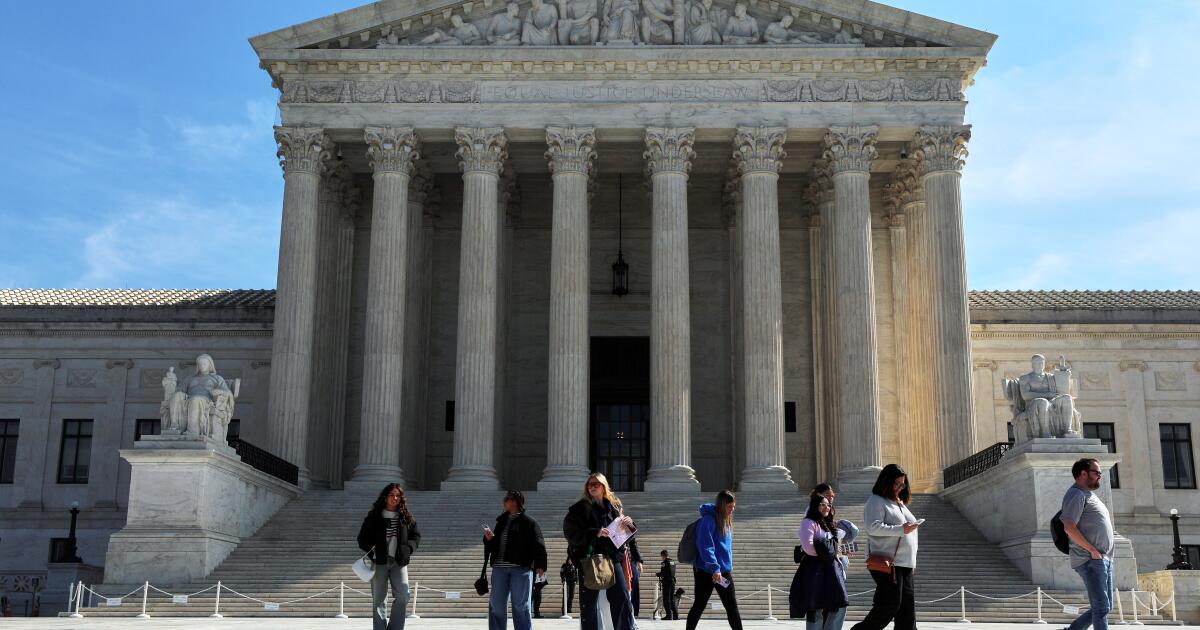
WASHINGTON — The Trump administration on Monday urged the Supreme Court to limit the reach of the 2nd Amendment and deny gun rights to “habitual” users of drugs, including marijuana.
But most of the justices sounded skeptical. They questioned whether marijuana users are so dangerous they should not have firearms.
They noted too that President Trump signed a recent executive order to reclassify marijuana as a lesser controlled substance.
“Why is this a test case?” asked Justice Neil M. Gorsuch. “Marijuana is sort of illegal and sort of isn’t and the federal government itself is conflicted on this.”
Federal laws on “controlled substances” and the 2nd Amendment created a conflict between gun rights and illegal drugs, but Gorsuch said marijuana users are not seen as a particular danger to the public.
“It’s such an odd case to have chosen” to decide the legal dispute between gun rights and drugs, he said.
Justice Amy Coney Barrett agreed.
“Legislatures can regulate to keep guns out of the hands of dangerous people,” she said. “What is the government’s evidence that using marijuana a couple times a week makes someone dangerous?”
Most of the justices sounded wary of ruling broadly to decide the legal status of other addictive drugs.
At issue was a provision of the Gun Control Act of 1968, which forbids gun possession by any person who “is an unlawful user of or addicted to any controlled substance.”
The Justice Department says about 300 people per year are charged with a crime under this provision. They include Hunter Biden, former President Biden’s son, who was charged and convicted of lying about his drug addiction when he applied for a handgun permit.
The case brought together civil libertarians and gun rights advocates, who said millions of Americans could face criminal charges if the government’s view is upheld.
Deputy Solicitor Gen. Sarah Harris, representing the administration, said the court should uphold the law to deny guns to habitual users of unlawful drugs.
“Congress decided it is dangerous to mix firearms with controlled substances,” she said. “The 2nd Amendment does not prohibit the government from temporarily disarming habitual marijuana users while they persist in using frequently.”
Such a ruling “would not open the door to disarming weekend beer drinkers,” she assured the court.
But Erin Murphy, a Washington attorney and 2nd Amendment advocate, said gun owners have not been on notice that having a handgun at home could lead to a criminal prosecution if they sometimes use marijuana.
The court has often said that criminal laws must be clear in defining what is illegal.
She agreed the law “may well support disarming people who are addicted to a controlled substance … if the government is able to actually prove that a particular substance is, in fact, addictive and dangerous.”
But that does not extend denying guns to someone who “consumes a few times a week something that Congress has designated a controlled substance,” Murphy added.
She was representing Ali Hemani, a Texas man who was investigated by the FBI in 2020 for his family’s suspected ties to the Iranian Revolutionary Guard Corps, a designated terrorist group.
When the FBI obtained a warrant to search his home, agents found a Glock pistol and 60 grams of marijuana as well as 4.7 grams of cocaine in his mother’s room. Hemani said he used marijuana about every other day.
He was charged with illegal gun possession because he was an unlawful drug user.
But citing the 2nd Amendment, a federal judge and the 5th Circuit Court of Appeals dismissed the charges on the grounds that he was not under the influence of drugs at the time of his arrest.
Appealing, the Trump administration said the Supreme Court should uphold the 1968 law and deny guns to those who are “habitual users” of illegal drugs.
Solicitor Gen. D. John Sauer said this prosecution “falls well within Congress’ authority to temporarily disarm categories of dangerous persons — here, habitual drug users.”
From the nation’s founding, “habitual drunkards” could be prohibited from having guns, and that historic principle supports denying guns to habitual drug users.
The American Civil Liberties Union defended Hemani and said the government’s view threatens to broadly extend the reach of the criminal law.
“Like tens of millions of Americans, Ali Hemani owned a handgun for self-defense, keeping it safely secured at home. Like many of those same Americans, he also consumed marijuana a few days a week,” they said in their brief.
“According to the government, those two facts alone sufficed to make him an ‘unlawful user’ of a controlled substance who could face criminal penalties.”
The court will hand down a decision in U.S. vs. Hemani by the end of June.
First Appeared on
Source link





Leave feedback about this