

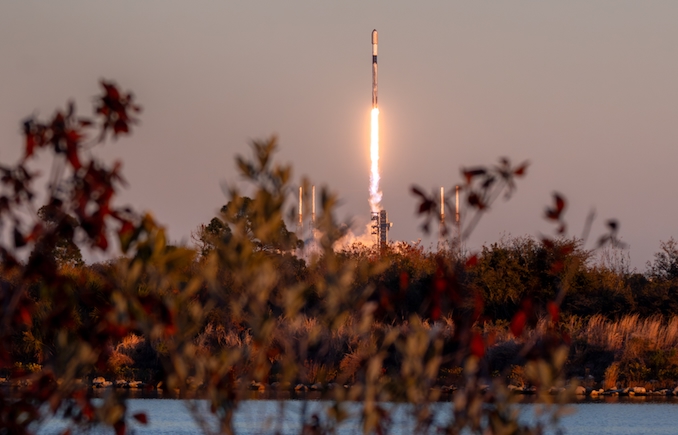
Update Feb. 24, 7:10 p.m. EST (0010 UTC): SpaceX confirms deployment of the 29 Starlink satellites.
SpaceX launched a Falcon 9 rocket late Tuesday afternoon with a batch of Starlink V2 Mini satellites onboard. The twilight flight from Cape Canaveral Space Force Station was the company’s 18th launch of the year supporting its broadband internet satellite constellation.
The Starlink 6-110 mission sent another 29 satellites into low Earth orbit. Prior to liftoff, SpaceX had more than 9,700 Starlink satellites in space, according to stats maintained by expert orbital tracker and astronomer, Jonathan McDowell.
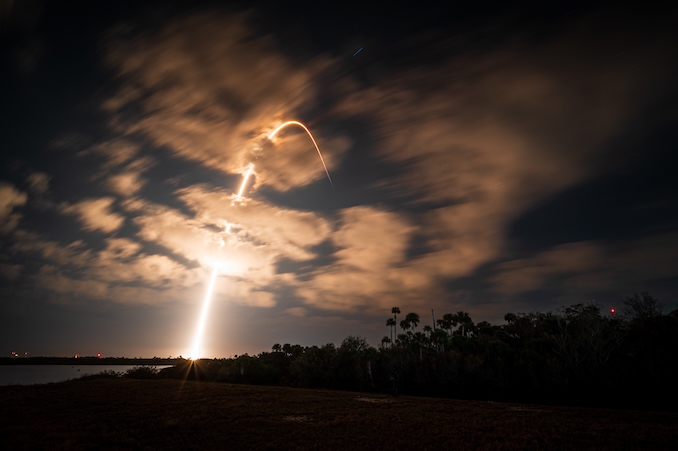
Liftoff from Space Launch Complex 40 happened at 6:04:10 p.m. EST (2304:10 UTC). The Falcon 9 rocket flew on a south-easterly trajectory upon leaving Florida’s Space Coast.
The 45th Weather Squadron forecast a greater than 95 percent chance for favorable weather at liftoff with no specific meteorological concerns.
“High pressure will continue to build across the peninsula overnight and into tomorrow, bringing ideal conditions for the launch window,” launch weather officers wrote.
SpaceX launched the mission using its Falcon 9 first stage booster with the tail number 1092. This was its 10th flight, following previous missions, including CRS-32, NROL-69, and USSF-36.
A little more than eight minutes after liftoff, B1092 landed on the drone ship, ‘Just Read the Instructions,’ positioned in the Atlantic Ocean to the northeast of The Bahamas. This was the 151st landing on this vessel and the 576th booster landing for SpaceX to date.
Price increases
One of SpaceX’s biggest selling points for reusability of its Falcon 9 boosters and payload fairings is that this drives down the overall cost of launching payloads into space. However, that doesn’t mean that the company doesn’t raise its prices.
The company updated its Falcon 9 rocket Capabilities and Services page. It now states that a standard payment plan through 2026 for a Falcon 9 rocket launching up to 5.5 metric tons to a geostationary transfer orbit (GTO) is $74 million, up from $70 million in 2025.
In 2022, SpaceX listed Falcon 9 launches with the same payload capacity at $67 million, citing possible future price increases due to inflation.
According to reporting from Ars Technica earlier this month, SpaceX’s internal costs for launching a reusable Falcon 9 rocket is $15 million.
For comparison, another rocket that aims to compete with the Falcon 9 in the future is Rocket Lab’s Neutron rocket. In the Q1 earnings call in May 2025, the company’s CEO Peter Beck said the company expected that a dedicated flight of its reusable rocket would be in the area of $55 million.
Pricing for other rockets can be harder to determine, but for a rocket like Blue Origin’s New Glenn, which can carry 13 metric tons to GTO is estimated to cost around $68 million per flight. NASA only paid $20 to fly its EscaPADE mission in November 2025, which carried a higher risk because it was just the second flight of the rocket to date.
First Appeared on
Source link





Leave feedback about this