

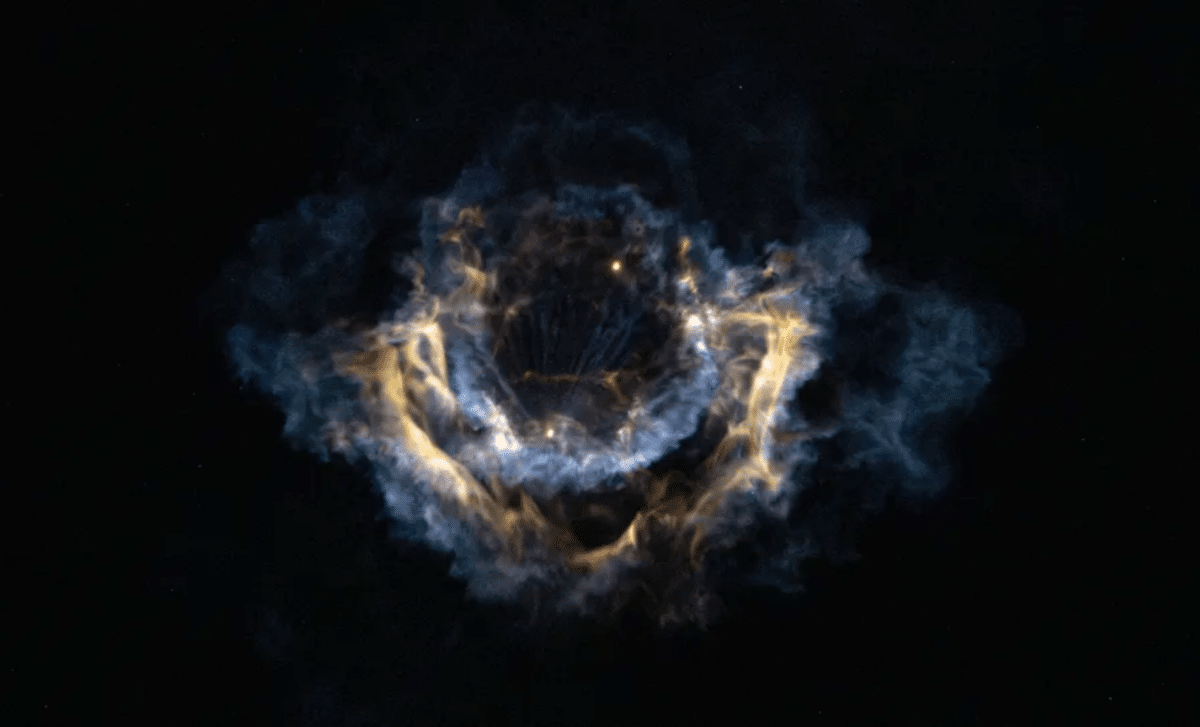
The recent image of the Falcon 9 rocket’s plume, captured during NASA’s Crew-12 mission launch, has taken the world by storm. The stunning nebula-like pattern, a byproduct of the rocket’s intense exhaust, offers a glimpse into the power and beauty of space exploration. As rockets break through Earth’s atmosphere, they leave behind spectacular visuals, showcasing the strength and innovation behind modern space travel.
A Deep Dive Into The Falcon 9’s Dramatic Exhaust Plume
The image captured by John Kraus, showcasing the SpaceX Falcon 9 rocket’s launch exhaust, reveals an awe-inspiring “jellyfish” effect, a stunning visual that immediately grabs attention. As the rocket ascends, its nine Merlin engines burn a mixture of liquid oxygen and kerosene, generating the thrust necessary to break free from Earth’s gravitational pull. This combustion results in the creation of hot gases, vapor, and soot that expand rapidly into the surrounding atmosphere. The photograph, taken almost directly under the plume, reveals how these forces create intricate and ever-changing patterns in the sky.
Such phenomena are not rare; SpaceX rockets have frequently created similar exhaust plumes, which, when captured from the right angle, resemble blooming flowers or nebulae. This image is one of the most striking yet, demonstrating how the force of the engines and the surrounding air interact in real-time, creating a powerful visual spectacle. It’s an artistic reminder of the raw power involved in space exploration, as well as a technical demonstration of the processes that drive modern rocket launches.
Image credit: NASA/John Kraus
The Crew-12 Mission and Its Astronauts: A Historic Journey to the ISS
Launched from Florida’s Cape Canaveral Space Force Station, the Crew-12 mission was more than just another space mission, it marked a new chapter in NASA’s partnership with SpaceX. This particular mission carried four astronauts aboard the Crew Dragon spacecraft, including NASA astronauts Jessica Meir and Jack Hathaway, European Space Agency astronaut Sochie Adenot, and Russian cosmonaut Andrey Fedyaev. Together, they embarked on a journey to the International Space Station (ISS), where they would spend several months contributing to scientific research and advancing international cooperation in space.
On February 14, 2026, the Crew Dragon successfully docked with the ISS, solidifying the mission’s success and marking the start of Expedition 74. This mission is especially significant as it follows the Crew-11 medical evacuation, ensuring that the station remains fully staffed. The astronauts aboard Crew-12 represent a diverse and talented group of individuals, each bringing unique skills and expertise to the ISS. Their role in the scientific experiments and operational tasks aboard the station will contribute immensely to our understanding of space and human adaptation in low Earth orbit.
The Power of SpaceX’s Rocket Technology: Fueling Future Exploration
SpaceX’s Falcon 9 rocket is a game-changer in modern space technology. Its reusability, an innovation that has drastically reduced the cost of space launches, continues to pave the way for future space exploration. This is particularly important as NASA and SpaceX focus on sending astronauts to the Moon, Mars, and beyond. The Falcon 9’s ability to return to Earth, land vertically, and be refurbished for subsequent launches is a critical leap toward making space travel more sustainable.
By reducing costs and improving efficiency, Falcon 9 is helping to usher in a new era of space exploration. In addition to its reusability, the rocket’s design is optimized to handle the extreme pressures and temperatures of launch, which is essential when considering missions to deep space. This technological innovation is a key part of SpaceX’s strategy to make space more accessible to both governmental and private sector missions in the coming years.
Behind the Stunning SpaceX Launch Plume: The Science of Rocket Exhaust
The beauty of rocket exhaust plumes, particularly those created by Falcon 9, is not just in their appearance but in the science they represent. When a rocket launches, the chemical reaction that takes place inside its engines generates gases that are pushed out at high speeds. This exhaust is composed of a mixture of hot gases, water vapor, and carbon particles. As these gases rapidly expand and cool, they form the characteristic plumes we see in the sky.
The plume’s shape and structure depend on several factors, including the rocket’s thrust, atmospheric pressure, and the speed of the exhaust gases. The “jellyfish” pattern that is often associated with Falcon 9 launches occurs when the hot exhaust interacts with the cooler air at higher altitudes. This interaction creates complex shockwaves that shape the plume into intricate forms. While it may look like a work of art, the formation of these patterns is rooted in the science of fluid dynamics and thermodynamics, which are critical areas of study for space engineers.
The Environmental Impact of Rocket Launches: A Growing Concern
As space exploration becomes more frequent, concerns about the environmental impact of rocket launches are growing. The exhaust plumes produced by rockets like the Falcon 9 contain various pollutants, including carbon dioxide, soot, and unburned fuel. These emissions have the potential to contribute to global warming and ozone depletion, particularly at the high altitudes where rockets operate.
NASA and other space agencies are increasingly aware of these issues and are working to mitigate the environmental impact of rocket launches. Innovations in fuel technology, as well as the development of more efficient and sustainable propulsion systems, are crucial in addressing these concerns. The space industry will need to find ways to balance the excitement and benefits of space exploration with the responsibility of preserving Earth’s environment for future generations.
First Appeared on
Source link






Leave feedback about this