

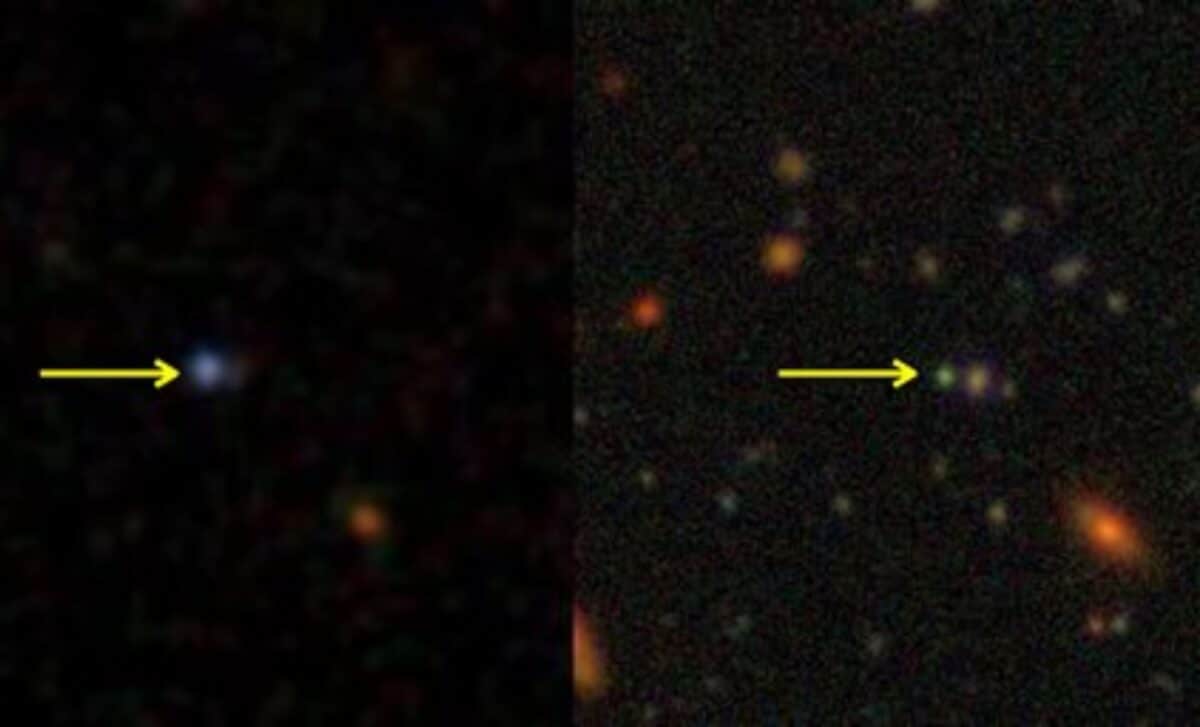
A galaxy roughly 10 billion light-years from Earth has dimmed to one-twentieth of its former brightness in only two decades, an astronomical eyeblink. The culprit, researchers say, is a supermassive black hole that appears to be running out of fuel at a pace nobody thought possible.
The discovery, led by researchers at the Chiba Institute of Technology, upends a long-held assumption about how black holes evolve. Until now, the prevailing view held that changes in mass accretion, the process by which black holes consume surrounding gas, unfold over tens of thousands of years, far beyond any human timescale of observation. This galaxy, catalogued as J0218−0036, has compressed that timeline into something a single scientist could witness across a career.
The findings were published November 4, 2025, in the Publications of the Astronomical Society of Japan, drawing on decades of archival data alongside fresh observations from some of the world’s most powerful telescopes.
The Discovery: Comparing Two Snapshots Across Two Decades
The story begins with a simple comparison. According to the study, researchers examined images of roughly 31,500 spectroscopically identified quasars where data from the Sloan Digital Sky Survey (SDSS) overlapped with newer imagery from the Hyper Suprime-Cam (HSC) on Japan’s Subaru Telescope. The SDSS data dated to around 2002; the HSC images, to 2018. When the team lined up both sets for J0218−0036, the difference was stark, the galaxy had faded dramatically across all three optical filters measured.
Typical active galactic nuclei, the luminous cores powered by feeding black holes, vary in brightness by around 30%. What the team found here was a decline by a factor of roughly 20 in total apparent brightness, and a factor of approximately 50 in the active galactic nucleus component specifically, between the early 2000s and 2023. That kind of variability, according to the paper, represents one of the largest amplitudes ever studied for an object of this type.
Follow-up observations poured in from an international array of instruments, the Gran Telescopio Canarias, the W. M. Keck Observatory, the SOAR telescope, and the Subaru Telescope itself, supplemented by archival X-ray data from XMM-Newton and photographic plate records stretching back approximately 70 years.
Ruling Out the Simpler Explanation
Before concluding the black hole was starving, the team had to eliminate a more mundane possibility: that adust cloud had simply drifted in front of the galaxy’s bright core, temporarily blocking the light. It’s a known phenomenon, and it would have been a far less dramatic explanation.
According to the study, that scenario was ruled out through multi-wavelength analysis. If dust obscuration were responsible, it would affect different wavelengths of light differently, shorter wavelengths dimming more than longer ones. But when researchers modeled the galaxy’s spectral energy distribution across six distinct time windows, from optical through near-infrared and into mid-infrared, the data consistently favored a scenario in which the active galactic nucleus itself was losing luminosity uniformly.
Both the Akaike Information Criterion and the Bayesian Information Criterion, statistical tools for evaluating competing models, strongly preferred the intrinsic accretion decline explanation over the dust scenario.
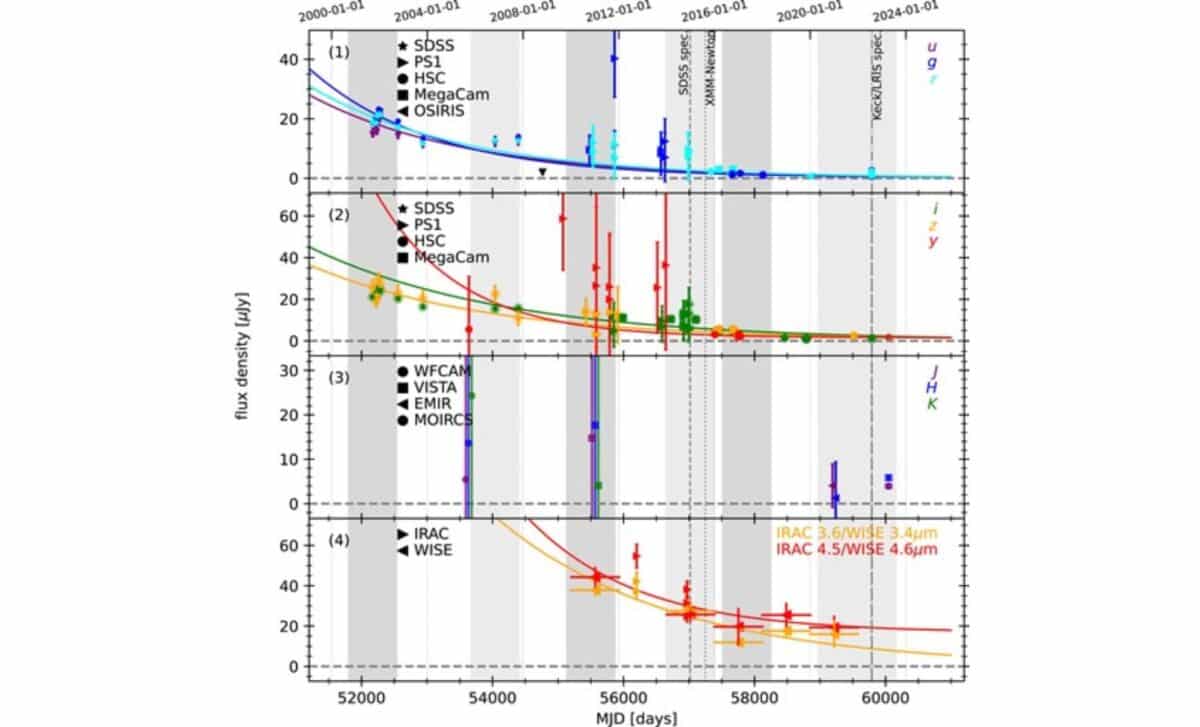
The Eddington ratio, a measure of how hard a black hole is feeding relative to its theoretical maximum, dropped from approximately 0.4 in the early SDSS imaging epochs to around 0.008 by the faintest observed phase. As the paper notes, that puts the black hole well below the threshold where standard accretion disk physics are expected to apply, suggesting the accretion mode itself may have fundamentally changed.
What This Means for Black Hole Science
The implications reach well beyond a single unusual galaxy. Standard theoretical models predict that changes in a black hole’s accretion rate should follow viscous timescales, the time it takes gas to spiral inward through an accretion disk, which for a black hole of this mass would stretch to roughly 10,000 years or more. According to the paper, the e-folding timescale observed for J0218−0036 was approximately 2,000 days in the observed frame, or around 700 days in the quasar’s own rest frame. That is orders of magnitude faster than models predict.
Lead researcher Tomoki Morokuma described the finding as a window into a process that had previously been considered unobservable on human timescales. “It is fascinating that an active galactic nucleus can change its brightness so dramatically over such a short period of time,” he said, “and that this fading appears to be caused by a large change in the accretion rate onto the supermassive black hole.”
Co-author Toshihiro Kawaguchi of the University of Toyama, who led the theoretical analysis, acknowledged the gap between observation and existing frameworks. According to Kawaguchi, the object “shows rapid variability that cannot be explained by standard models,” making it a critical test case for developing new theoretical approaches. The mechanism behind such a rapid shutdown remains unknown, an open question the team says will require both further observations and new theoretical work to resolve.
First Appeared on
Source link






Leave feedback about this