

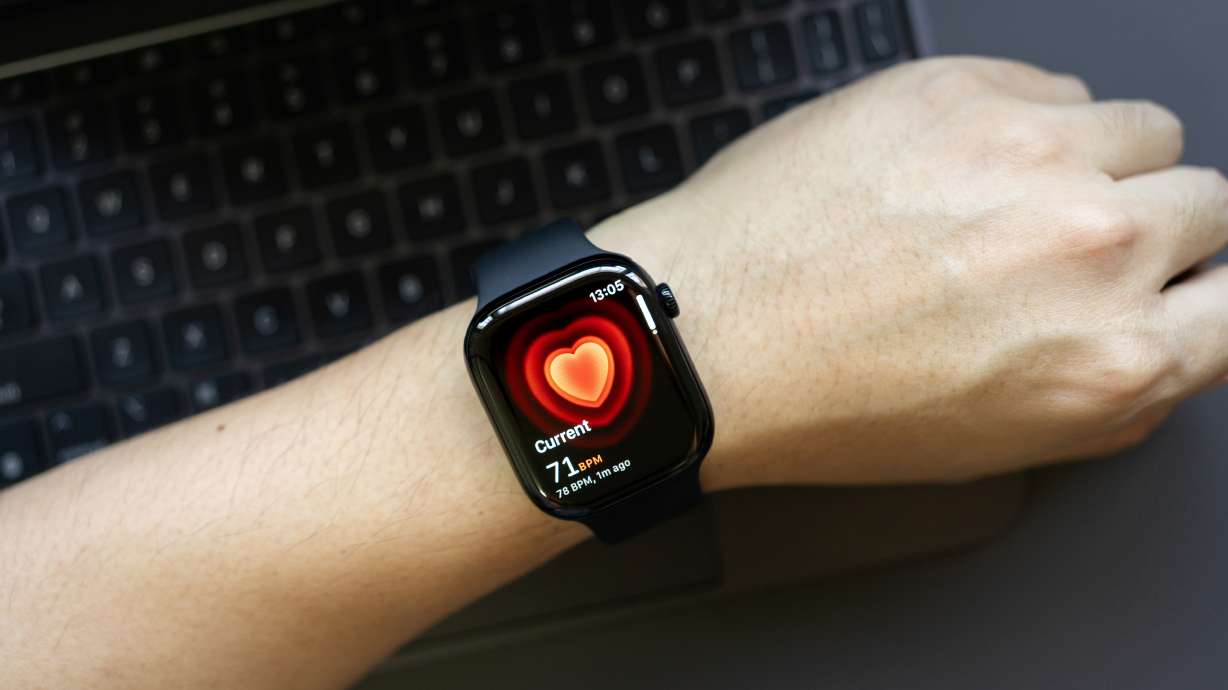
SALT LAKE CITY — Researchers are warning against using only a smartwatch to screen for high blood pressure in a recent University of Utah Health study.
Adam Bress, professor of population health sciences with tenure at the University of Utah School of Medicine, found that the watch falsely alerts people without high blood pressure while missing alerts for some who do have high blood pressure in a study published in the Journal of the American Medical Association.
High blood pressure is often called a “silent killer” because it is the leading cause of heart disease, but most people do not experience any symptoms. Smart watches can support, but not replace, regular blood-pressure checks, according to a statement Monday from U. Health.
“If (use of smart watches) helps get people engaged with the health care system to diagnose and treat hypertension using cuff-based measurement methods, that’s a good thing,” Bress said.
In September, the U.S. Food and Drug Administration approved the Apple Watch’s hypertension notifications feature, which uses optical sensors in the watch to detect blood flow patterns, but the statement said it is not intended to diagnose high blood pressure.
“It represents a step toward wearable-based population screening,” U. Health officials said.
An Apple analysis had previously found the notification feature did not alert about 59% of people with undiagnosed hypertension, and about 8% of people without hypertension would receive a false alert.
Because there are an estimated 200 million Apple Watch users, 30 million of whom are in the U.S., the research from U. Health concluded that although it is a “promising public health tool,” widespread use of the technology for hypertension diagnosis could lead to problems.
The study found those receiving alerts are more likely to have high blood pressure. For adults under 30, receiving an Apple Watch alert increases the chance of having high blood pressure from 14% to 47%, while in adults over 60, it raises the chance from 45% to 81%. Not receiving an alert for adults over 60 lowers the chance of having high blood pressure to 34%.
The absence of an alert for high blood pressure is more reassuring for younger adults but can be less reassuring for older adults or subgroups that are more likely to have high blood pressure, the numbers show.
According to U. Health, adults under 40 with no additional risk factors should have a blood pressure screening every three to five years, and adults over 40 should be screened every year. The researchers said those using Apple Watch devices should still obtain this screening with a blood pressure cuff so they do not miss opportunities for early detection and treatment.
Bress recommended that when people receive a hypertension alert on their watch, clinicians should use a “high-quality cuff-based office blood pressure measurement” and consider an additional measurement outside their office, like home blood pressure monitoring or ambulatory blood pressure monitoring, to confirm the diagnosis.
U. Health said the same research team plans to do follow-up studies into what demographics are associated with more false negatives and false positives.
The Key Takeaways for this article were generated with the assistance of large language models and reviewed by our editorial team. The article, itself, is solely human-written.
First Appeared on
Source link





Leave feedback about this