

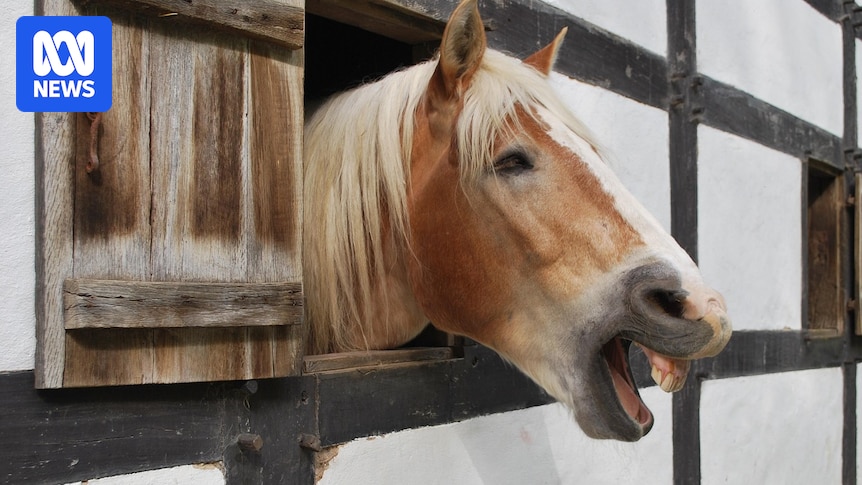
Anyone who lives around, works with, or simply loves horses will know they can be noisy characters.
Three of the main sounds they make include whinnies (the loud neighing sounds they’re known for), squeals, and nickers.
Nickers are deep sounds because of their low frequency, while squeals are much higher. But whinnies are a unique combination of both high and low.
Until now, it was a mystery as to how a horse could make these two different sounds at the same time.
But new research, published in Current Biology, suggests whinnies are like a horse is singing and whistling at the same time.
A decade’s long mystery
The ability to make two sounds at once is known as biphonation.
Birds, which have two sets of vocal structures, can easily do this.
But it is trickier for mammals, including humans, because they only have one set of vocal cords.
“[Biphonation] happens in some [mammal] species, but it’s quite rare,” behavioural ecologist Elodie Mandel-Briefer said.
A spectrogram showing how nickers have low frequencies, squeals have high frequencies and whinnies have both. (Supplied: Elodie Mandel-Briefer)
Dr Mandel-Briefer, an associate professor at the University of Copenhagen, was studying horse expression of emotions in 2015 with colleagues when they discovered the animal used low and high frequencies when it whinnied.
Neuroaudiologist Peter Scheifele, a professor from the University of Cinncinati not involved in the new study, said it was weird horses could create such a high pitch given their body size.
“The rule of thumb is that the lower the frequency the animal can produce, the more the animal sounds like ‘I’m fit, I’m big, I’m bad, you don’t want to mess with me.'”
What’s making the different pitches?
To look into the whinny, Dr Mandel-Briefer and her team put cameras down the noses of horses with diseased and paralysed vocal cords.
They saw that even though the horses could not move their vocal cords, a high frequency was still made when they tried to whinny.
“You see [the muscles above the vocal cords] contracting very strongly, and then you can hear the high pitch,” she said.
Loading…
The researchers thought the high pitch could be a whistle, a sound created by a stream of air forced through a small gap causing the air around it to vibrate at a particular frequency.
This is compared to the low sound made with the vocal cords, where the air pushes against the tight cords, causing them to open and close in waves.
To test this, the team took horse larynxes — the cartilaginous organ that contains the vocal cords and is also known as a voice box in humans — from a butcher in France to test in a lab.
They blew normal air and helium through the larynx, pressing it down to mimic the muscle contractions they saw in the endoscopy video.
Sound travels faster in helium, so if the source of the high pitch is a whistle, it will sound higher in helium than in regular air.
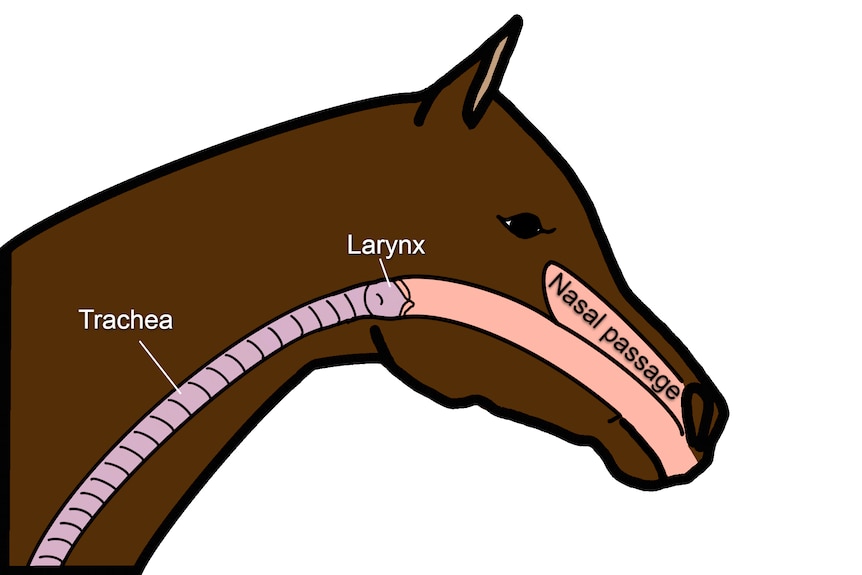
The larynx and vocal cords of a horse are located at the top end of the trachea. (ABC Science: Peter de Kruijff)
Physicist Noël Hanna, from the University of New South Wales College, who was not part of the study, said if the high frequency was made by the vocal cords, the helium would “make no difference”.
Dr Hanna said the study showed clearly that there were two different sources of sound when a horse whinnies.
“One is the physical vibration of the vocal cords and the other is the whistle,” Dr Hanna said.
He suggested a next step in this research would be to work out what was amplifying the whistle in the larynx.
So things like whether a horse requires particular muscles to start and control the whistle or if tissue in the larynx and the rest of the vocal tract shape its sound.
“What the horse is doing with its tongue … where it’s jaw is or what its lips are doing … that all has an effect,” Dr Hanna said.
But, Dr Hanna said the initial finding was a big first step.
“Hats off to them. It’s a big study.”
What is a whinny in ‘horse speak’?
Further research needs to be undertaken to explain why horses evolved this whinny and how it might be used to communicate, but the researchers have some theories.
“It could be that the high pitch is for long distance communication and the low pitch for short distance,” Dr Mandel-Briefer said.
“Although high-pitch frequencies travel less far, they are going to be produced much louder.“
Dr Mandel-Briefer said this could be why whinnies were used when horses were separated or reunited with other horses.
Professor Scheifele said he had seen his horses call out to each other when they were out of sight.
Another theory is that horses are able to show their emotions through pitch.
“So the lower pitch indicates the intensity of the emotion of the horse, and the high pitch, whether it was pleasant or unpleasant,” Dr Mandel-Briefer said.
“It’s very obvious for me also, because I used to ride horses … the positive whinny is very different from a negative whinny.”
First Appeared on
Source link






Leave feedback about this