

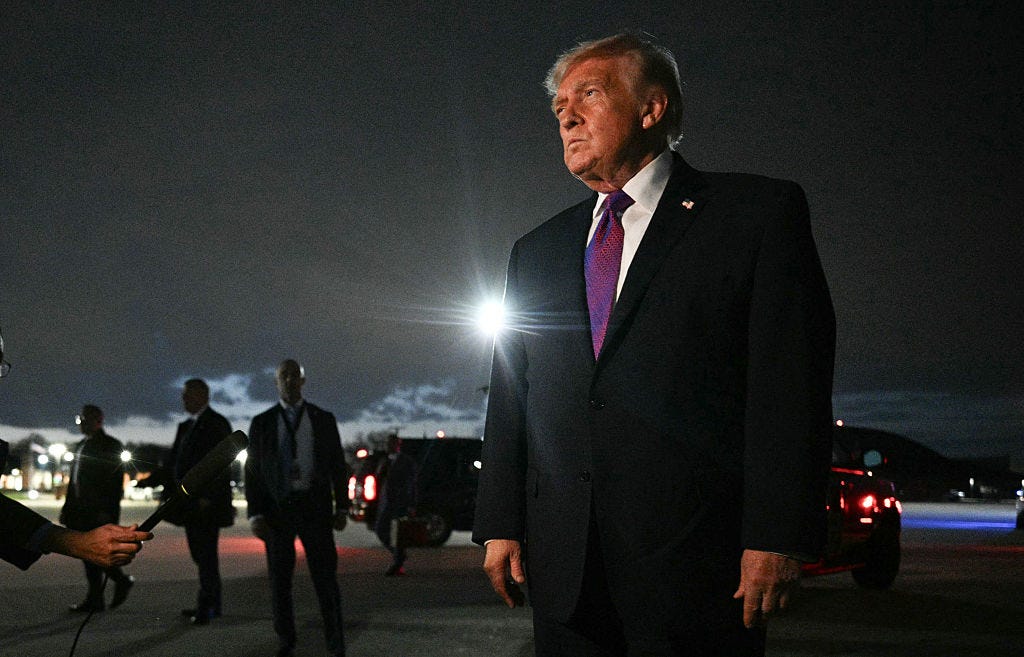
Way back in June 2024, Andrew wrote that “one awkward thing about Trump discourse today is that all the vile things about him suck up so much oxygen that it can be hard to make space to talk about the ways in which he’s merely very stupid.”
We thought about that this morning—and about how it’s now become a government-wide phenomenon—when we encountered this Deadline headline: “Kash Patel Confirms UFC Fighters Will Train FBI Agents This Week, Calling It a ‘Historic Opportunity.’” What a time to be alive. Happy Thursday.
by William Kristol
President Trump hasn’t been particularly coherent about what it is we’re trying to accomplish in Iran. He seems to have taken us to war without a clear plan or purpose. But he has given his war a striking moniker: Operation Epic Fury.
It’s an unusual one. Usually, in naming military operations, the Pentagon seeks to convey an attitude of strength or determination. Last June’s strike against Iran’s nuclear program was called Operation Midnight Hammer. January’s operation in Venezuela was dubbed Operation Absolute Resolve.
But such names no longer seem to satisfy Trump’s child-like grandiosity and dictator-like megalomania. As Trump explained yesterday at a rally in Hebron, Kentucky, it was “Epic Fury” that spoke to him.
In the midst of delivering a brief war update, Trump paused over the name. “Epic Fury!”, he shouted with relish. “Is that a great name?” he asked rhetorically. And then Trump explained: “They gave me, like, 20 names. And I’m like, falling asleep. I didn’t like any of them. Then I see Epic Fury. I said, ‘I like that name, I like that.’”
It’s a ridiculous and embarrassing name.
After all, this is a war that Trump has characterized as merely a “little excursion.” So by Trump’s own telling, it’s not very “epic.”
And “fury?” That’s not perhaps the term to choose if you want to reassure the American people and the world that this war you’ve started is based on sound strategic judgment, and that this military operation is well-considered.
But if you revel in tough-guy triumphalism and world-historical vanity, then I suppose “Epic Fury” hits the spot. Is it possible that Trump has some vague memory of Homer’s Iliad? It’s an epic account of great fury, and its sort-of hero, Achilles, became famous. Will Trump have his Homer? “Sing, Goddess, of the fury of Trump!”
Of course, Homer does seem to suggest over the course of his long epic poem that the rage of Achilles was kind of a mixed blessing for his fellow Greeks.
What about the epic fury of Donald Trump? How’s that working out for us?
Trump thinks, or claims to think, it’s been just great. As he said yesterday in Kentucky, “Let me say we’ve won . . . We won. We won. In the first hour it was over. But we won.”
And earlier in the day, Trump called Barak Ravid of Axios to tell him that “The war is going great. We are way ahead of the timetable.” Later, in Ohio, he said “For us, it’s turned out to be easier than we thought.”
Is he protesting just a bit too much?
Surely he knows that so far he’s failed to remove the reprehensible Iranian regime. He knows the Iranians still have plenty of short-range missiles, drones, and naval mines because they’re continuing to use them, some to damaging effect. He knows that he’s been unable to prevent the closing of the Strait of Hormuz, the disruption of the global economy, and a dramatic rise of oil prices up to the neighborhood of $100 a barrel. He knows that seven American soldiers have been killed and many more seriously injured. He knows that the cost of all this is running at some $2 billion a day. And even he must know that U.S. forces were responsible for the killing of scores of school children in an accidental bombing—a tragedy that, as the New York Times put it, “is sure to be recorded as one of the most devastating single military errors in recent decades.”
You might think that Trump would therefore know—though he’d never admit it—that all is not going swimmingly well. After all, while he may not be re-reading his Homer, he’s probably aware of what our own bard, Joe Rogan, is saying. The podcaster who supported Trump in 2024 declared on his show Tuesday that the war was “crazy” and had left Americans feeling “betrayed.” “This one’s nuts,” Rogan concluded.
I suspect that Trump may realize deep down that his exercise in epic fury is nuts. Presumably that’s why he’s assuring us that “Any time I want it to end, it will end.” I expect him to declare victory and end it soon.
But it won’t be remembered as an epic victory for the United States. All we can hope is that Epic Fury doesn’t turn out to have been an epic disaster.
If you had to name a military operation to capture the purest spirit of Trump, what would you call it? Share your ideas.
by Andrew Egger
It’s clear by now that Donald Trump’s subordinates know the secret to thriving in his orbit is to butter him up shamelessly and mercilessly at every turn. And yet it remains genuinely repulsive to watch that dynamic play out in the sort of fealty displays usually associated with ludicrously totalitarian regimes.
On Monday, Trump delivered a speech at the Congressional Institute, where he was joined on stage by four members of House Republican leadership: Speaker Mike Johnson, Majority Leader Steve Scalise, Conference Chairman Lisa McClain, and Majority Whip Tom Emmer. As Trump took the stage, they immediately began to applaud—and then, bizarrely, they just didn’t stop. For nearly two minutes they stood there, clapping, as Lee Greenwood’s “God Bless the USA” played over the loudspeakers. Trump just stood there, pivoting slightly, occasionally firing off a dance move. At one point, Scalise briefly dropped his hands, then appeared to think better of it and got back to clapping again. It was a lesson straight from Solzhenitsyn’s Gulag Archipelago: “Don’t ever be the first to stop applauding.”
Still, House leaders might console themselves, there are worse humiliations. You could be in Trump’s cabinet, doomed to spend your life flapping around in clown shoes. The Wall Street Journal reported this week that Trump has recently fallen in love with the American shoe brand Florsheim, and he’s taken to having pairs ordered for all the men in his office. “It’s hysterical,” one female White House aide told the Journal, “because everybody’s afraid not to wear them.”
But there’s a problem: Trump’s just guessing everybody’s shoe size. And after the piece appeared, people began to notice: Oh, that’s why Marco Rubio and JD Vance keep getting photographed with their feet swimming in outrageously large Oxfords.
I invite you to consider the constant low-level physical and psychological drain of spending your entire professional life in way-too-big shoes.
These middle-aged men, some of the most powerful in the world, are not allowed even to stand or walk normally. The shoes are not very expensive—about $145—but apparently even to order a replacement pair in the correct size would risk an unacceptable breach of courtly etiquette. What if he noticed?? So they clomp around, their posture and gait arrested, their blisters and spinal alignments unimaginable, some non-trivial percentage of their neurons constantly devoted to keeping the damn things on. For them, slavishness to Donald Trump has gone beyond the merely mental; they feel it in their skin, their joints, their bones.
Against that backdrop, it’s hard even to get too worked up about the other White House aesthetic controversy of the week: Defense Secretary Pete Hegseth banning press photographers from the Pentagon briefing room for releasing pictures of him he considers insufficiently hot. Sure, it’s an outrage against ordinary norms of a free press, but at least it’s an outrage being carried out due to pure human vanity—Hegseth thinks he’s a smokeshow, and he demands to be presented as such. That urge is identifiably human. Worms don’t care how they look.
WHO KILLED THOSE GIRLS? As information has slowly trickled out about the mistaken American bombing of an Iranian girls’ school, many people have reasonably wondered: Was AI involved in the decision that led to the death of scores of Iranian schoolchildren?
As has been widely reported, the Defense Department used AI heavily during its target planning for its initial strikes on Iran, assembling target lists on systems from the defense contractor Palantir that are powered by AI technology from Anthropic. But reporting from multiple outlets suggests that the problem was likely one of outdated intelligence from the Defense Intelligence Agency: The site of the school was on a target list because the building, which was next door to a military compound, was part of the compound years ago.
If that’s true, then the Pentagon’s AI wasn’t at fault for the mistake—it simply passed along a piece of faulty data that had been fed into it. But it’s still reasonable to wonder if a Pentagon that wasn’t leaning on AI systems would have made the same mistake. The Washington Post reports on how the Pentagon’s AI use is “speeding the pace of the campaign,” turning “weeks-long battle planning into real-time operations.” The power of these tools allows the military to move at unprecedented speed and scale—but that in turn significantly raises the pressure on, for instance, the human analysts whose job it is to vet targets before they’re attacked. “Given the speed and scale of Operation Epic Fury,” WaPo reported, “those targets may not have received updated vetting.”
In other words, it’s plausible that the school strike was exactly the sort of mistake humans interacting with AI tend to make: Not being thorough enough in double-checking the machine’s extremely correct-looking outputs. And here’s a reminder: The Pentagon is currently fighting a major legal battle with Anthropic precisely because it thinks, over the strenuous objections of the company, that it should be able to take humans out of this loop altogether.
THE COALITION CRACKUP CONTINUES: Back in January, we wrote about Donald Trump’s growing problem with a demographic that helped get him re-elected: young men. A big part of their concern, according to Speaking with American Men pollster John Della Volpe, was that Trump was more focused on foreign policy than on domestic affordability. And you’re not gonna believe this, but this business in Iran seems to be making the issue worse. The New Republic’s Greg Sargent reports:
Della Volpe told me he just conducted over 50 interviews with men of ages 19 to 29 for a forthcoming release. They are registering “strong opposition” and dismay with Trump over the war, Della Volpe said, describing their message this way: “He assured them there would be no more wars, and it feels like betrayal.” . . .
In a sense, Trump’s economic failures and Iran invasion constitute a double whammy of broken promises. He gave young people hope for a brighter economic future rooted in populist nationalist renewal and also hope for a future of peace. “Neither of those things has been delivered,” Della Volpe said.
We won’t hold it against the kids that they believed those promises in the first place. Fool me once, etc.
THINGS THAT MAKE YOU SAY ‘HMMM’: Where is the money Trump extorts from companies—ABC, Meta, Paramount, X—actually going? Congressional Democrats are trying to find out. WaPo reports:
The four companies each committed millions of dollars to the project through legal settlements with Trump in the months after the 2024 presidential election, seeking to resolve claims they had harmed him by restricting his access to social media or defaming him in their coverage. The commitments totaled at least $63 million, according to company statements and media reports.
But the Donald J. Trump Presidential Library Fund, Inc., which was set to receive at least some of the settlement funding, was administratively dissolved in September by Florida officials after it did not submit a mandatory annual report. Three months later, Jacob Roth, the lawyer who originally incorporated the fund, filed articles of dissolution, OpenSecrets first reported last year.
“Now it is unclear where this money has gone, exacerbating concerns about corruption that were apparent at the time of the settlement,” the lawmakers wrote.
All totally above-board and corruption-free, we have every confidence. Read the whole thing.

And a bonus:

First Appeared on
Source link

Leave feedback about this