

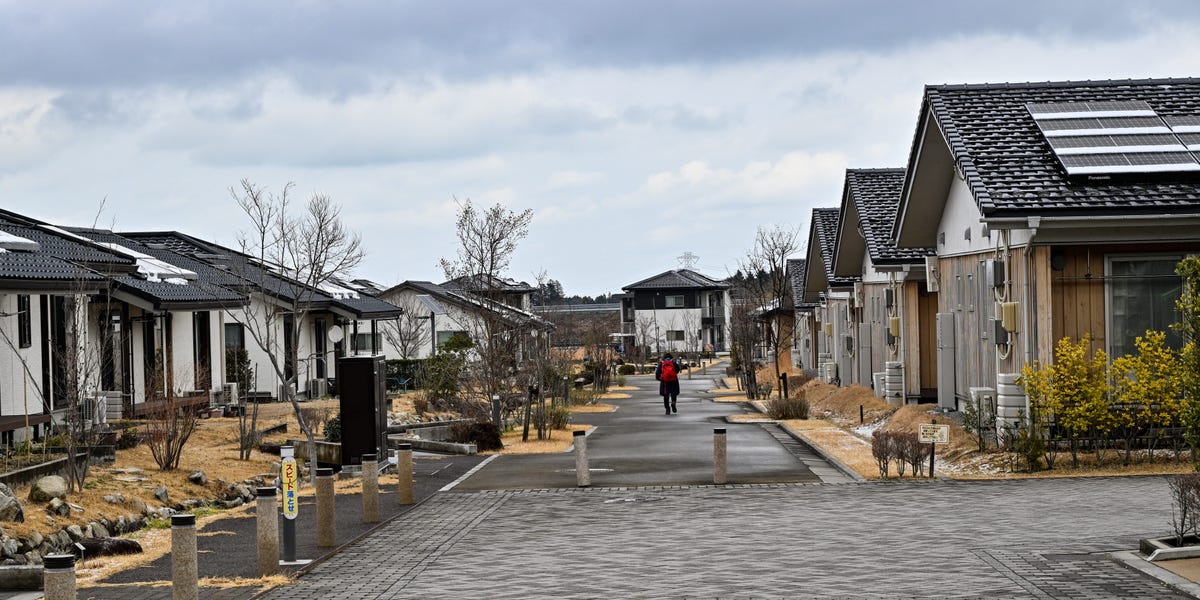
Fifteen years ago, Fukushima, Japan, was home to one of the worst nuclear disasters in history. Today, some places in the region look just as they did in the immediate aftermath of that fateful Friday in 2011.
After a 9.0 magnitude earthquake and tsunami ravaged the electrical grid and flooded the reactor units, the Fukushima Daiichi Nuclear Power Plant suffered a nuclear incident that resulted in the plant’s three functioning cores experiencing meltdowns within three days.
In the aftermath of the disaster, more than 100,000 people were evacuated from their homes, with even more displaced from the area, per the World Nuclear Association.
The surrounding area saw high radioactive releases, resulting in the incident’s level-7 rating on the International Nuclear and Radiological Event Scale. The only other nuclear disaster in history to be classified as a level 7 was the 1986 Chernobyl disaster.
David W. Miller, an adjunct professor of nuclear, plasma, and radiological engineering at the University of Illinois Urbana-Champaign, assisted in research and recovery work with Japanese engineers following the disaster. For his efforts, he was awarded the Society Contribution Award by the Japan Society of Mechanical Engineering.
Part of the post-disaster collaboration between Japanese and American engineers was focused on improving Japan’s authority hierarchies at nuclear power plants. Miller told Business Insider the Fukushima incident was worsened by a power structure that was rank-oriented rather than collaboration-based.
Political interference was also a problem, Miller said. At the time of the disaster, Japanese law allowed the prime minister to overrule and influence the decisions of plant managers. Following the disaster, Japan took steps to reform its nuclear regulatory structure and develop a collaboration-based model at its nuclear plants.
“Sharing knowledge, good practices, and lessons learned is critical for success in the nuclear age,” Miller said. “An error-free operation is not only an absolute mandate, it’s a reality that needs to happen.”
While Fukushima provided valuable lessons in nuclear management and disaster mitigation, the incident left behind devastating effects that are still felt to this day.
See the immediate aftermath of the disaster and what it looks like 15 years later, in photos.
An earthquake and ensuing tsunami on March 11, 2011, triggered the disaster.

YOSHIKAZU TSUNO/AFP/GettyImages
The nuclear power plant, which was about 110 miles from the earthquake’s epicenter, suffered reactor meltdowns.


AFP/POOL/AFP via Getty Images
Today, some parts of towns like Okuma still remain uninhabited and inaccessible.

NurPhoto/NurPhoto via Getty Images
Okuma and other towns are trying to return to normalcy.

NurPhoto/NurPhoto via Getty Images
The area’s residents are very familiar with radiation dosimeters.

NurPhoto/NurPhoto via Getty Images
Efforts to dispose of and recycle contaminated waste are widespread in the area.

Yuichi YAMAZAKI/AFP via GettyImages
The area is subject to strict inspections.

Yuichi YAMAZAKI/AFP via GettyImages
The disposal of wastewater continues to be met with backlash.

PHILIP FONG/AFP via Getty Images
Some structures remain destroyed 15 years later.

NurPhoto/NurPhoto via Getty Images
Some plant workers and community members have found new ways to help out.

Philip FONG/AFP via GettyImages
This January marked the first restart of a TEPCO-operated nuclear reactor in Japan since 2011.

JAPAN POOL/JIJI PRESS/AFP via GettyImages
Nuclear energy remains a controversial issue in Japan.

Kazuhiro NOGI/AFP via GettyImages
First Appeared on
Source link



Leave feedback about this