

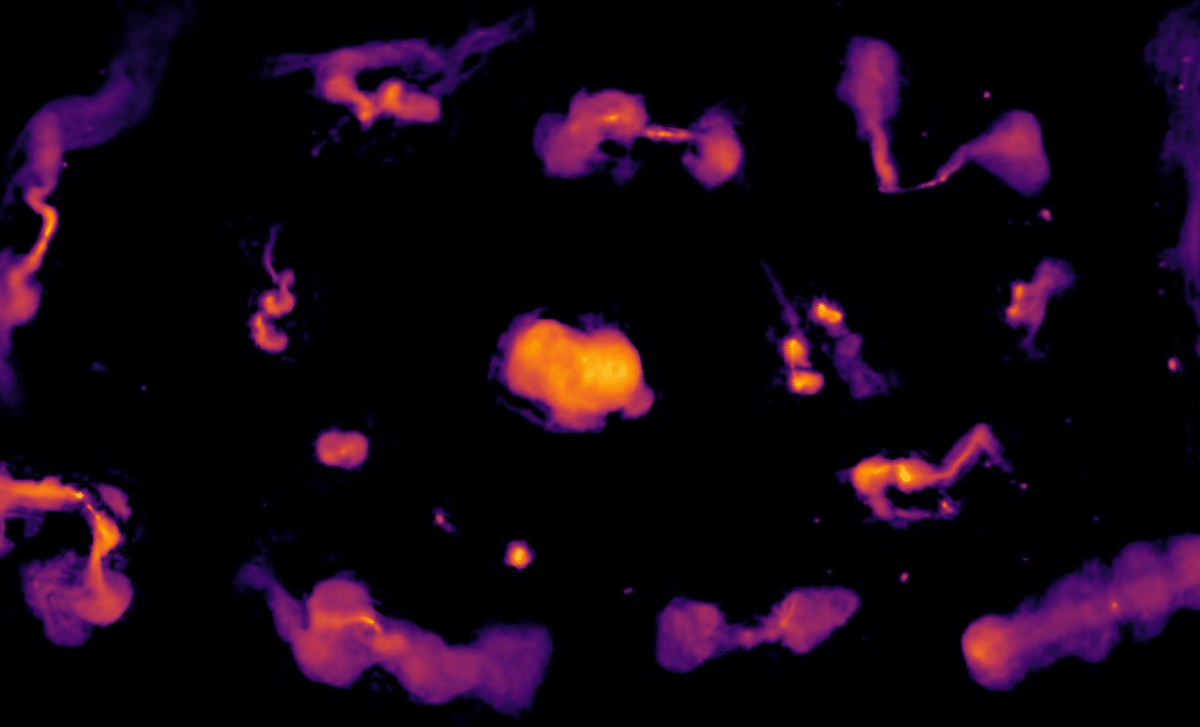
The universe is vast, filled with countless cosmic objects and phenomena, many of which remain hidden from our eyes. Traditional optical telescopes reveal only part of the picture, leaving much of the universe’s activity in the dark. But by observing the sky through low-frequency radio waves, astronomers are uncovering a different and much more detailed view of the cosmos. A recent study, published in Astronomy & Astrophysics, has taken a major step forward in this effort, mapping 13.7 million cosmic sources.
A Decade of Collaboration and Innovation in Radio Astronomy
The LOFAR Two-Meter Sky Survey (LoTSS-DR3) represents the culmination of over a decade of effort by an international team of scientists and researchers. The study’s vast dataset, accumulated through countless hours of observation and meticulous data processing, reveals a picture of the universe in unprecedented detail.
“This data release brings together more than a decade of observations, large-scale data processing and scientific analysis by an international research team,” says Dr. Timothy Shimwell, lead author and astronomer at ASTRON and Leiden University, Netherlands.
The collaboration includes experts from across Europe, with contributions from the Netherlands, Germany, France, the United Kingdom, and several other nations. The LOFAR network itself is a key component of this effort, with its array of radio stations spanning across Europe, some separated by nearly 2,000 kilometers. This unique design makes LOFAR one of the largest and most sensitive radio telescopes in the world. As a result, the LoTSS-DR3 survey is not only an incredible scientific achievement but also a testament to the power of international cooperation in pushing the boundaries of astronomy.
In addition to providing a wealth of data, the survey’s methodology required innovative new techniques to process and analyze the vast amounts of information collected. The team’s ability to overcome challenges such as ionospheric distortions and the sheer scale of data, 18.6 petabytes, was critical to achieving the sharp, detailed images that the survey is known for today.
Credit: LOFAR surveys collaboration.
Unlocking the Mysteries of Supermassive Black Holes
One of the most exciting findings from the LoTSS-DR3 survey is its detailed analysis of supermassive black holes and the enormous jets of radio emission they produce. These black holes are found at the centers of many galaxies, and their radio emissions can stretch across millions of light-years, providing astronomers with valuable clues about their nature and evolution.
“We can study a diverse population of supermassive black holes and their radio jets at different stages of their evolution, showing how their properties depend not only on the black hole itself, but also on the galaxy and environment in which it resides,” explains Prof. Martin Hardcastle of the University of Hertfordshire, U.K.
The survey’s ability to capture such intricate details of these black holes is allowing scientists to better understand how the surrounding galaxy influences the behavior of these cosmic giants. By observing their jets and emissions, the survey also offers new insights into the mechanics of energy transfer and particle acceleration in these extreme environments, deepening our understanding of high-energy astrophysics.
These discoveries could have far-reaching implications for how we understand the life cycles of galaxies and black holes, potentially reshaping theories about the formation and growth of supermassive black holes over cosmic time.
Credit: LOFAR surveys collaboration.
New Discoveries of Cosmic Phenomena
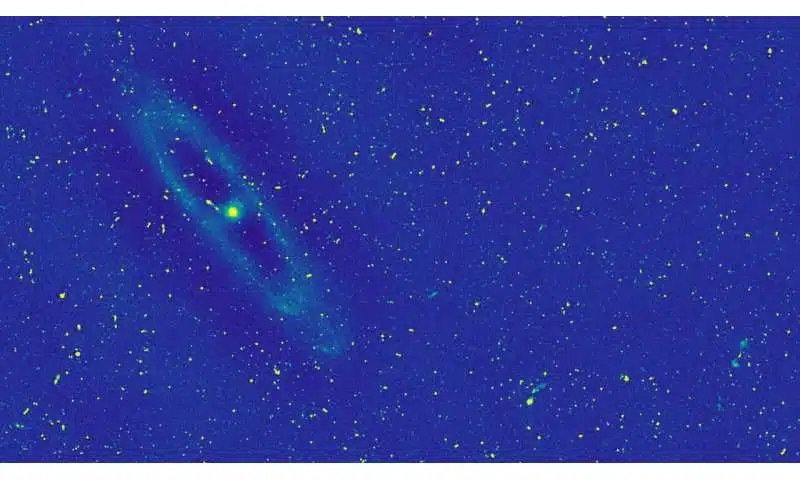
Beyond the supermassive black holes, the LoTSS-DR3 survey has also revealed several rare and elusive objects previously difficult to observe. The data has uncovered faint supernova remnants, merging galaxy clusters, and even radio emissions potentially linked to exoplanets interacting with their host stars. These discoveries highlight the extraordinary variety of systems at play within the universe and the power of low-frequency radio observations.
“By studying many galaxy clusters, we can show that giant shocks and turbulence drive particle acceleration and strengthen magnetic fields across millions of light-years, something we now see to be happening far more than previously anticipated,” says Dr. Andrea Botteon of INAF in Bologna, Italy.
This finding, published in Astronomy & Astrophysics, provides crucial evidence for the role of cosmic turbulence in shaping the physical conditions of galaxies and clusters over vast distances. It also suggests that particle acceleration is much more prevalent than once thought, giving new avenues for future research into cosmic ray physics and the behavior of high-energy particles.
These unexpected discoveries underscore the importance of the LoTSS-DR3 survey in expanding our understanding of the universe’s most extreme and dynamic environments.
Overcoming the Software and Computational Challenges
Processing the massive amounts of data generated by the LOFAR telescope presented significant challenges, particularly with the need to correct for the distortions caused by Earth’s ionosphere. The survey team developed innovative algorithms and techniques to overcome these obstacles, enabling the production of extremely high-resolution images of the low-frequency radio sky.
“The software challenge was enormous,” says Dr. Cyril Tasse of the Paris Observatory, who led the algorithm development. “It took years to design, refine and optimize the algorithms, but they now allow us to routinely produce extremely sharp and detailed images of the low-frequency radio sky, and hunt for time-variable signals from stars and exoplanets.”
These advancements in data processing and algorithm development not only improved the resolution of the images but also enabled the team to detect time-variable phenomena, such as flares from stars and signals from exoplanets, that were previously difficult or impossible to observe with traditional methods. This represents a major step forward in our ability to observe the dynamic nature of the universe across time and space.
First Appeared on
Source link






Leave feedback about this