

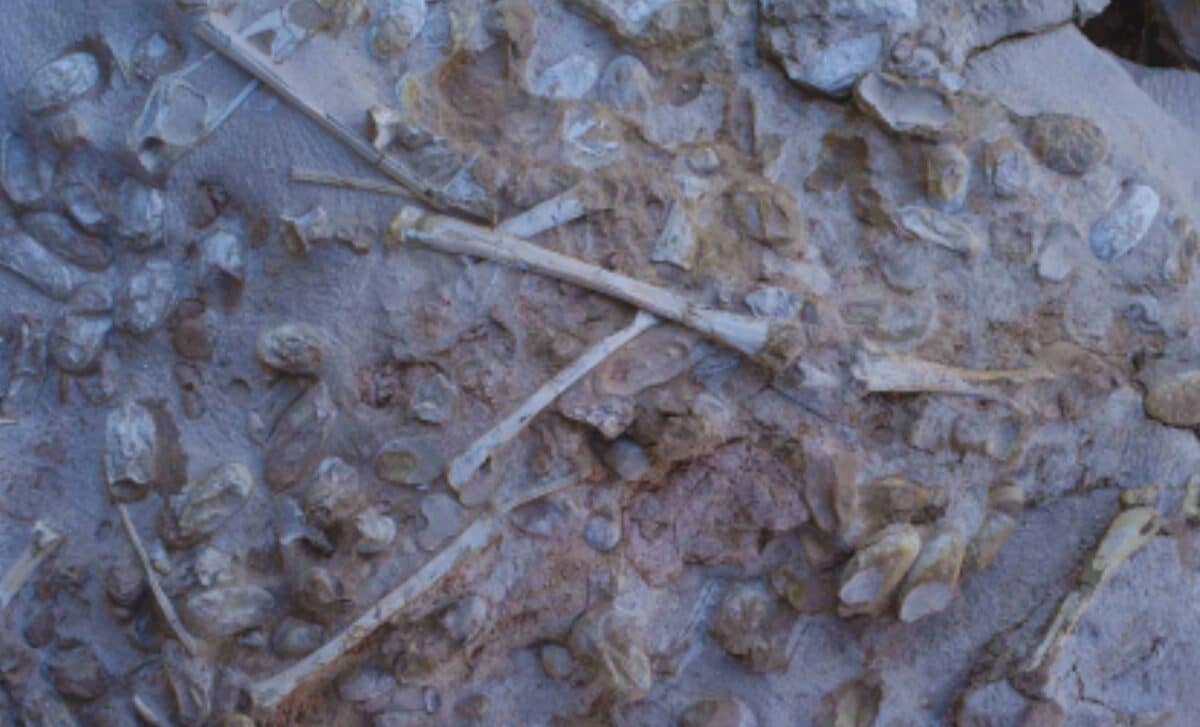
More than 200 fossilized eggs belonging to the flying reptile Hamipterus tianshanensis have been unearthed in northwestern China. The discovery includes at least 16 partial embryos, several preserved in three dimensions.
The find, reported in Science, marks one of the largest collections of pterosaur eggs ever documented. According to the research team led by Xiaolin Wangof the Chinese Academy of Sciences, the eggs date back roughly 120 million years to the early Cretaceous period.
Until now, pterosaur reproduction had remained largely mysterious. Only a handful of eggs had previously been identified worldwide, five from the same Chinese site and two from Argentina, one of which contained a flattened but well-preserved embryo. This new concentration changes the scale of available evidence and allows researchers to move beyond isolated specimens.
A Rock Containing 215 Eggs
The eggs were recovered from a sandstone block measuring about three meters square. According to the study published in Science, at least 215 eggs were identified, all attributed to Hamipterus tianshanensis, a species that lived in what is now Xinjiang, China.
“The specimens can be attributed to Hamipterus tianshanensis, the sole species in this bonebed. The most important section is a sandstone block (3.28 m²) that yielded 215 eggs, but up to 300 may be present, because several more appear to be buried under the exposed ones,” said Xiaolin Wang.
Earlier discoveries at the site had yielded only five eggs, as previously reported in Science News. The new excavation dramatically expands the sample size. Researchers confirmed that at least 16 of the eggs contain partial embryos, some of them preserved in three dimensions rather than flattened.
Such preservation is unusual. Pterosaur eggs had soft, thin shells, more similar to those of modern lizards than to the rigid shells of dinosaurs or birds. That softness often led to deformation during fossilization, which helps explain why intact embryos are so rare.
Preserved by Flood and Rapid Burial
The eggs were not found in their original nesting positions. According to Alexander Kellner of the Museu Nacional/Universidade Federal do Rio de Janeiro, co-author of the study, they appear to have been jumbled and deformed after being transported by floodwaters during an intense storm.
Sediment carried by the water likely buried the eggs quickly. Kellner explained that rapid burial was necessary for preservation because the soft-shelled ones would otherwise have decomposed. The sandstone block itself suggests a high energy event capable of moving and concentrating the clutch.
Embryos Suggest Walking Before Flight
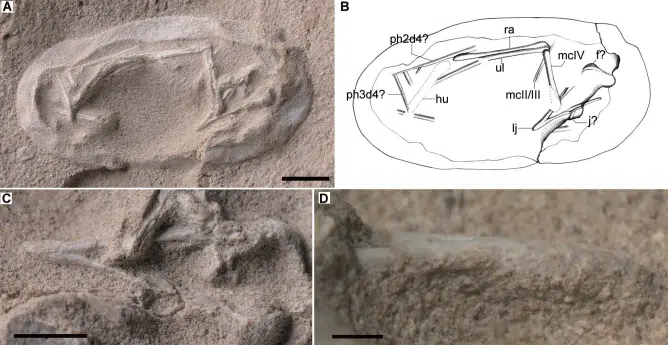
Researchers used computerized tomography to scan the find and examine their contents without damaging them. Two of the best-preserved embryos provided key anatomical details.
A wing structure known as the deltopectoral crest, critical for anchoring flight muscles, was not fully developed, even in an embryo interpreted as nearly at term. In contrast, the femur was well developed. Researchers behind the study sayid that:
“computed tomography scanning, osteohistology, and micropreparation reveal that some bones lack extensive ossification in potentially late-term embryos, suggesting that hatchlings might have been flightless and less precocious than previously assumed.”
That interpretation has drawn caution. D. Charles Deeming of the University of Lincoln, who was not involved in the research, noted in a column published in the same issue that determining whether an embryo was truly near term is difficult. He warned of “a real danger of overinterpretation.”
Still, the unusually large sample offers new opportunities. With hundreds of eggs available for measurement, researchers can now examine variation in size and shape.
First Appeared on
Source link






Leave feedback about this