

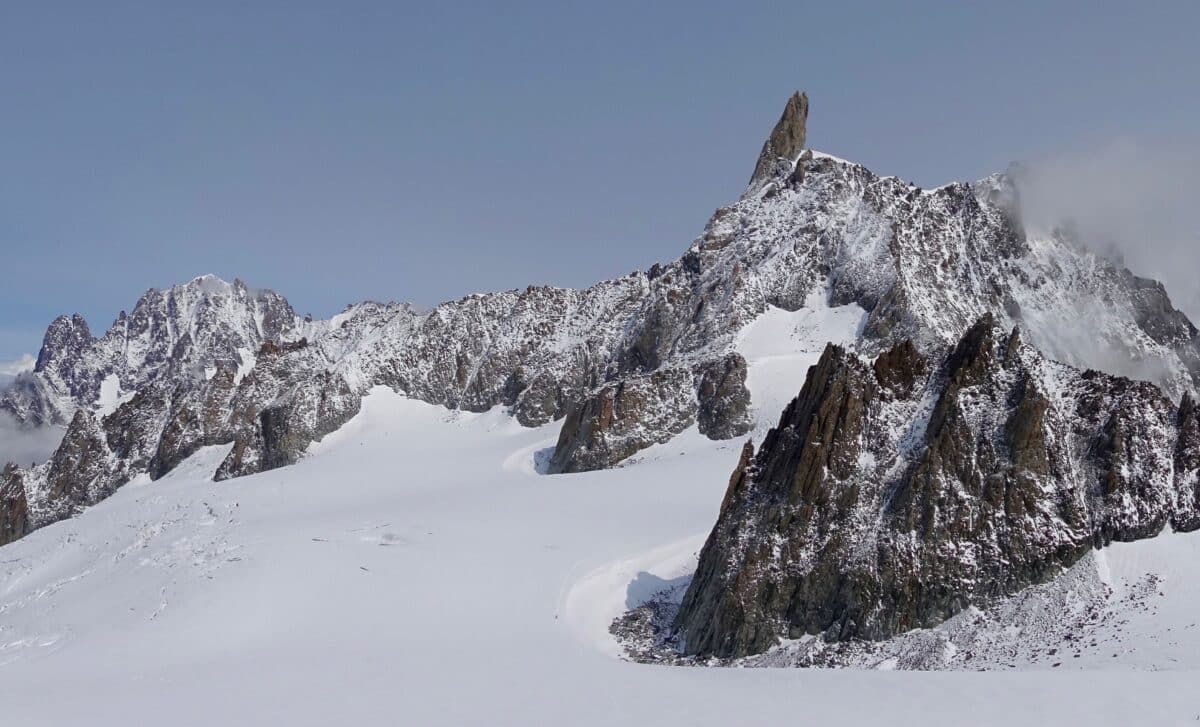
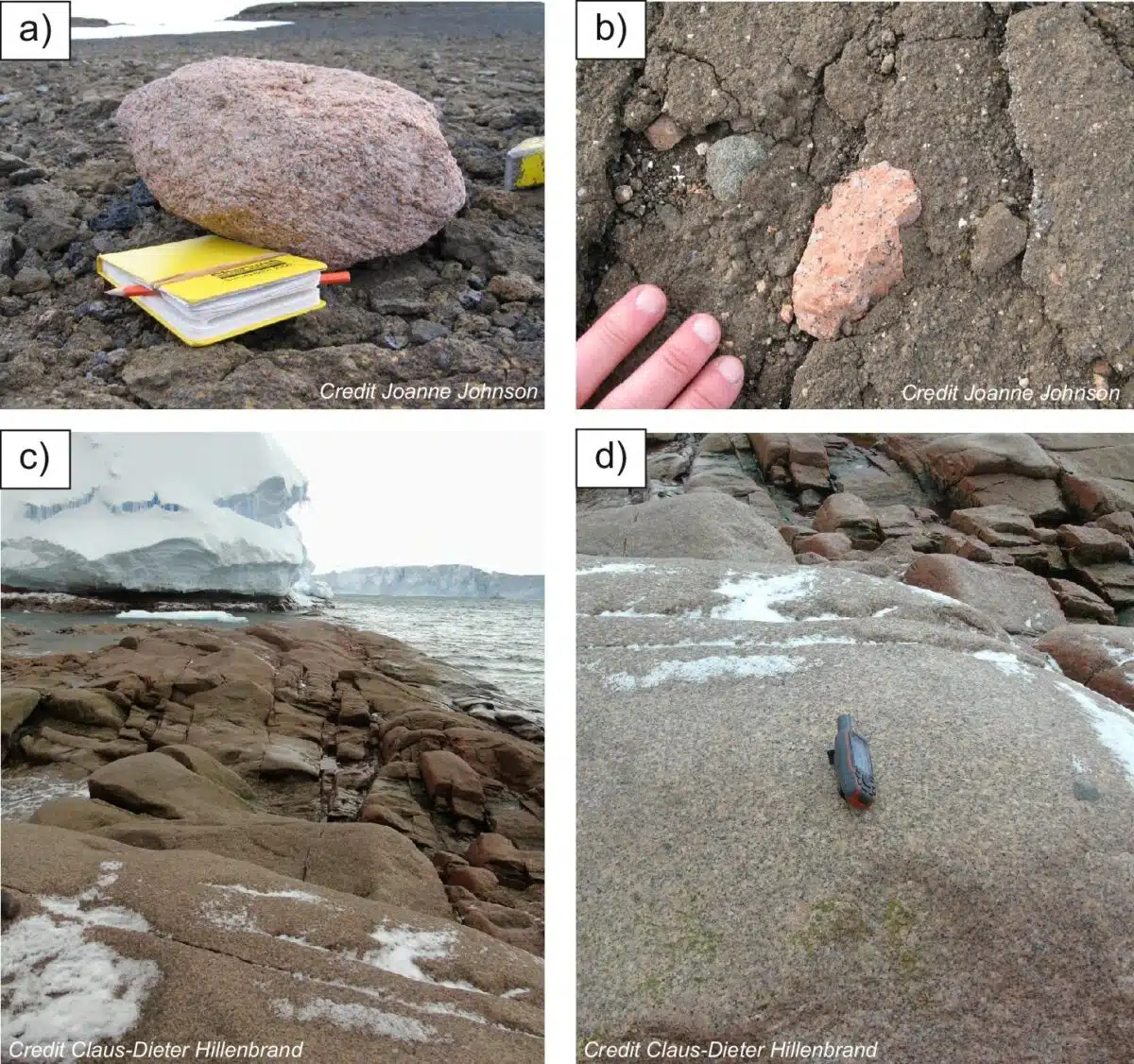
Bright pink boulders scattered across the peaks of West Antarctica’s Hudson Mountains have led scientists to identify a massive granite body buried deep beneath the ice. What first appeared as a geological curiosity is now tied to a structure stretching for tens of kilometers below the Pine Island Glacier.
These rocks stand out sharply against darker volcanic terrain, drawing immediate attention during field observations. Their presence at high elevation raised a simple but puzzling question: how did granite formed deep underground end up on exposed mountain summits?
A research team led by the British Antarctic Survey (BAS) investigated the phenomenon using a combination of rock sampling and airborne geophysical surveys.
Boulders Dated to the Jurassic Period
The first breakthrough came from analyzing radioactive decay in mineral crystals within the granite. This method showed the rocks formed around 175 million years ago, during the Jurassic period. According to the British Antarctic Survey, this age excludes any connection with the surrounding volcanic rocks, which are much younger.
The granite must therefore originate from a different, older source buried beneath the region. This result shifted the investigation toward what lies below the ice rather than what is visible at the surface.
Scientists Spot Hidden Granite Deep Underground
To locate that source, scientists conducted airborne surveys measuring subtle variations in Earth’s gravitational field. These gravity anomalies revealed a large subglacial formation beneath the southern Hudson Mountains.
As explained in the study, published in Nature Communications Earth & Environment in October 2025, the buried body measures about 100 kilometers wide and 7 kilometers thick. Its size and composition match those of the pink granite boulders found on the peaks. As Dr. Tom Jordan, lead author and geophysicist at BAS, explained, combining dating techniques with gravity data made it possible to connect isolated surface rocks to a deep, hidden structure. In a statement, Dr. Jordan explained.
“It’s remarkable that pink granite boulders spotted on the surface have led us to a hidden giant beneath the ice.” He added that “by combining geological dating with gravity surveys, we’ve not only solved a mystery about where these rocks came from, but also uncovered new information about how the ice sheet flowed in the past and how it might change in the future.”
How Glaciers Pushed Rocks to the Top?
The final explanation lies in the movement of ice over long periods. The boulders are classified as “glacial erratics,” meaning they were transported far from their place of origin by glaciers. While glaciers typically carry debris downhill, their flow can change over time. Variations in ice thickness, shape, and direction can move rocks across landscapes and even uphill. Dr. Joanne Johnson, a co-author of the study, said these rocks serve as records of past ice movement.
“Rocks provide an amazing record of how our planet has changed over time, especially how ice has eroded and altered the landscape of Antarctica. Boulders like these are a treasure-trove of information about what lies deep beneath the ice sheet, far out of reach.”
By identifying their source, scientists can better understand how the West Antarctic Ice Sheet has evolved and how it may continue to change as environmental conditions shift.
First Appeared on
Source link





Leave feedback about this