

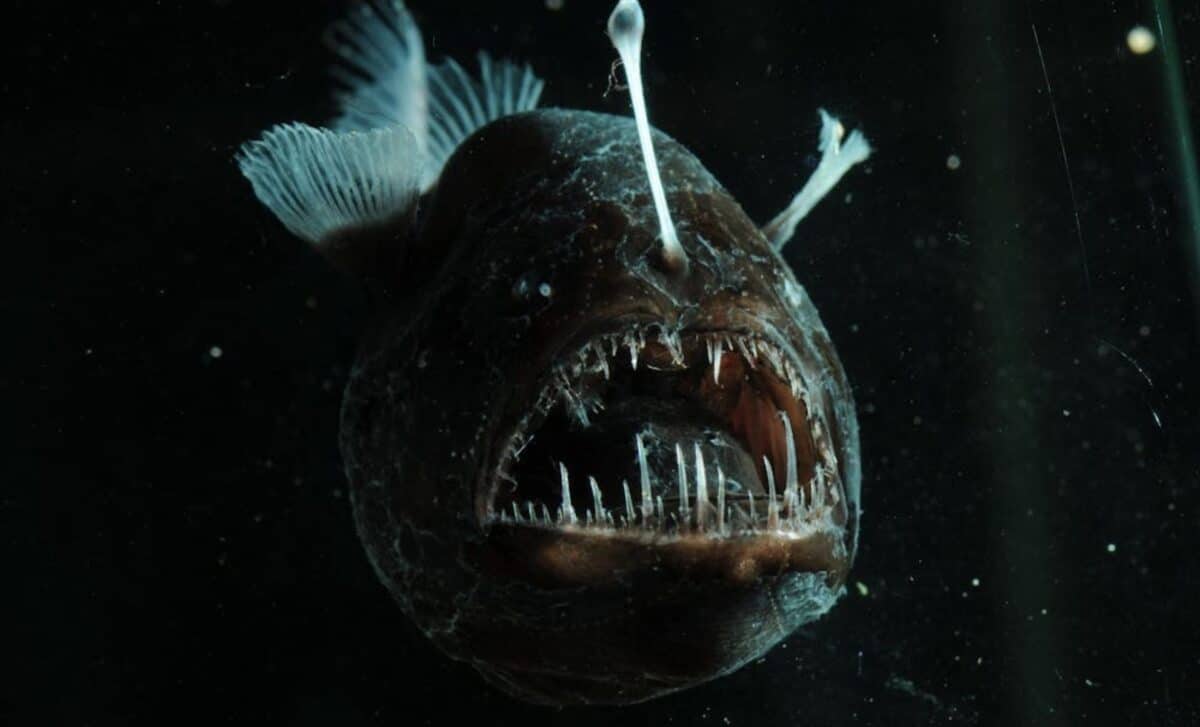
A team of scientists has revealed a previously unknown type of visual cell in deep-sea fish larvae, an unexpected finding that reshapes more than 150 years of scientific thinking about vertebrate eyesight.
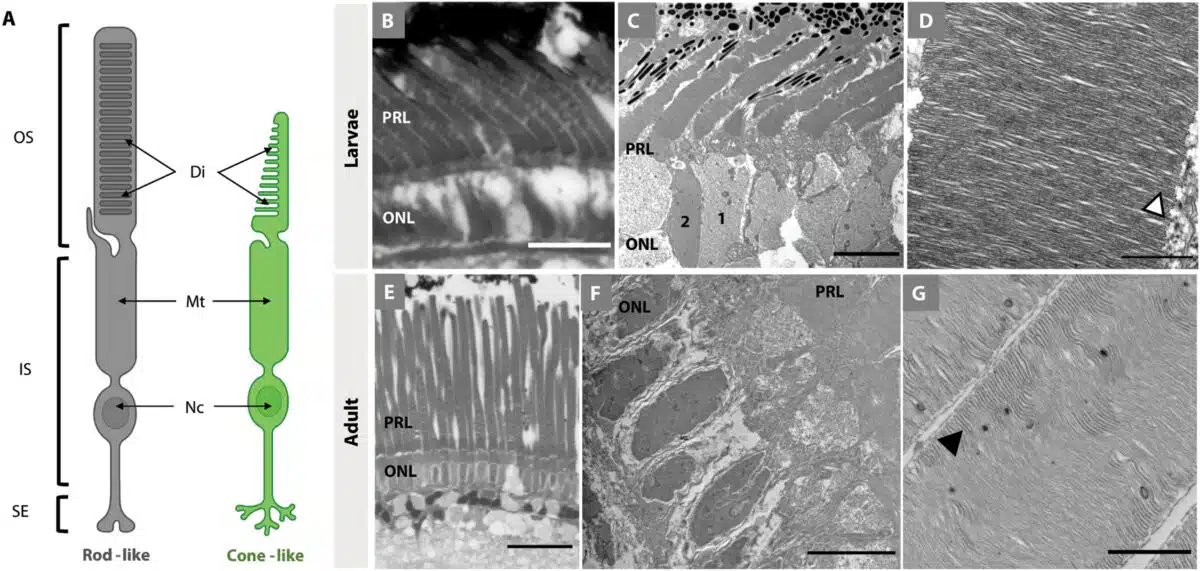
Until now, vision was believed to depend solely on two photoreceptors: cones for bright environments and rods for darkness. The new study uncovers a third, hybrid cell that merges traits of both.
Life In The Ocean’s Twilight Zone
The study, led by Dr. Fabio Cortesi at the University of Queensland and published in Science Advances, centers on a fish species inhabiting the mesopelagic zone. Commonly known as the “twilight zone,” this region spans depths of approximately 50 to 200 meters, where light levels are extremely limited.
Creatures living here face a unique visual challenge. They must detect dim sunlight from the surface while also spotting brief pulses of bioluminescent light produced by other organisms. Predators and prey alike rely on these flashes to survive.
The twilight zone is one of the largest ecosystems on the planet, yet it remains among the least explored. Each new species studied offers insight into how life adapts to darkness, pressure, and limited energy.
A Rare Hybrid Eye Structure
What makes this fish remarkable is its hybrid eye architecture. Instead of fitting neatly into known visual categories, its eyes appear to combine structural traits linked to different light-detection strategies.
Most vertebrates rely on two main types of photoreceptor cells: rods, which are highly sensitive in low light, and cones, which enable color vision in brighter conditions.
“For more than 150 years, textbooks have taught that vision in most vertebrates is made of cones and rods—cones which work in bright light and rods for dark situations,” Dr. Cortesi explained. “But our study of deep-sea fish larvae revealed a new cell type—a photoreceptor that optimizes vision in gloomy or twilight conditions. It combines the molecular machinery and genes of cones with the shape and form of rods.”
This fish, though, seems to bridge two visual worlds. Its eye structure suggests an ability to remain highly sensitive to faint light while retaining features that provide greater visual flexibility. That combination could allow it to detect silhouettes against the faint glow from above while also perceiving bioluminescent signals in the surrounding darkness.
First Appeared on
Source link





Leave feedback about this