

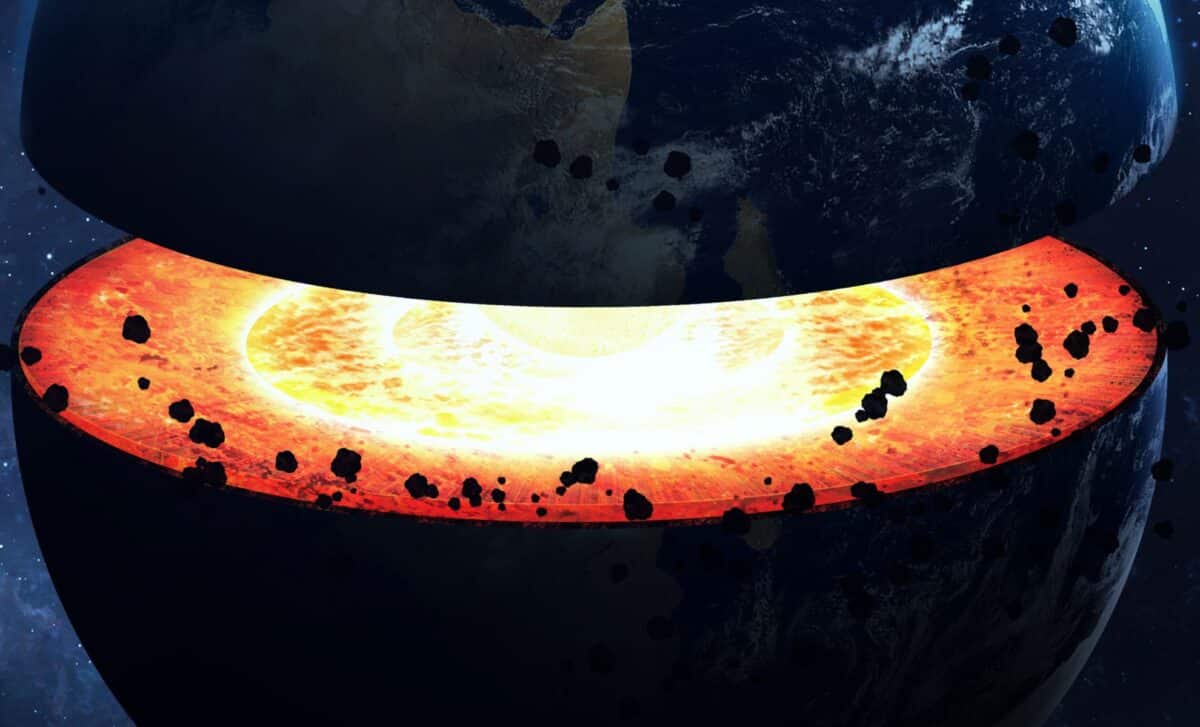
While many theories have suggested that comets and asteroids brought water to Earth after its formation, a new study proposes a bold alternative: Earth’s core might be storing the equivalent of 45 oceans of water as hydrogen.
The study, led by Motohiko Murakami at ETH Zurich, offers a novel look into the conditions of the Earth’s core, which has long been a challenge to study directly. Using advanced laboratory techniques that simulate the extreme pressures and temperatures found deep inside Earth, the researchers suggest that hydrogen was likely captured during the planet’s early development, before the core and other layers separated.
Simulating Extreme Conditions to Study the Core
According to the study, published in Nature Communications, hydrogen likely entered Earth’s core early, traveling alongside silicon and oxygen as the planet’s interior formed. The researchers recreated the extreme pressures and temperatures from this formative period using a laser-heated diamond anvil cell, a device that compresses samples of metal under intense heat and pressure, mimicking the conditions present when Earth’s core was created billions of years ago.
“Using state-of-the-art tomography, we were finally able to visualise how these atoms behave within metallic iron,” Dongyang Huang, a former postdoctoral researcher and principal author of the study, explained.
In their experiments, the researchers melted a small sample of metallic iron inside a water-bearing crystal capsule. The hydrogen, oxygen, and silicon from the water moved into the molten iron, and the sample was then rapidly cooled, allowing the scientists to examine how the atoms were arranged.
Through this technique, they discovered that hydrogen does not exist in the core as a free gas or water molecules. Instead, it becomes chemically bound within the metal, forming iron hydrides connected to silicon- and oxygen-rich structures.
New Theory on Earth’s Water Origins
The findings suggest that Earth’s water may not have arrived only through comets and asteroids, as many have believed. Instead, as explained by the research, hydrogen could have been stored deep in the Earth’s core from the planet’s formation, possibly providing a substantial portion of the water we see today. The researchers estimate that hydrogen could constitute up to 0.36% of the core’s mass, which, if converted into water, could be equivalent to as much as 45 oceans.
“The findings enhance our understanding of the deep Earth,” stated Motohiko Murikami. “They provide clues as to how water and other volatile substances were distributed in the early solar system and how the Earth acquired its hydrogen…The water we see on the Earth’s surface today may be just the visible tip of a gigantic iceberg deep inside the planet.”
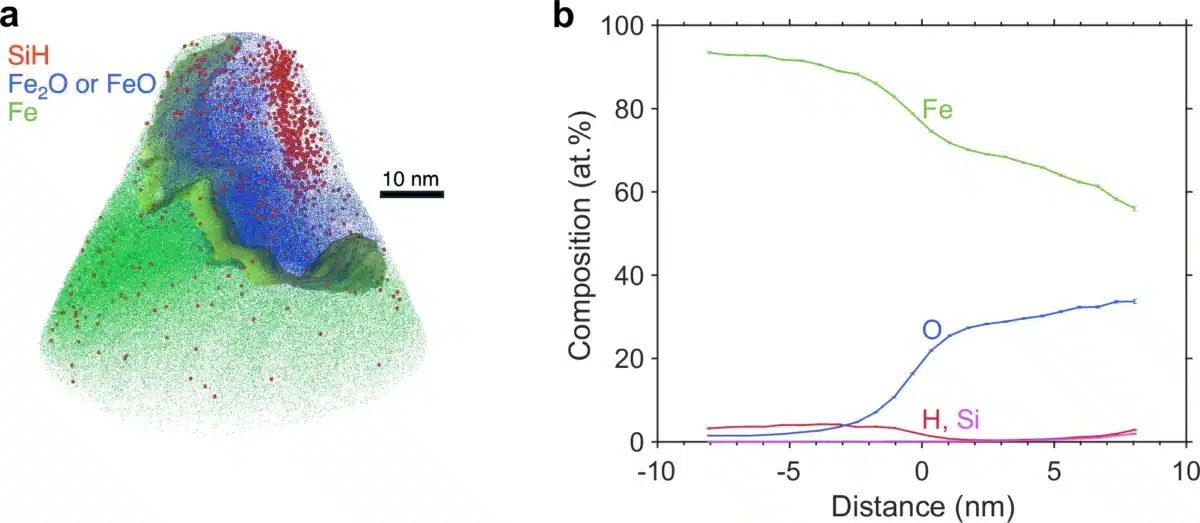
By showing that large amounts of hydrogen were likely trapped early in the planet’s history, the study supports the theory that much of Earth’s water may have been part of the planet’s initial inventory, hidden deep within its core.
Planet Evolution Gets a Major Update!
This research has wider implications for how scientists study other planets, especially rocky exoplanets. As noted by the researchers, the findings could help scientists model how hydrogen behaves in planetary interiors under extreme pressures. The presence of hydrogen in a planet’s core could influence how it develops its metallic core and even its potential to support life.
The study provides new clues about how Earth’s early atmosphere and magnetic field were influenced by the planet’s internal processes and suggests that the planet may have been richer in water during its formative years than we ever imagined.
First Appeared on
Source link






Leave feedback about this