

Scientists have uncovered a massive water reservoir deep beneath Earth’s surface, contained within a mineral called ringwoodite. This “ocean” is three times larger than all of Earth’s surface oceans combined, and it is located about 700 kilometers below the surface in the mantle.
The discovery of water trapped in ringwoodite shakes the traditional theory that Earth’s water was brought by comets. This new finding, featured in Science, offers a compelling alternative and points to the possibility that water may have gradually seeped out from the Earth’s interior over millions of years.
Where Did Water Come From?
The idea that Earth’s water came from comets has dominated scientific discussions for years. However, according to Steven Jacobsen, a geophysicist at Northwestern University, the discovery of a massive water reservoir within ringwoodite provides strong evidence that water may have originated from within the planet itself.
“These mineral transformations greatly hinder the movements of rock in the mantle,” stated by Professor Frank Brenker, a geoscientist at Goethe University in Frankfurt.
This deep “ocean” could help explain why Earth’s surface oceans have remained relatively stable in size for millions of years. Jacobsen suggests that this hidden water reservoir might act as a natural buffer, regulating the volume of Earth’s surface oceans and preventing drastic changes in sea levels.
He added to New Scientist that, “It’s strong evidence that the Earth’s water came from within.” This discovery also prompts the question: how much of Earth’s water remains locked away in the planet’s interior?
A Tool for Locating Reservoir Underground
As explained in the research, Jacobsen’s team used a network of over 2,000 seismometers to study seismic waves generated by more than 500 earthquakes. These waves travel through the Earth’s interior, and their speed is affected by the materials they encounter. When the waves passed through rocks containing water, such as ringwoodite, they slowed down. This slowing indicated the presence of water deep within the mantle, confirming the existence of the hidden reservoir.
Besides seismic evidence, Jacobsen and his team conducted laboratory experiments where they recreated the extreme conditions found at 700 kilometers below Earth’s surface. By exposing ringwoodite to high pressure and temperature, they confirmed that the mineral can indeed store significant amounts of water. These results were consistent with previous studies, including one by Graham Pearson, who found evidence of water in ringwoodite within a diamond brought to the surface by volcanic activity.
“Since our initial report of hydrous ringwoodite, we’ve found another ringwoodite crystal, also containing water, so the evidence is now very strong,” he said.
Water’s Role Below Earth’s Crust
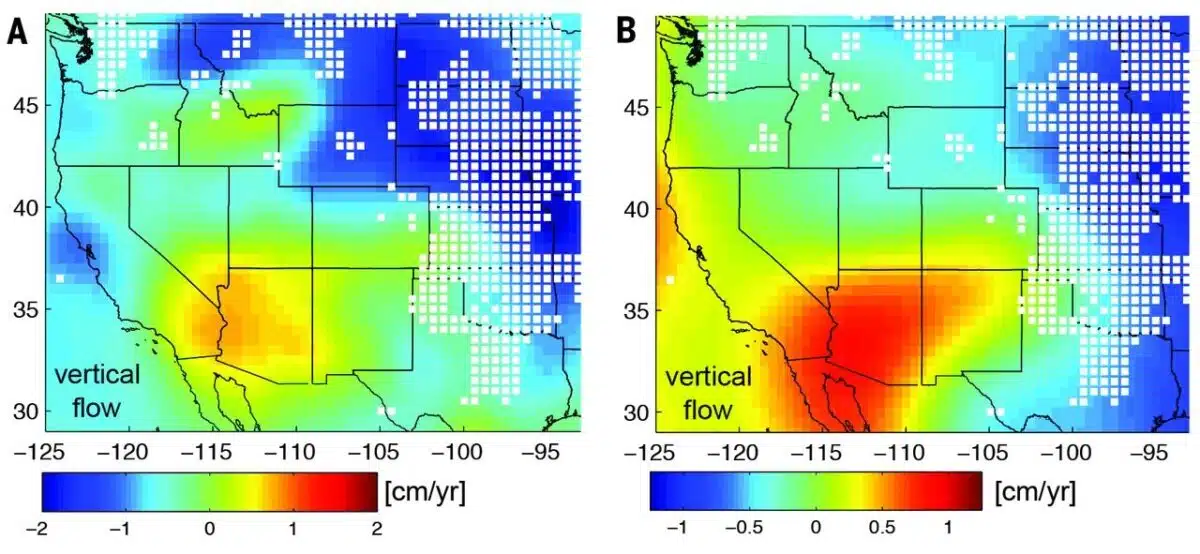
The water stored in ringwoodite could be crucial in regulating heat and material movement between the mantle and the Earth’s surface. This could, in turn, affect tectonic activity and the stability of Earth’s crust over geological timescales. The researchers has found this watery rock beneath the United States, but they now hope to determine whether this deep water reservoir extends around the globe.
“We should be grateful for this deep reservoir,” noted Jacobsen. “If it wasn’t there, it would be on the surface of the Earth, and mountain tops would be the only land poking out.”
It’s a new way of looking at Earth’s inner workings, one that could reshape our understanding of how the planet formed, how water moves through it, and what comes next.
First Appeared on
Source link






Leave feedback about this