

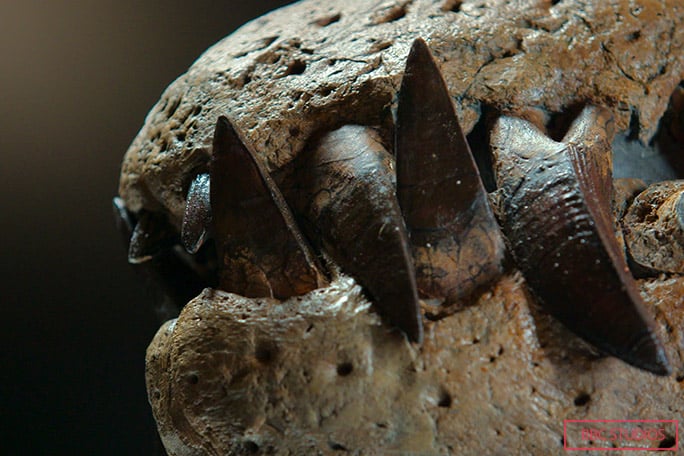
A massive pliosaur skull, dating back 150 million years, has just entered the Guinness World Records for its exceptional state of preservation. Found along England’s Jurassic Coast, this fossil, nicknamed SeaRex, stands out as one of the most complete ever discovered. Scientists describe it as an extremely rare find, with some calling it a “one in a billion” specimen.
What makes this discovery even more striking is how it was recovered. The skull was lodged high in a cliff, far from the kind of controlled environment often associated with fossil digs. Researchers also believe more of the skeleton could still be hidden in the surrounding rock.
A Skull That’s Almost Perfectly Preserved
The SeaRex skull is about 95 percent complete, with nearly all of its original bones intact. Around 130 sharp teeth are still interlocked, just as they would have been millions of years ago. According to Guinness World Records, this makes it the most complete skull ever recorded.
Dr. Judyth Sassoon from the University of Bristol said she had never encountered such a well-preserved Kimmeridgian pliosaur. She explained that:
“It contains a lot of anatomical details in a single specimen that are only found partially preserved in other specimens.”
Spotted On A Beach, Hidden In A Cliff
The discovery began when fossil enthusiast Phil Jacobs found part of a snout on a beach in Dorset. He recorded a video and shared it with Steve Etches, the renowned fossil collector who founded the Etches Collection, who recognized its potential. As explained by the experts, a drone survey later revealed the rest of the skull embedded 12 meters up a cliff.
“It didn’t take very long to actually locate where the thing was, but it was right in the middle of a cliff. And you think, ‘Oh God.’ You look on these programs and they’re in a quarry and it’s dead easy, and they have their cups of tea and they brush away.”
Reaching it required descending on ropes to confirm what they were seeing. Etches explained that the skull was preserved upside down, which made it look unusual at first. He also noted that the process was far more challenging than the simplified excavations often shown in documentaries.
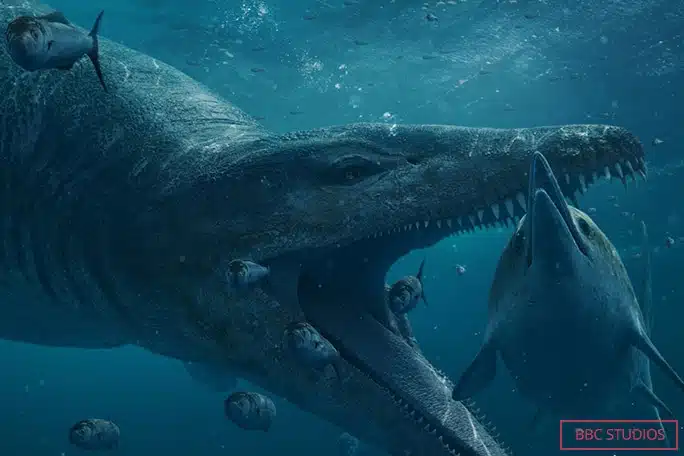
Even Attenborough Was Impressed by This
The size of the skull made a strong impression on Sir David Attenborough, who featured the discovery in a BBC program. He described it as enormous and said he had not fully realized its scale until seeing it in full.
“That is one of the biggest skulls you’ve ever seen,” he said. “I mean, it’s huge and so although I was aware of the tip that was first discovered I hadn’t fully appreciated how big the whole head would be and it’s enormous. Sheer scale was what first impressed me.”
The skull measures about 2 meters (6 feet) in length and belonged to a powerful marine predator. Its bite force may have rivaled that of a Tyrannosaurus rex. Fossil expert Chris Moore pointed out that additional bones, including vertebrae and parts of the limbs, have already been identified nearby.
“We took out part of the shoulder blade, some paddle digits and some of the vertebrae, that were inside of the head and you could see there were more bones going in. So, I’m sure the whole animal is there.”
First Appeared on
Source link





Leave feedback about this